Nobody building a self-driving car in California has to dodge a cow on the highway. In India, the cow is not an edge case — it is the road. A Bengaluru startup looked at this chaos and asked the question that Tesla and Waymo never quite had to answer: what does autonomy look like when it is built for the world’s most unpredictable traffic first? Minus Zero has spent five years answering it — with a camera-only artificial-intelligence platform that learns to drive the way humans do, and that the company describes as India’s first end-to-end AI-based autopilot system for cars.
Nature-inspired AI: one model, eyes only
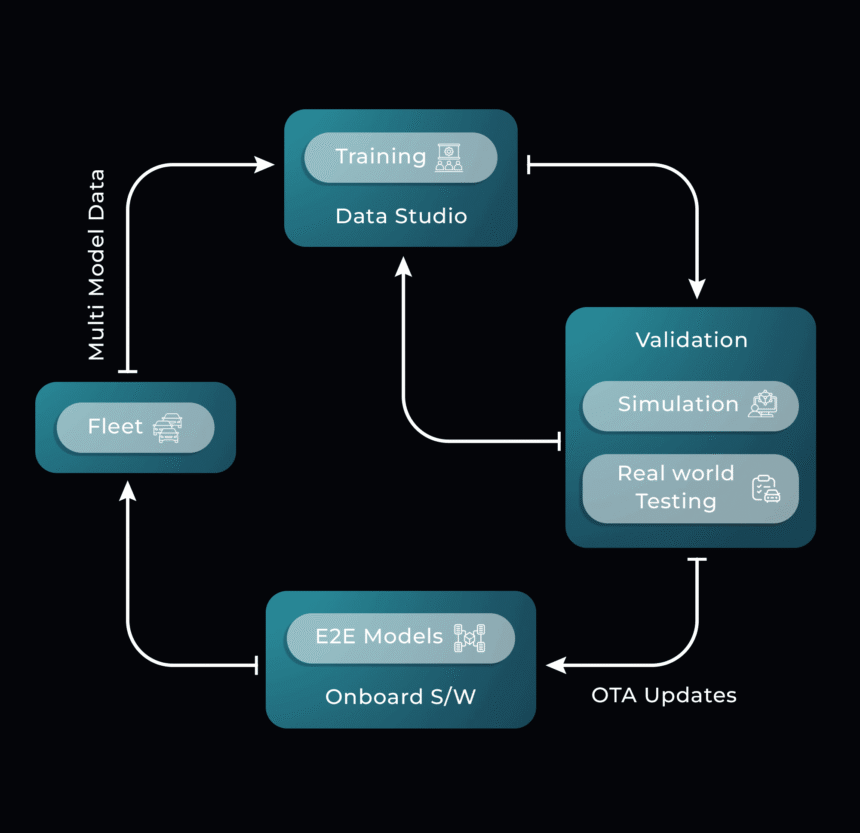
Most self-driving stacks are mosaics: a perception module here, a planning module there, fused from expensive LiDAR, radar, GPS-RTK and high-definition maps. Minus Zero’s bet is that this scaffolding is exactly what makes autonomy fragile and unaffordable. Its approach, laid out in a whitepaper on “Nature-Inspired AI” (NIA), treats the driving task as one continuous intelligence: a single end-to-end foundational model that learns from raw, unlabelled visual data — physics-aware vision and predictive decision-making modelled on the human brain — and outputs driving behaviour directly.
The company calls this True Vision Autonomy: the car sees only through cameras, with no LiDAR, no radar and no pre-built HD maps to lean on. Because the system teaches itself from experience rather than being hand-programmed with traffic rules, it generalises to roads it has never seen before — the key, Minus Zero argues, to making autonomy work not just in Bengaluru but across the emerging markets where the technology is needed most. On its website, the company points out that more than 80% of the world’s road accidents happen in developing countries, even as almost all advanced driver-assistance systems are deployed in a handful of wealthy ones.
Image: Minus Zero (official company image).
The zPod: India’s first fully autonomous vehicle
In June 2023, Minus Zero put its technology on wheels with the zPod — a four-seater, bi-directional autonomous vehicle with no steering wheel, presented as India’s first fully autonomous car. Six high-resolution cameras (four on the sides, one each at the front and rear) feed the embedded AI, which handles obstacle avoidance, speed control and precise stopping in real time. The design is deliberately radical: without a driver’s seat to face, the passengers sit facing each other, and the pod can simply reverse direction instead of making a U-turn — a small but telling piece of non-driver-centric design thinking.
More Read
The zPod is intended for controlled environments — residential communities, college campuses and tech parks — and the company has said it has no plans to commercialise the pod itself. It was built as a demonstration: proof that a camera-only stack could carry passengers, and inspiration for automakers to reimagine what a car looks like when nobody has to drive it.
The autopilot built for Indian traffic
The commercial milestone came in May 2025, when Minus Zero unveiled its end-to-end AI autopilot system for passenger cars navigating dense Indian urban traffic. Unlike the test-track demonstrator, this is a product for real streets: it handles narrow roads, oncoming vehicles, unmarked lanes, stray animals, push-carts and small two-wheelers — the everyday obstacles that rule-based autonomy systems stumble on. Self-supervised foundational models keep learning from daily driving input, so the system’s real-world performance keeps improving with every kilometre.
The system is in the “hands-off, eyes-on” category, with a safety driver required at all times while it goes through validation. The company says it is already working with a couple of large original equipment manufacturers, in talks with more, and is aiming for production readiness within two years — targeting L2+ and L2++ capability, with L3 on the roadmap. Behind the scenes, the startup has also built its own validation machinery: generative-AI photorealistic simulation environments, vision-language models for data processing and a bespoke onboard software stack, all developed in-house.
Video: Minus Zero (official company channel).
From highways to ports: Ashok Leyland and the research ecosystem
Minus Zero’s ambitions are not limited to passenger cars. In June 2024 the startup announced a strategic partnership with Ashok Leyland, one of India’s largest commercial vehicle makers, to bring autonomous driving to trucking — starting with ports, factories and corporate campuses, and expanding to hub-to-hub and long-haul applications as regulations evolve. It is a natural first act for autonomy: repetitive routes in controlled industrial zones, where the safety case is strongest and the economics clearest.
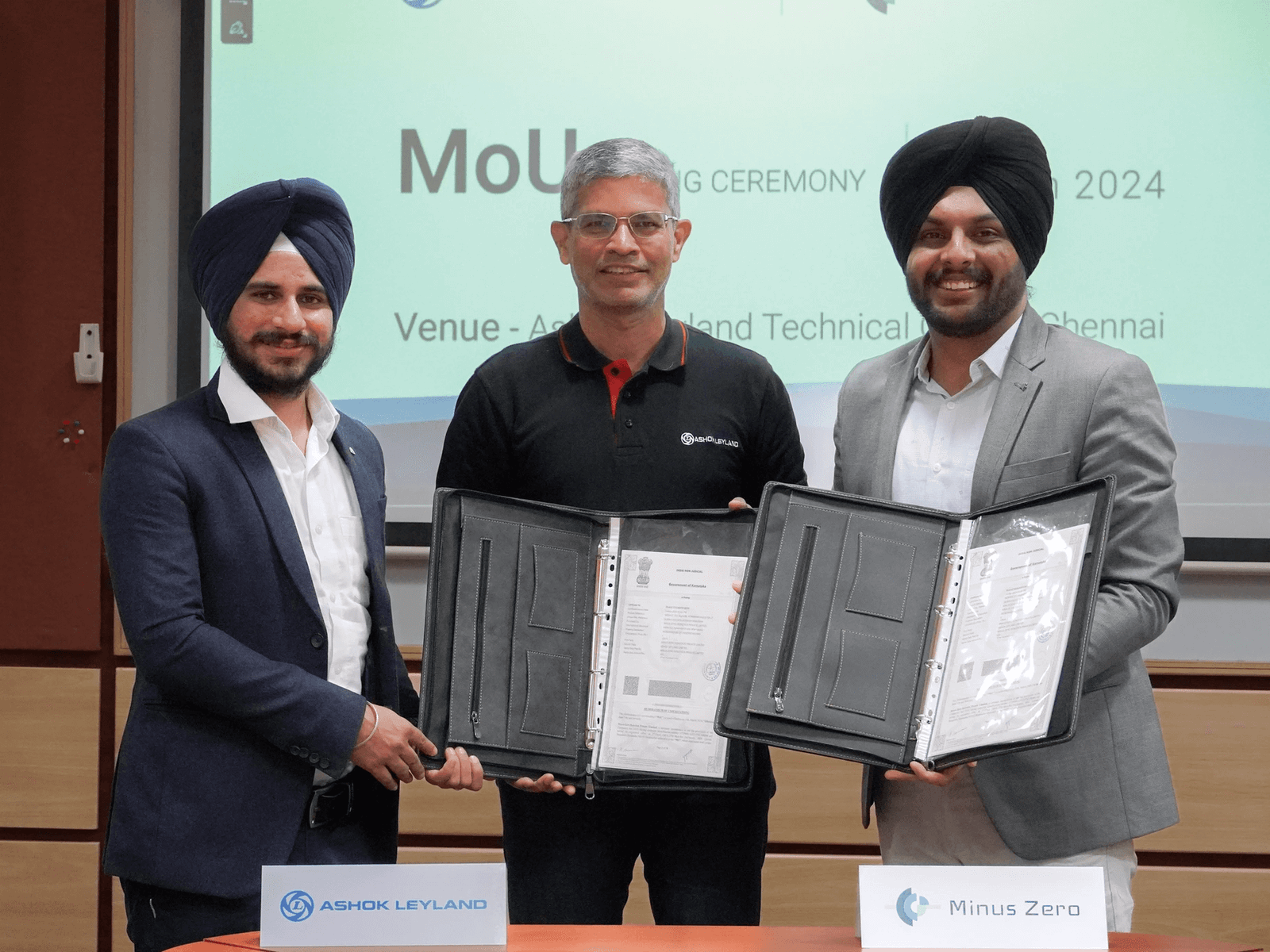
Image: Minus Zero (official company image).
The company is also investing in the research ecosystem it needs around it. It has signed a memorandum of understanding with IIIT Hyderabad and I-Hub Data to build foundational models for autonomous driving together — including a large-scale, engineered dataset of Indian roads for training, validation and benchmarking ADAS and autonomy models, documenting the country’s wildly varied road infrastructure, traffic flows and environmental conditions.
The company behind the wheel
Minus Zero was founded in 2021 in Bengaluru by Gagandeep Reehal and Gursimran Kalra while they were still students. It raised a $1.7 million seed round in May 2022 led by Chiratae Ventures, with participation from the JITO Angel Network and senior executives from NVIDIA and Lyft. Kris Gopalakrishnan, the co-founder of Infosys, took one of the first rides in the zPod.
Five years in, the company’s thesis looks increasingly like the right one for the world it serves. Autonomy designed for tidy, lane-marked California boulevards was never going to survive Bengaluru — so Minus Zero built autonomy in Bengaluru. If its camera-only, end-to-end AI can master the country’s most chaotic roads, every road in the developing world becomes an addressable market. The next billion automotive users, as the company likes to put it, won’t be buying autonomy imported from somewhere else. They’ll be buying it from home.