Every phone call and every gigabyte of mobile data in India begins at a radio. Almost none of those radios are Indian. The steel towers along our highways are filled with equipment designed in Stockholm, Shenzhen and Seoul — while a 15-year-old deep-tech company in Bengaluru has been quietly designing and manufacturing its own.
Lekha Wireless Solutions calls itself a leader in indigenous mobile wireless communication equipment, and the claim is unusually literal. The company designs, develops and manufactures 4G, 5G and IEEE 802.16 (“dot16”) RAN equipment — the radio access network hardware that forms the business end of a mobile network. It is one of the very few Indian original equipment manufacturers building full telecom network hardware end to end, for private and public mobile networks alike.
The radio is where networks begin
A mobile network is only as Indian as its radio. Towers, fibre and spectrum get the headlines, but the radio access network — the radios and antennas that connect your phone to the rest of the network — is the layer where signals become calls, and it has historically been the hardest part of telecom to build at home. Lekha’s answer is a complete, locally engineered product line: the radio unit, the centralised and distributed units, and the orchestration layer that ties them together.
The company’s portfolio is built on Open RAN architecture, the industry’s open, disaggregated approach that breaks the radio access network into interchangeable parts and frees operators from vendor lock-in. Lekha’s O-RAN 7-2x split-based 5G stack includes software-based RAN controllers that run on commercial off-the-shelf hardware, which the company says delivers faster time to market and significant cost optimisation. Crucially, the central unit (CU) and distributed unit (DU) protocol stacks are internally developed — software written by Lekha’s own engineers rather than licensed from abroad.
maRUt: Open RAN hardware, made in India
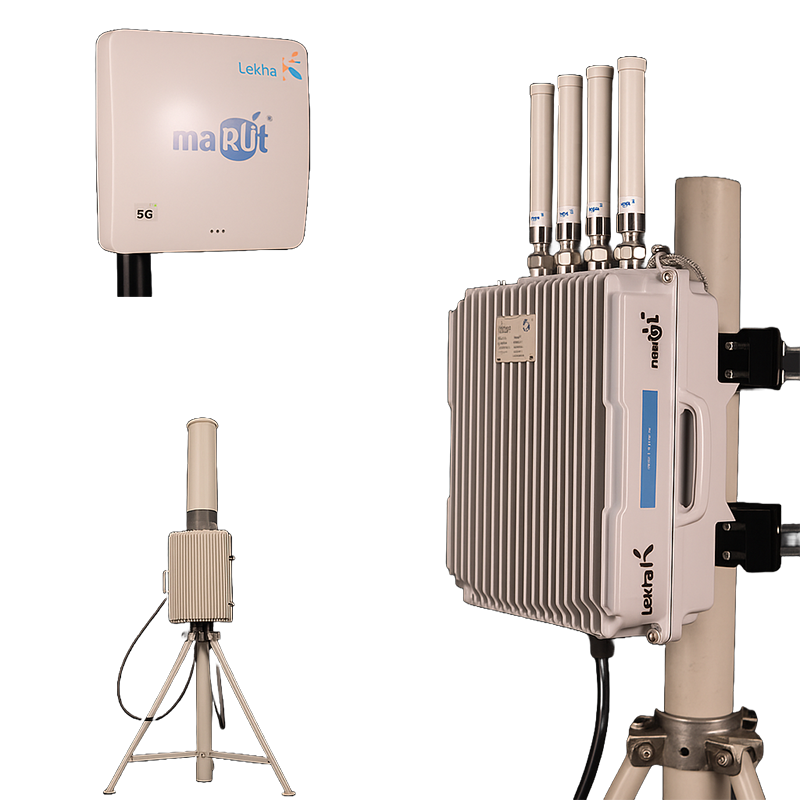
The workhorse of the portfolio is the maRUt series of O-RAN-compliant radio units, the boxes that actually transmit and receive the wireless signals. Lekha offers three variants: a high-power unit delivering up to 40 watts per antenna for outdoor macro deployments, a mid-power 5-watt-per-antenna unit also for outdoor use, and a compact 250-milliwatt-per-antenna unit for indoor coverage. All three implement the control, user, synchronisation and management plane functions defined in the O-RAN 7-2x specifications.
The radios support popular 5G FR1 frequency bands — n28, n1, n38, n41, n48 (CBRS) and n78 — with both FDD and TDD modes, and the company says band support can be extended to any FR1 band where there is a business case. A Service Management and Orchestration node handles remote provisioning, configuration, fault and performance management of the portfolio, and integrates northbound with third-party network management systems. Lekha provides turnkey 5G networks, working with an ecosystem of 5G core vendors, systems integrators and deployment specialists.
More Read

A leaner radio: the Samana upgrade
This October, at the India Mobile Congress 2026, Lekha announced that it is upgrading its 5G and 4G RAN products with Analog Devices’ Samana platform — the ADRV906x chip family that fuses RF and digital signal processing into a software-defined radio architecture on a single chip. The move gives Lekha’s radios O-RAN-compliant 7.2x Low PHY functionality, and the engineering payoff is threefold: simpler radio designs, lower power consumption and faster product development cycles.
“Our strength is the ability to understand customer needs and develop complete wireless products from concept through deployment,” said Ramu TS, chief executive of Lekha Wireless. “Together, we are creating locally engineered wireless products that serve customers in India and global markets.” Vivek Tyagi, head of regional sales and head of India at ADI, said Lekha brings “deep domain experience in 3GPP and IEEE wireless data communication product development,” with ADI’s wireless, RF, power and timing technologies used across Lekha’s public, private and railway platforms.
Mines, railways, factories — and the battlefield
Where Lekha’s engineering really earns its keep is in environments where off-the-shelf telecom gear was never designed to go. Its product line serves private networks in mining, railways, factory automation and industrial SCADA — the closed, mission-critical networks that keep mines, railways and plants running. The company also builds IEEE 802.16s/t data connectivity solutions for railways, and has partnered with system integrators and operators to accelerate private-network rollouts.
The defence portfolio is even broader. Lekha builds MANET software-defined radios for the armed forces, missile control and telemetry radios, high-performance radios for autonomous vehicles, secure wireless backhaul, MIL-STD radios, and drone, aerostat and HAPS-based 4G/5G networks for border surveillance, forward operating areas and disaster zones. Its RANDome architecture packages an entire standalone 4G/5G network into a rapidly deployable portable bubble — private cellular coverage for forward units and disaster relief where public networks are unavailable or disrupted. Ruggedised 5G handsets, including the MITRA platform, complete the picture, and the company is even building quantum-secure 5G networks with post-quantum cryptography for defence and government communications.
A seat at the 6G table
Lekha’s influence extends beyond hardware into the standards that will govern the next generation. The company is a member of the Telecommunications Standards Development Society, India (TSDSI) and a founding member of the Bharat 6G Alliance, and it actively participates in 5G-Advanced and 6G standardisation. According to its partner Druid Software, Lekha has received multiple patents in 4G and 5G technologies. Its in-house R&D facility is certified by the Department of Scientific and Industrial Research (DSIR) — the government’s recognition of genuine research capability.
The company behind the radios
Founded in 2010 and headquartered in Bengaluru, Lekha has spent 15 years doing the unglamorous, indispensable work of telecom: hardware, software, RF design, protocols and compliance, all in-house. CEO Ramu TS has led the company’s evolution from an R&D services player into a full product OEM — one that now spans public networks, private industrial networks, railways, defence and, increasingly, the 6G research frontier.
India’s digital future will be built on radios. Lekha Wireless is making sure some of the best of them are designed, developed and manufactured at home.