Every year, India’s sericulture industry produces thousands of tonnes of silk — and a surprising share of it never becomes a sari. The cocoons left behind after fully grown moths emerge can’t be reeled into thread, so they are swept aside as waste. In Bengaluru, a startup decided that waste was worth more than the textile it couldn’t become. Inside every cocoon sits fibroin, a natural protein that is stronger than steel by weight, biocompatible, biodegradable, and remarkably good at coaxing human cells to grow. Fibroheal Woundcare has spent nine years turning that protein into sterile wound dressings, foams, powders and gels — and its silk bandages are now used in more than 500 hospitals across India.
The first non-textile silk company
Fibroheal Woundcare was incorporated on 6 April 2017 by Vivek Mishra (founder, director and CEO), Bharat Tandon and Subramanian Shivaraman. Tandon had founded Vetcare, the animal-health company later acquired by Provimi and then Cargill; Shivaraman had co-founded Sutures India, now Healthium Medtech. Their combined experience in medical devices and health innovation went into a bet nobody else was making: that silk belonged in hospitals, not just handlooms. The company describes itself as one among the few companies working across the globe on the non-textile application of silk protein as a biomaterial.
The supply chain is part of the story. Fibroheal buys the cut cocoons that the textile industry can’t use from silk farmers, isolates the fibroin and sericin proteins, and then uses different molecular weights and concentrations of the proteins to build different products. Waste becomes raw material; the sericulture economy gets a new buyer. Early research was supported by the Department of Biotechnology and BIRAC, C-CAMP invested under its LEAP programme, and in 2020 the company won the Technology Development Board’s National Award for Technology Start-ups, conferred by the Department of Science and Technology.
A pharmacy shelf made of silk
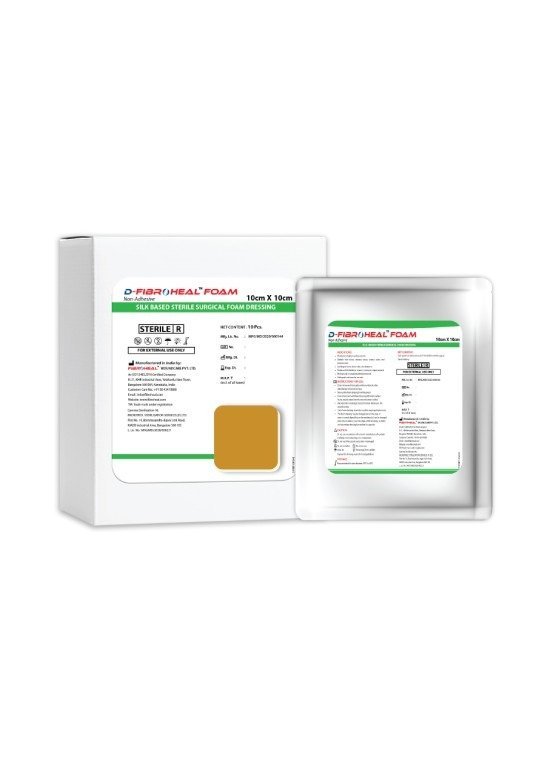
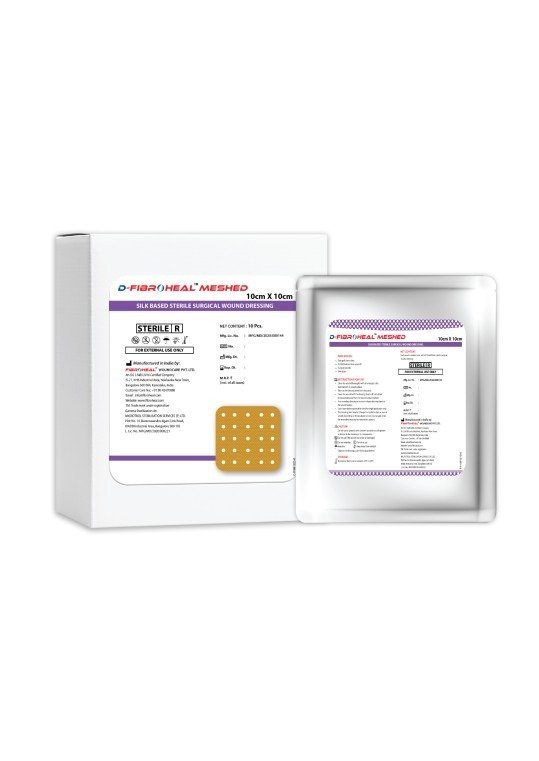
The catalogue reads like a conventional advanced-wound-care shelf — except every product is built on silk. The flagship D-Fibroheal range includes sterile surgical dressings in meshed and PU-foam forms, a sprinkling powder, silver-infused antimicrobial variants, and adhesive dressings. Around them sit FibroZyme for enzymatic debridement, FibroMoist gel and spray for moisture management, the D-Fibroheal Scarlite line for scar management after C-sections, burns and trauma, and a moisturising cream.
The meshed dressing shows the engineering thinking: a silk-protein surgical dressing for skin graft donor sites, partial-thickness burns, surgical wounds and ulcers, suitably meshed to drain exudate into a secondary dressing while keeping the wound bed optimally moist. The company says the formulation promotes fibroblast proliferation and collagen deposition — the cellular machinery of healing. Everything is manufactured in ISO 13485 and GMP-certified facilities.
Then there is Fibroplug, the company’s haemorrhage-control innovation. Fibroheal says Fibroplug has been used by the Indian defence forces in emergency situations — including, the company notes, during Operation Sindoor — an unusually direct line between a sericulture by-product and the battlefield.
More Read

150,000 patients and counting
The research engine behind the products is substantial: 9 granted patents, the ninth announced in April 2026 and jointly owned with the Indian Institute of Science, plus more than 30 academic collaborations. The company reports its products are used in more than 500 hospitals and that over 150,000 patients have been treated with the range. Revenue grew 77% in the first quarter of FY2026-27 compared with the year-ago quarter, and a recent Rs 14 crore raise — after an earlier Rs 6.3 crore pre-Series A from surgeons, doctors and bankers — is aimed at scaling commercial capabilities and entering developed markets.
The global push has begun. In February 2025 Fibroheal partnered with US-based SYLKE, which works in post-operative care, and the company says an ongoing study at Johns Hopkins in Baltimore is evaluating silk-protein solutions in skin-graft donor sites. Clinicians have noticed: Dr Sushma Sagar, Additional Professor at the JPN Apex Trauma Center at AIIMS, has said she uses the dressing on donor sites and superficial burns, reporting faster healing, less pain when the dressing is removed, and better cosmetic scars. In October 2026 the startup was named to the Karnataka government’s Innoverse Enabler Cohort 1, the state’s deep-tech scale-up programme.
Why it matters
Advanced wound care is one of those quietly imported categories — dressings, foams and matrices shipped in at global prices while India’s diabetic and post-surgical population keeps growing. Fibroheal’s range is designed and manufactured in India, priced for Indian hospitals, and built from a domestic raw material that was literally being thrown away. The dressings are biodegradable, reducing the medical-waste footprint of synthetic alternatives, and every box sold keeps a silk farmer’s by-product in the economy.
From broken cocoons to sterile bandages, from a DBT grant to defence forces and a Johns Hopkins study — the Bengaluru startup’s trajectory suggests silk’s most valuable second act was never in fashion. It was in healing.
Keep reading: The Living Drug, Made in India: Inside ImmunoACT’s CAR-T Revolution at One-Tenth the Global Cost · From Bengaluru to Britain: Inside Renalyx’s AI-Powered Dialysis Revolution · More Chemicals, Materials & Life Sciences stories
Like stories like this? Add Exceptional Technology as a preferred source on Google to see more of our reporting in your search results and Discover feed.