Designing a chip the conventional way is a slow, grinding marathon. Specs are written, processor cores sourced and integrated, the interconnect fabric built by hand, the software stack prepared in a separate silo — and every one of those handoffs eats weeks. For even a moderately complex embedded SoC, the journey from a clean sheet to a frozen RTL design can take four to six months, most of it spent solving the same integration problems the industry has been solving for decades. In Chennai, a small fabless semiconductor company has decided that bottleneck is simply unacceptable — and built a machine to shatter it.
The company is InCore Semiconductors, and its SoC Generator platform turns that months-long front-end design slog into minutes. Fire the tool with a set of architectural choices, go for a coffee, and come back to find the RTL, the interconnect, the IP integration, the bootable software stack and the documentation — all generated, deterministic, ready to validate on real FPGA hardware.
The team behind the SHAKTI processor
InCore’s roots run to the heart of India’s open-silicon movement. The company was founded in 2018 by the creators of the SHAKTI processor programme at IIT Madras — the team that gave India its first indigenous RISC-V processor programme — and it remains headquartered at the IIT Madras Research Park with offices in Bengaluru and Delhi. It is backed by Peak XV Partners (formerly Sequoia Capital India), and it has set itself one audacious goal: to become the partner of choice for any product company adopting RISC-V, anywhere in the world.
The company’s processor portfolio covers three families tuned for different jobs: Azurite, built for ultra-low-power applications like motor control and battery-powered devices where fast interrupt response matters; Calcite, for mid-tier embedded products such as point-of-sale terminals and smart cameras; and reference SoC designs, license-ready for teams that want RISC-V done for them. Customers, the company says, have put these cores through rigorous evaluation and found better performance-per-watt, more customizability and stronger support than the incumbents — endorsements that come from engineering leaders at NXP Semiconductors, SK Hynix and HCL, quoted on the company’s website.
Silicon proof: the InSoC-2 test chip
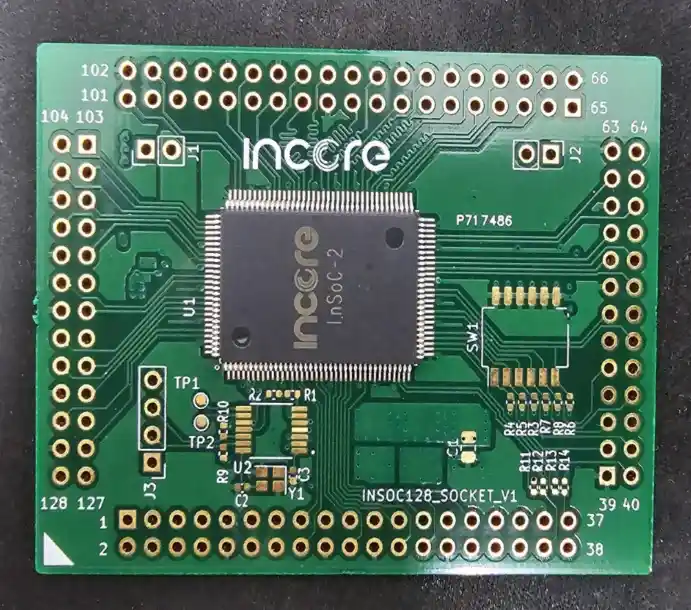
A design-automation platform is only as good as the silicon it produces, so InCore put its own platform on trial. The result is the InSoC-2 test chip: six heterogeneous RISC-V cores — four Azurite cores and two Calcite cores — wired together with a custom in-house network-on-chip, plus debug, security and peripheral blocks, all fabricated on TSMC’s 40-nanometre process.
The case study numbers are striking. A single SoC designer created the first cut of the SoC RTL in minutes using the platform; after a few iterations to land the optimal configuration, the RTL was frozen in two to three days. The traditional route, the company says, would have needed a team of three to four SoC engineers and two to three months to reach the same point — and downstream teams for software, verification and physical design could start their work far earlier too. The chip passed successful bring-up and runs a real-time operating system, confirming both its functional and architectural soundness.
More Read

That silicon-ready discipline extends beyond the test chip. InCore says its processor IP is now silicon-proven across multiple customer chips and technology nodes ranging from 180nm down to 16nm — the kind of foundry-hardened credibility that lets a processor IP company compete with the giants. The company showcased its RISC-V processor IP and SoC design automation tools at SEMICON India 2026, where its platforms drew attention across embedded and edge-AI applications.
Deterministic by design
In an era when generative AI is being tried for everything, InCore has deliberately taken a different path. “Our SoC Generator is about deterministic precision, not pattern-matching guesswork,” says Neel Gala, the company’s CTO and co-founder. His reasoning is blunt: chip design involves billions of possible scenarios, and a mistake is catastrophic, not cosmetic. “This demands guaranteed accuracy, not probabilistic hallucinations.” The platform gives engineers what he calls Gen-AI-like superpowers — ten configurations generated, validated and compared in a morning — but with deterministic guardrails that keep the hardware bug-free.
CEO and co-founder G.S. Madhusudan frames the ambition plainly: as application-specific computing replaces the old general-purpose era, even the largest incumbents will want to migrate their portfolios to RISC-V quickly, and InCore aims to be their prime enabler. From cores to full SoCs, from IoT and security to automotive, edge AI, storage and media — the Chennai startup is building the machinery that lets small teams design chips like giants, and letting India’s silicon speak for itself on real foundry silicon.
Keep reading: From Bengaluru to America: Inside ANSCER Robotics, the Warehouse Robots That Cleared the US FCC · Built, Not Bought: Inside General Autonomy, the Bengaluru Startup Walking Its Own Robot Dog Through Traffic · More Industrial Automation & Technology stories
Like stories like this? Add Exceptional Technology as a preferred source on Google to see more of our reporting in your search results and Discover feed.