


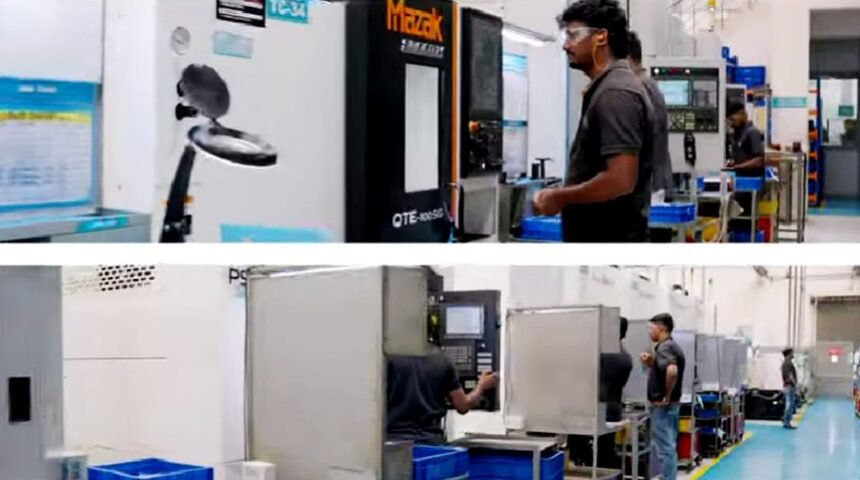
Inside every commercial aircraft, buried deep within the landing gear, the engine casing and the avionics bays, sit thousands of small, unglamorous machined parts — bushes, brackets, manifolds, washers, actuators — each one holding a tolerance measured in microns. Get any one of them wrong and a multi-hundred-million-dollar aircraft does not fly. The companies that make these parts live in a world of fanatical process control, where a single audit can end a contract. In Bengaluru, one such company has quietly become the machine shop that some of the biggest names in world aviation trust with that responsibility.
The company is JJG Aero, and its customer list reads like a who’s-who of global aerospace: Collins Aerospace, Safran, GE Aerospace, Pratt & Whitney, Boeing, Woodward and Liebherr are all on the roster. The company says it now ships more than 1,500 unique precision-machined part numbers to over 30 original equipment manufacturers and Tier-1 suppliers across commercial aviation, automotive and industrial segments.
Built to print, finished to perfection
JJG Aero’s model is what the industry calls build-to-print: the customer sends the drawing, and JJG Aero machines, finishes, assembles and tests the component. That sounds simple until you look at the process chain the company has built in-house. Machining runs from simple 2-axis work all the way to complex 5-axis milling on machines like Mazak machining centres, and it is backed by more than 30 NADCAP-approved special processes — electroplating, anodising, painting, non-destructive testing — under one roof.
That vertical integration is the point. In aerospace, every special process a part goes through must be separately qualified, and each handoff between suppliers is a risk. By keeping plating, finishing and inspection in-house, JJG Aero can ship a fully finished, tested assembly rather than a raw machined blank — the difference between being a job shop and being a strategic supplier. Mechanical assembly, testing and documentation complete the chain, so parts arrive ready to bolt onto the aircraft.
CEO Anuj Jhunjhunwala puts it plainly: the company makes “small detailed parts, machined components that go into landing systems, interiors, engines, rails, avionics, and other segments of commercial aircraft.” The current catalogue of around 1,500 part numbers is set to grow by hundreds more this year, including far more complex components.

More Read
From a 2008 spin-off to a global supply-chain bet
JJG Aero’s roots go back to 2008, when it was founded as a subsidiary of JJ Glastronics by Anuj Jhunjhunwala. It built its first dedicated aerospace facility at Jigani near Bengaluru in 2019, added a second at Bommasandra in 2023, and today runs more than 100 CNC machines and 30 process lines across about 60,000 square feet of manufacturing space.
The numbers tell a story of compounding credibility: the company has recorded a compound annual growth rate of 35 per cent over the past three years, according to its investor Norwest. Market research cited at the time of its latest fundraise notes that India accounts for less than 2 per cent of the global aerospace components market — which is exactly why global investors are suddenly paying attention. As aircraft production ramps up worldwide, legacy vendors in the West are struggling to meet demand, and India’s precision-manufacturing ecosystem keeps winning its way onto more approved-supplier lists.
A 200,000-square-foot leap
In January 2026, JJG Aero raised a $30 million Series B round led by Norwest — the first time the global investment firm has backed an aerospace components manufacturer in India. The round followed a $12 million Series A from CX Partners in April 2024.
The money has a single, concrete destination: a new 200,000-square-foot manufacturing facility on a 10-acre site in North Bengaluru, alongside capacity expansion at the existing plants and investment in advanced processes and sub-assemblies. The company is targeting ₹1,000 crore in annual revenue by 2032–33 — an order-of-magnitude jump that the new plant, housing far more machines and specialised processes, is designed to power.
Norwest’s managing director Shiv Chaudhary said the investment would help the company improve earnings quality by moving up the value chain into higher-value-added components — exactly the direction JJG Aero’s roadmap already pointed. The company also runs a subsidiary serving the automotive and industrial segments, broadening the base its aerospace precision feeds.
Why it matters
There is a particular kind of national industrial ambition that does not make headlines: not the rocket that lifts off, but the supply chain that can build to the tolerances of the companies that build rockets. JJG Aero belongs to that story. When Boeing, Safran and GE Aerospace qualify a Bengaluru machine shop for flight-critical parts — and then stay, and grow the order book at 35 per cent a year — it signals that India’s precision-manufacturing credibility is compounding, audit by audit, part number by part number. The North Bengaluru plant is the bet that this compounding has only just begun.
Keep reading: Detonation Engines for Indian Missiles: Inside Prime Toolings, the Bengaluru Startup Building the Propulsion Stack · 30 Kilos at 16,400 Feet: Inside Bajrang UAV, the Ahmedabad Startup Delivering to India’s Highest Battlefields · More Aerospace & Defense stories
Like stories like this? Add Exceptional Technology as a preferred source on Google to see more of our reporting in your search results and Discover feed.







