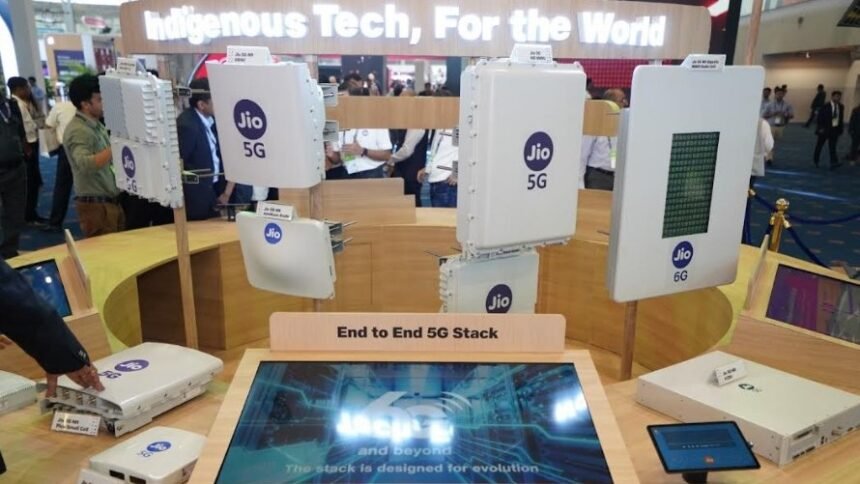
At India Mobile Congress 2026 in New Delhi, the most striking line at Reliance Jio’s booth was not a slogan so much as a mission statement: “Indigenous Tech, For the World.” Ranged beneath it were the white antenna panels and radio units of the company’s end-to-end 5G stack — hardware the company designed and built in India — alongside a newer panel carrying a different badge: Jio 6G. At IMC 2026, held from 7 to 10 October, Jio laid out its plans to do for 6G what it already did for 5G: own the entire stack, from radio to software, and take it global.
What Jio showcased is its pre-6G technology stack: the company describes its Giga MIMO Radio as India’s first, a massive-antenna radio system designed to push far more capacity through crowded networks — stadiums, railway stations, city centres — than today’s 5G gear. Next to it stood a common baseband unit the company says can support both 5G and 6G, a clever piece of future-proofing that would let an operator upgrade toward 6G on a single infrastructure rather than rebuilding from scratch.
Built for a faster, quieter future
The numbers Jio is targeting for 6G are ambitious. The company says its 6G technology aims to handle up to five times the capacity of 5G, cut latency nearly tenfold, and push toward peak data speeds of around 100 Gbps. Those are development targets the company has set for itself, but they map directly onto the applications Jio showcased: holographic video calls, remote healthcare, real-time AI services, and next-generation education and farming tools. Jio’s display themes said it plainly: “India’s 6G in the Making” and “From India to the World.”
There is also a telling engineering detail in how Jio talks about the transition. Chairman Akash Ambani has said the company wants to implement 6G largely as a software upgrade rather than an entirely new infrastructure build-out — a philosophy that flows from the company’s decision to develop its own hardware and software for 5G in the first place. The network it is designing is AI-native, using artificial intelligence to manage operations, and quantum-safe, building in security for the era when quantum computers arrive.
8,000 patents and a seat at the standards table
The deeper story at IMC was intellectual property. Jio says it has filed more than 8,000 patents across its technology portfolio, including hundreds in the pre-6G space, and made over 934 contributions to global telecommunications standards. Speaking on the sidelines of IMC 2026, Ambani linked this to the Prime Minister’s target that 10% of 6G patents should come from India — a goal Jio says it intends to contribute to heavily. The government’s own Bharat 6G Vision document, released in March 2023, aims for India to help design, develop and deploy 6G by 2030.
This is a genuine reversal of the industry’s history: in every previous mobile generation, Indian operators bought the technology from foreign equipment makers. Jio is building the alternative — radios, baseband units, network software and satellite systems designed in India — and contributing the resulting research into the global standards process itself, through bodies like 3GPP.
More Read
Satellites, AI and the road to 2030
Jio’s IMC showcase went beyond the radio. The company is developing an indigenous satellite technology stack under the banner of “Sovereign Satellite Connectivity,” with proposals for a constellation of roughly 1,600 low-earth-orbit satellites and 23 ground stations to take connectivity to India’s entire landmass, beyond where terrestrial networks reach. It is also working on AI-enabled voice and data services, aiming to make everyday connectivity smarter for Indian consumers.
The global timeline gives Jio room to run: international 6G standards are expected around 2030, with industry testing anticipated around 2028 and commercial services rolling out in the 2029–2030 window. Jio believes India could be among the first countries to launch 6G — and the company is positioning itself not just to sell it at home, but to export Indian-built telecom technology to the world.
Keep reading: From Silicon to Systems: Inside IndieSemiC, the Ahmedabad Startup Building India’s First VEGA-Based LoRa Module · From Idea to Silicon in 10 Minutes: Inside InCore, the Chennai Startup Automating India’s Chip Design · More Industrial Automation & Technology stories
Like stories like this? Add Exceptional Technology as a preferred source on Google to see more of our reporting in your search results and Discover feed.