In May 2025, a cardiac surgeon stood at a console in Strasbourg, France, and closed a hole in a patient’s heart. The patient was in Indore, India — more than 4,000 miles away. The operation, an atrial septal defect closure, ran to completion without a technical issue, with what the team described as imperceptible latency and flawless precision. It was the world’s first intercontinental robotic cardiac telesurgery, and the machine on both ends was built by an Indian company. The surgeon was Dr Sudhir Srivastava, founder of SS Innovations, and the machine was the SSi Mantra 3.
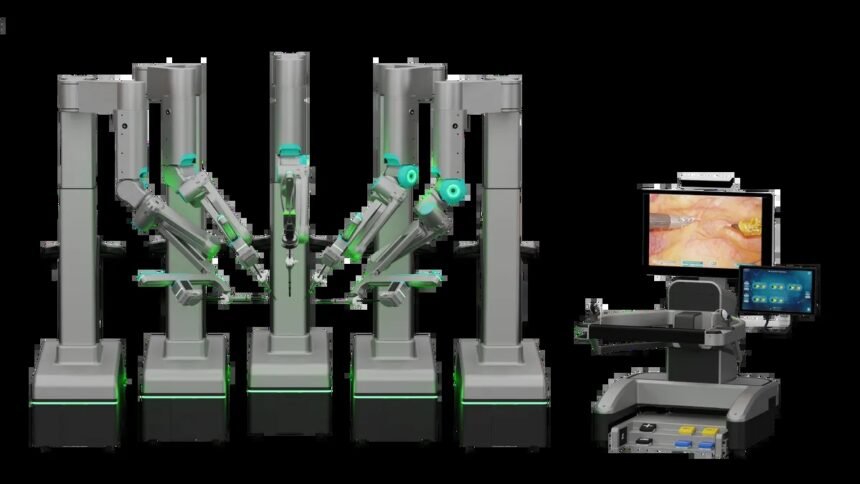
The SSi Mantra is India’s first indigenous surgical robotic system. It is a modular multi-arm platform: up to five robotic arms on patient-side carts, a 3D 4K vision system with a 32-inch monitor, an open-faced ergonomic surgeon command centre, and a Vision Cart that gives the table-side team the same magnified view the surgeon sees. The company says more than 40 different robotic endo-surgical instruments work across specialties including cardiac surgery, and that the modular arms allow collision-free positioning. SS Innovations describes the system as a cost-effective alternative to global incumbents such as the da Vinci — and the device carries CDSCO Class B and Class C approvals from India’s regulator.
A record book written over distance
Telesurgery is where the SSi Mantra has made its name. In January 2025, the system performed two cardiac telesurgeries with the surgeon in Gurgaon and the patients 286 kilometres away in Jaipur, holding latency to 35–40 milliseconds. That spring the company reported a 2,000-kilometre-plus north-to-south robotic cardiac telesurgery, and in January 2026 it hosted what it called India’s first robotic telesurgery marathon to mark 100 telesurgeries on the system. The Strasbourg-to-Indore procedure, performed during the Society of Robotic Surgery annual meeting with Dr Husam H. Balkhy moderating and Dr Lalit Malik coordinating patient-side support in Indore, put the milestone in the global record books.
Scale, measured in hospitals and procedures
The numbers have compounded fast. As of 8 September 2026, the company says 238 SSi Mantra systems were installed — up 42% from 168 at the end of 2025 — across 12 countries, with recent expansion into Colombia, Sri Lanka and the Philippines. Cumulative multi-specialty procedures reached 14,103, up 79% from 7,885 at the end of 2025, with around 1,500 physicians trained and more than 170 procedure types performed. In September 2026, HCG Hospital in Ahmedabad launched a robotic cardiac surgery programme on the SSi Mantra 3.0, beginning with a LIMA take-down led by Dr Brajmohan Singh and proctored by Dr Lalit Malik. SS Innovations, listed on NASDAQ as SSII, is pursuing US FDA review and European CE marking to carry the system into further markets.
“This historic achievement not only demonstrates the advanced capabilities of our SSi Mantra 3 surgical robotic system but also further paves the way for redefining and democratising global delivery of complex cardiac care, especially in regions with limited access to surgical expertise,” Dr Srivastava said after the intercontinental procedure. A surgeon’s hands, extended 4,000 miles — that is what Indian-built surgical robotics now looks like.
Keep reading: The Scanner That Will See Inside Millions: Inside Panacea Medical Technologies, the Bengaluru Company Building India’s Own 32-Slice CT Scanner · The Backpack That Keeps Vaccines Alive: Inside Blackfrog, the Manipal Startup Cooling India’s Last Mile · More Chemicals, Materials & Life Sciences stories
More Read

Like stories like this? Add Exceptional Technology as a preferred source on Google to see more of our reporting in your search results and Discover feed.