


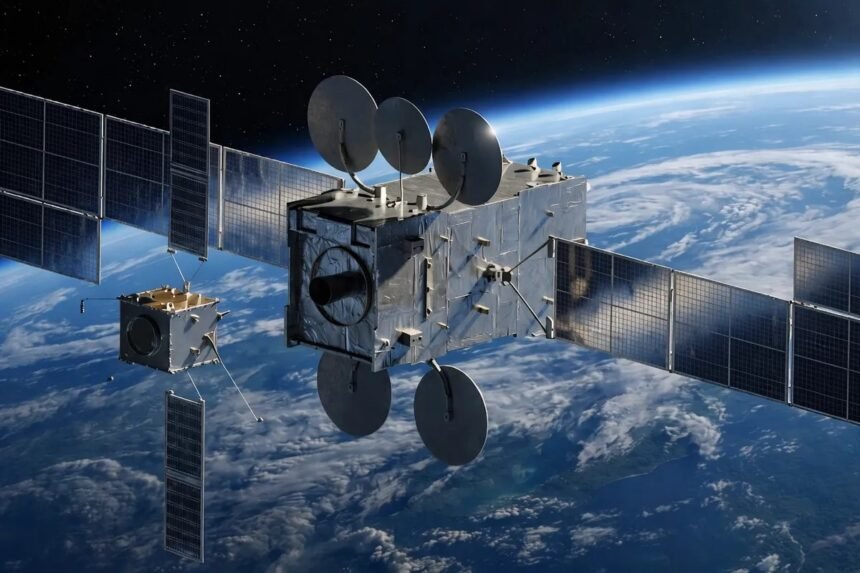
When a satellite runs out of fuel, almost nothing on it is actually broken. The electronics, the antennas, the payloads — all still work. But without propellant to hold its position, the operator has no choice but to retire it, sometimes abandoning an asset worth hundreds of millions of dollars. Aule Space, a Bengaluru deep-tech startup, has decided this abandonment should end: its “jetpack” servicer satellites are designed to fly up to ageing spacecraft, dock with them, and take over station-keeping with their own propulsion — extending the host satellite’s working life by up to six years.
The company was founded in 2024 by Jay Panchal, who started his career as an early engineer at Pixxel working on the mechanical systems of its hyperspectral satellites, alongside Nithyaa Giri, the chief technology officer and a founding engineer at Trify EV, and Hrishit Tambi, the chief operating officer, who previously worked alongside European Space Agency scientists at LibreCube. The original idea was space debris removal — but after discussions with customers and space agencies, the team realised that servicing valuable satellites was the more immediate commercial opportunity. The same rendezvous and docking technology, they say, can eventually support debris removal too.
The core engineering bet is non-cooperative docking: attaching to satellites that were never designed to be serviced. Instead of relying on expensive LiDARs or radars, Aule is building vision-based navigation that uses cameras to understand the target satellite’s position and orientation. Its computer-vision models are trained on imagery from a dark-room test facility fitted with a sun simulator, which recreates how a satellite appears in space, and an air-bearing test platform that creates a frictionless environment to simulate force-free movement. The company says its technology has been validated at an ISRO facility used for the SpaDeX docking mission, and puts it at Technology Readiness Level 6.
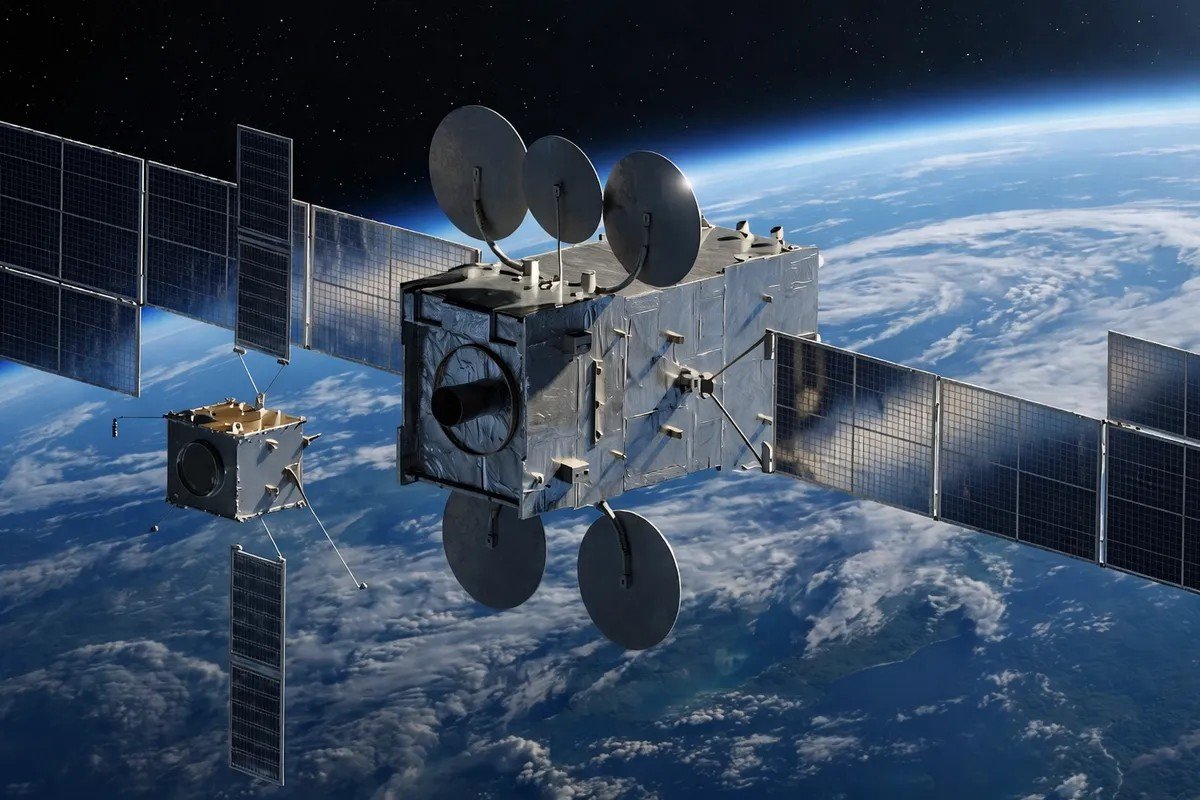
The economics behind the idea are striking. The company points to more than $100 billion worth of privately owned geostationary satellites in orbit, roughly 320 communication satellites in geostationary orbit today, with some 20 to 25 running out of fuel every year. One servicing spacecraft is not limited to a single customer: the company says it could dock with a satellite, extend its life by a couple of years, detach, and move on to the next one. The only company to have demonstrated comparable satellite life-extension before is the American aerospace firm Northrop Grumman, with its 2020 missions — and Aule says it is building toward similar capabilities at roughly twenty times lower cost, through what it describes as the world’s first private demonstration of non-cooperative satellite docking using camera-only navigation.
Investors have backed the ambition. Early in 2026 the company raised a $2 million pre-seed round led by the deep-tech venture firm pi Ventures, with participation from angel investors including Tonbo Imaging’s CEO Arvind Lakshmikumar and former Intelsat board member Eash Sundaram. The company has also been through the Entrepreneurs First accelerator programme and is backed by the Transpose Platform. The team is now about 23 people strong, with engineers from Pixxel, Skyroot and ISRO, plus advisors who have worked on India’s docking missions and communication satellite programmes.
The next milestone is the one that matters most: the company plans to launch its first demonstration satellite next year, and says that once it successfully demonstrates docking in orbit, the technology will reach TRL 9 — the point at which commercial contracts can begin. Its longer-term vision runs further: building a robotic workforce for space, moving into extraterrestrial robotics, and eventually asteroid mining. As Panchal puts it, nobody abandons a car just because it runs out of fuel — and, if Aule succeeds, nobody will abandon a satellite for that reason either.
More Read
Keep reading: The Eyes India Couldn’t Buy: Inside SpectraGaze, the Ahmedabad Startup Building Indigenous Imaging Sensors for Space · A Peacock Made of 3,473 Drones: Inside BotLab Dynamics, the IIT-Delhi Startup That Put on the World’s Largest Drone Show · More Aerospace & Defense stories
Like stories like this? Add Exceptional Technology as a preferred source on Google to see more of our reporting in your search results and Discover feed.







