On a modern factory line, parts fly past faster than any human eye can judge them. A scratch on a bearing, a missing label on a bottle, a hairline crack in a circuit board — each one is a defect that can become a recall, a rejected shipment, or a warranty claim. For years, the answer was more inspectors, more sampling, more hope. A Chennai company called Jidoka Technologies is building a different answer: cameras that never blink, and artificial intelligence that learns what a good part looks like — then checks every single one, at full line speed.
Jidoka Technologies was founded in 2018 in Chennai by Sekar Udayamurthy, Dr Krishna Iyengar and Vinodh Venkatesan, three engineers who had watched manual quality checks struggle on real shop floors. The company’s name comes from a Japanese manufacturing principle that means intelligent automation — automation with a human touch. That idea runs through everything Jidoka builds: machines that do the tireless watching, so people can do the thinking.
The brain: Kompass
At the heart of Jidoka’s system is Kompass, a deep-learning software platform that the company describes as the decision engine for visual inspection. Kompass learns defects from a manufacturer’s own parts — the company says it can start from as few as 20 samples per defect — and then inspects every unit on the line, keeping an image record of everything it passes and everything it rejects. Because it learns from real parts rather than a fixed template, the company says it adapts when a product variant changes, when lighting shifts, or when a new kind of flaw appears.
Kompass is built to run on the cameras, lighting and automation a factory already has. The company says deployment takes six to eight weeks: its engineers walk the line, confirm camera coverage, train the model on the customer’s actual parts, run it in shadow mode beside the existing process, and then switch it live at the reject gate once accuracy is confirmed. The payoff the company reports is striking: 98% or higher defect detection, throughput up by about a third, and false positives down by 30–40%.
The hands: Huron, Tigris, Miyake and Fujin
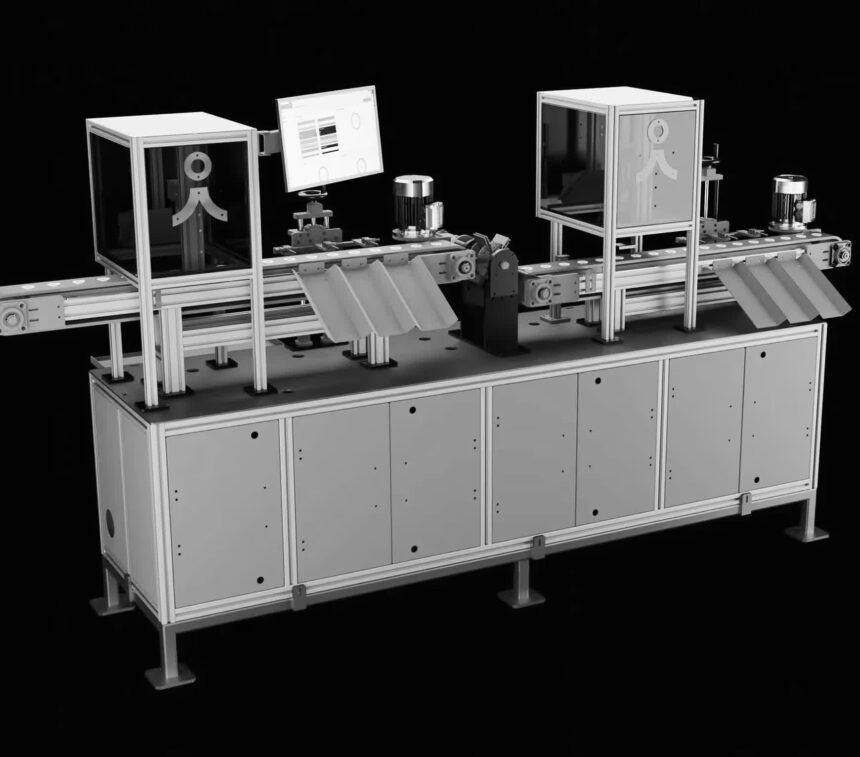
Where a line needs new hardware, Jidoka offers four modular platforms that pair with Kompass. Huron is a 360° multi-camera platform for complex, multi-surface parts, inspecting up to 250 parts per minute at 98% accuracy. Tigris is a twin-conveyor flip system that turns flat parts over for double-sided checks, at up to 120 parts per minute. Miyake is a manual-loading station with multi-camera vision for low-volume runs and spot checks. And Fujin, the company’s high-resolution two-axis inspection table, moves either the product or the camera to capture ultra-detailed images of large, flat products — printed circuit boards, textiles, airbags and machine tools — at 3–5 parts per minute with up to 98% accuracy, catching microscopic flaws the eye cannot resolve.
More Read

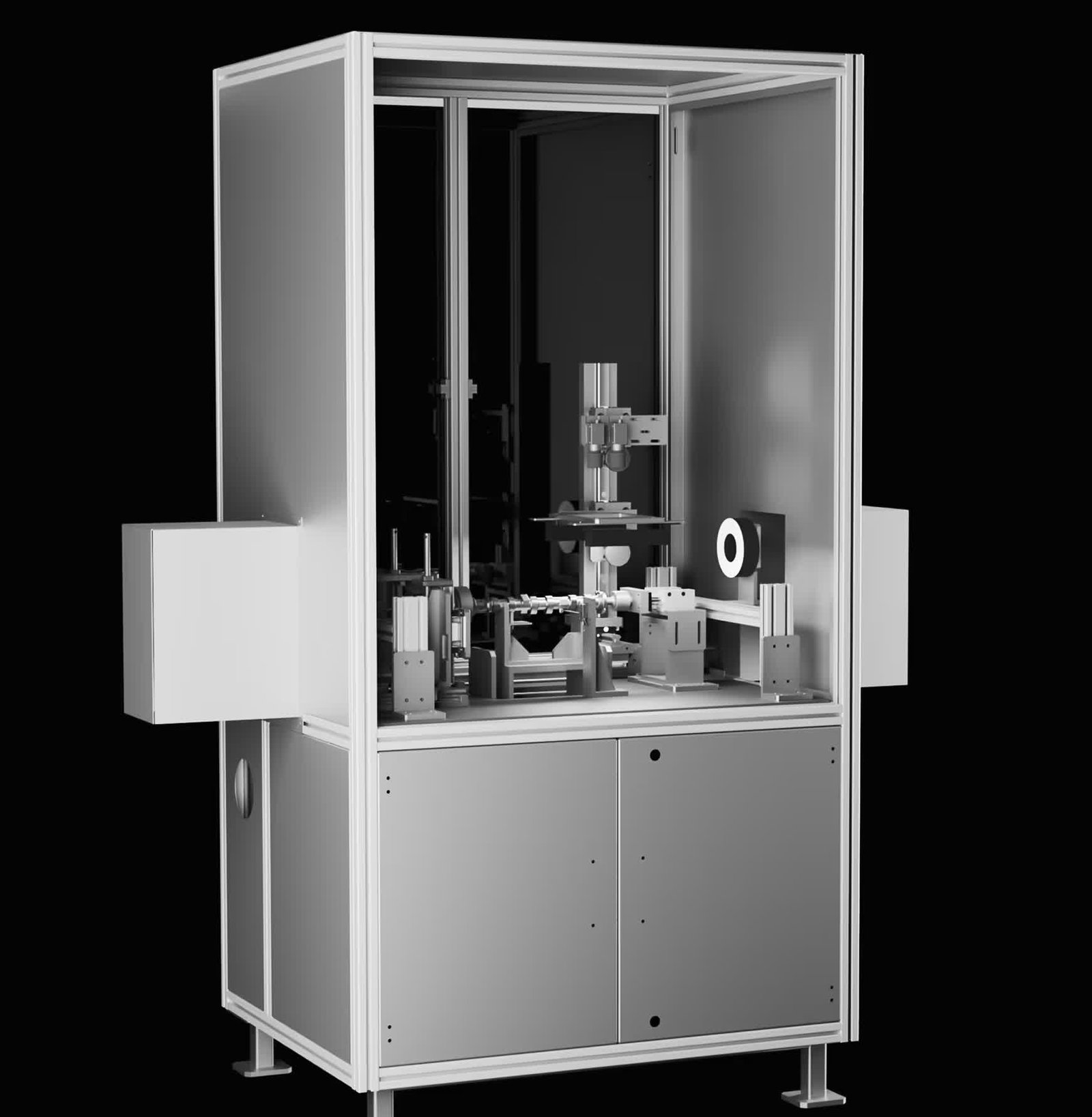
Jidoka Technologies’ vision inspection cabinet (company image).
Together, the company says, Kompass paired with its hardware can inspect up to 1,000 products per minute on a single line. The systems work with components from leading automation vendors such as Keyence, Siemens, Basler, Mitsubishi and Omron, and they plug into a plant’s existing PLCs, MES and ERP systems.
Already on the line
This is not a laboratory promise. Jidoka says its systems are now trusted by more than 48 customers worldwide, across six industry verticals, with more than 100 implementations and over 300 million product inspections every day. Its work spans automotive, FMCG, pharmaceuticals, electronics, logistics and general manufacturing — from OEM and component inspection, where the company reports 99.5% accuracy, to assembly verification, label and text verification, counting and sorting.
The company’s case studies show the range. On a biscuit line for Britannia, Jidoka reports over 99% detection accuracy at 12,000 biscuits per minute. On a bottling line, its label inspection runs at more than 300 bottles per minute. Jidoka was also named among the winners of Maruti Suzuki’s Mobility and Automobile Innovation Lab programme, and it has a technical alliance with Mahindra Logistics, under which its counting and quality-inspection solution rolls out across warehouses, checking consignments against invoices as they arrive and leave.
That momentum earned Jidoka a place in Google’s 2026 accelerator cohort for AI-first Indian startups, selected from around 2,500 applicants — a recognition of a company that has spent eight years solving one of manufacturing’s hardest, least glamorous problems, and solving it at scale.
Every factory wants first-time-right manufacturing: every product built to specification, no rework, no scrap, no customer complaint. Jidoka’s bet is that the way there is not sharper human eyes, but tireless ones — cameras and AI that check every part, learn every defect, and never get tired at the ten-thousandth unit of the shift. From its Chennai base, the company is quietly making Indian factory lines see better than ever before.
Keep reading: One Tiny Chip, Every Satellite: Inside Silizium Circuits, the Kochi Company Putting NavIC and 5G on Indian Silicon · Built in Bengaluru, Walking on Four Legs: Inside PARAM, General Autonomy’s Homegrown Robot Dog · More Industrial Automation & Technology stories
Like stories like this? Add Exceptional Technology as a preferred source on Google to see more of our reporting in your search results and Discover feed.