Watch a dog walk through a factory and you see a machine perfectly shaped for the job: four legs that step over cables, climb stairs and keep their balance on ground no wheel could handle. Now imagine that dog built from scratch in Bengaluru, by a five-person team that had previously built a walking humanoid — and you have PARAM, the quadruped robot from General Autonomy that is putting Indian robotics on legs.
General Autonomy calls PARAM India’s most powerful indigenous robot dog, and the machine earns the description the moment it starts moving. It walks on its own, spots obstacles and plans a path around them, climbs stairs up to 30 centimetres high, sidesteps through tight gaps with a sideways “crab walk”, and picks itself up and carries on if it trips. It is the kind of mobility that turns a robot from a lab curiosity into a working colleague for places humans should not have to enter.
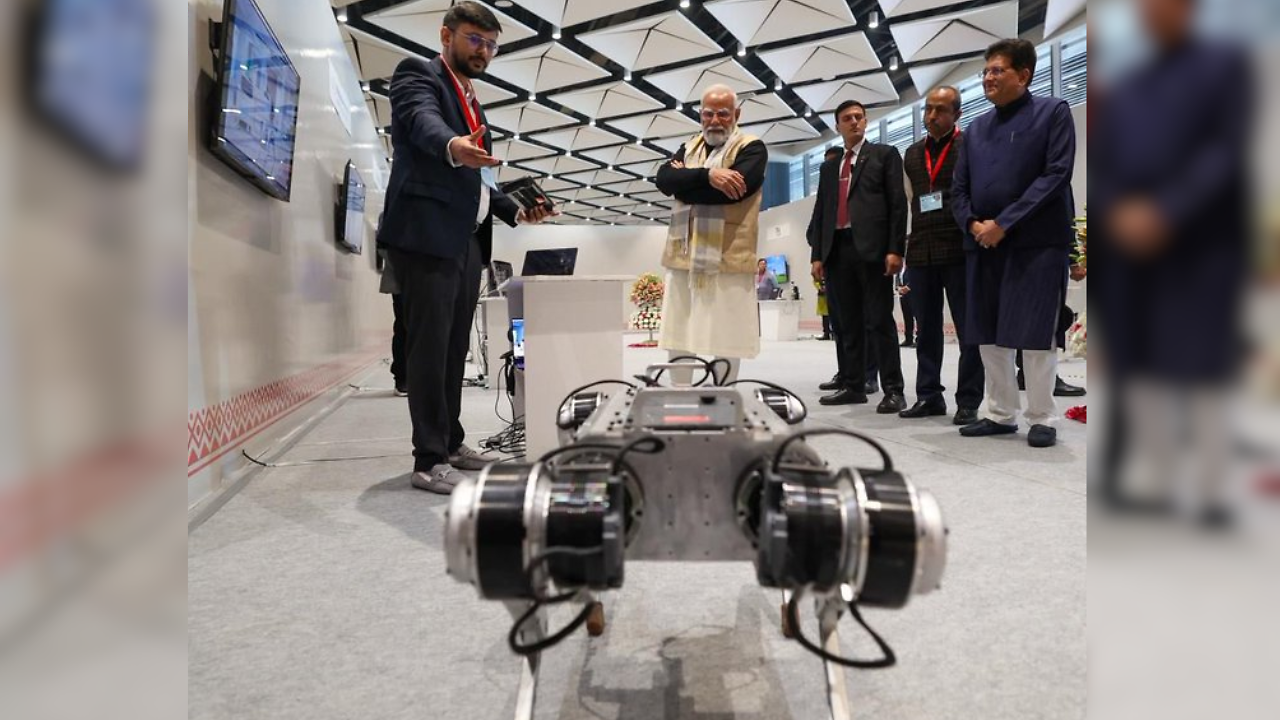
PARAM, General Autonomy’s quadruped robot, at its showcase demonstration.
Built for the ground wheels cannot handle
PARAM is a rugged four-legged platform built for inspection and payload delivery over rough ground. On the company’s current platform page, PARAM stands 0.60 metres tall, weighs 50 kg and carries a payload of up to 25 kg across 12 degrees of freedom. The company says it can run for up to eight hours on hot-swappable batteries, reach speeds of 3 metres per second and jump up to a metre high — a combination that lets one machine cover a large site, carry real equipment and keep working while its batteries are swapped.
The engineering that makes it possible is almost entirely homegrown. General Autonomy says the chassis, the software, the perception and the planning are all built in India, with only the NVIDIA processor and some specialised actuators imported — and the company says it wants to localise even those over time. Its proprietary locomotion stack is what lets PARAM move without a human driving every step: the robot senses its surroundings, decides where to place its feet and recovers its balance on its own.
More Read

From a humanoid to a robot dog
PARAM did not come out of nowhere. General Autonomy was founded in January 2023 by Farid Ahsan and Bhanu Pratap Singh, two IIT Kanpur alumni who had spent nearly nine years helping build ShareChat into one of India’s largest homegrown social platforms. They walked away from software to build machines for factories, betting that India’s next big automation gains would come from physical robots rather than apps.
Their first machine was Atom-1, which the company describes as India’s first walking humanoid robot platform. The lessons from getting a two-legged machine to balance and walk fed directly into PARAM, which the team built in about seven months. In January 2026, General Autonomy was one of ten deeptech startups picked by Startup India to showcase its technology at National Startup Day — and PARAM was presented to Prime Minister Narendra Modi at the showcase. The robot dog went on to win national attention at the India AI Impact Summit 2026, where visitors watched it navigate streets, stairs and obstacles entirely under its own control.
Where PARAM goes to work
General Autonomy is building PARAM for the jobs where legs beat wheels: inspection and monitoring in factories and warehouses, work in hazardous environments, disaster response in unsafe zones, border surveillance and scientific research. A quadruped can climb into a plant, cross a rubble-strewn yard or patrol a perimeter that would stop a wheeled robot cold — and it can do it carrying sensors and equipment, again and again, without fatigue.
That is also why the company is not stopping at four legs. Alongside PARAM, General Autonomy is developing Taara, a general-purpose humanoid built for human spaces — doors, stairs, tools and shelves — standing 1.43 metres tall with 23 degrees of freedom and a 10 kg payload. Robot dogs like PARAM are the step toward that future: useful for inspection and monitoring today, while the harder humanoid engineering matures.
Backed to keep building
Investors have backed the bet. General Autonomy raised about Rs 25 crore in a pre-seed round in 2023 led by Elevation Capital and India Quotient, and followed it in May 2026 with a seed round of about Rs 32 crore led by the same investors, valuing the company at around Rs 280 crore. The company says the capital is going straight into research and development — into its robot dogs and its humanoid systems — with a team of about 19 people in Bengaluru driving the work.
The ambition is beautifully simple: machines designed and built in India, for the factories, warehouses and frontiers of India and the world. PARAM is already walking proof that a small Indian team can build a world-class legged robot from scratch. The next step is watching it walk into work — up the stairs, across the yard and into places no machine from India has gone before.
Keep reading: One Tiny Brain for Every Machine: Inside Signalchip’s JEET, the Homegrown Microcontroller From India’s Chip Pioneers · Tap, Track, Unlock: Inside Muse Wearables’ Ring One Gen 2, the Indian Smart Ring That Does It All · More Industrial Automation & Technology stories
Like stories like this? Add Exceptional Technology as a preferred source on Google to see more of our reporting in your search results and Discover feed.