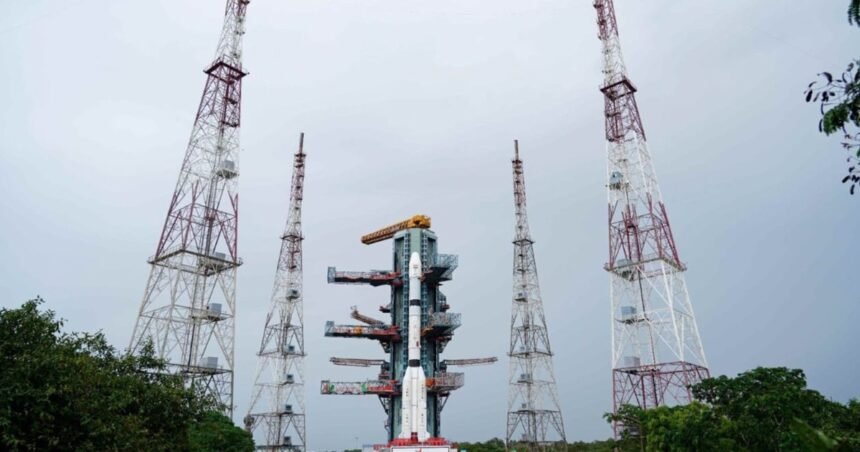
At 11:51 on Friday night, a 50-metre rocket lit up the sky over Sriharikota — and India’s own navigation system took a decisive step back to full strength. The Indian Space Research Organisation’s GSLV-F18 rocket lifted off from the Second Launch Pad at the Satish Dhawan Space Centre, carrying the NVS-03 navigation satellite into the night. ISRO itself called it a rescue mission for NavIC — and the mission delivered.
The launch was the 20th flight of India’s Geosynchronous Satellite Launch Vehicle, a three-stage rocket standing nearly 50 metres tall with a lift-off mass of around 420 tonnes. It carried the 2,232-kilogram NVS-03 spacecraft and placed it precisely into its intended Geosynchronous Transfer Orbit. Over the coming days, the satellite will use its onboard propulsion to raise its orbit to its final geosynchronous slot at 32.5 degrees East, after which ISRO will run its checks and commission it for service. At 12:23 AM, ISRO declared mission success, confirming NVS-03 was in its intended orbit. The mission was ISRO’s third space launch of 2026.
NVS-03 is the third satellite of ISRO’s second-generation navigation series, following NVS-01 and NVS-02, and it carries something India has worked hard to build at home: an indigenous atomic clock, flying alongside procured clocks. Atomic clocks are the heartbeat of any navigation system — they are what let a receiver on the ground turn faint signals from space into an exact position. NVS-03 also adds the L1 navigation signal to the existing L5 and S-band signals, widening what NavIC can do for everyday users.
NavIC — Navigation with Indian Constellation — is India’s own answer to GPS: a regional system built to provide accurate positioning, velocity and timing services across India and up to 1,500 kilometres beyond its borders. It matters for everyone from farmers and fishermen to airlines and soldiers, and for the strategic systems that must never depend on a foreign signal.
That is what made this launch so important. Before Friday night, only three satellites were providing NavIC’s positioning, navigation and timing services — too few for standalone positioning. ISRO Chairman V Narayanan said it plainly after the launch: with NVS-03, India has “the minimum satellites needed to restore NavIC’s PNT services”. He also called it one of the most optimal performances achieved by any launch vehicle in the world.
The mission also closes a chapter that began with a setback. NVS-02, launched in January 2025, reached its transfer orbit but was stranded when a valve regulating oxidiser flow failed to open. NVS-03 picks up exactly where that mission stopped — a replacement built, launched and delivered, restoring the constellation’s strength.
More Read

There is a quieter significance too. Every indigenous atomic clock India places in orbit strengthens the country’s time sovereignty — the ability to keep its own precise time, under its own control, as part of the One Nation, One Time vision. The government notified the Legal Metrology (Indian Standard Time) Rules in August 2026, making Indian Standard Time the country’s common, legally recognised time reference. NavIC’s clocks in space and IST’s clocks on the ground are two halves of the same independence.
Five second-generation navigation satellites are envisaged in all, and with NVS-03 on its way to its slot, the constellation is growing stronger with every flight. The satellite still has its orbit-raising manoeuvres and commissioning checks ahead — the careful, unglamorous work that turns a successful launch into a working service. But Friday night’s liftoff already did the hard part: it put India’s navigation future back on its own feet, on an Indian rocket, with an Indian clock keeping the time.