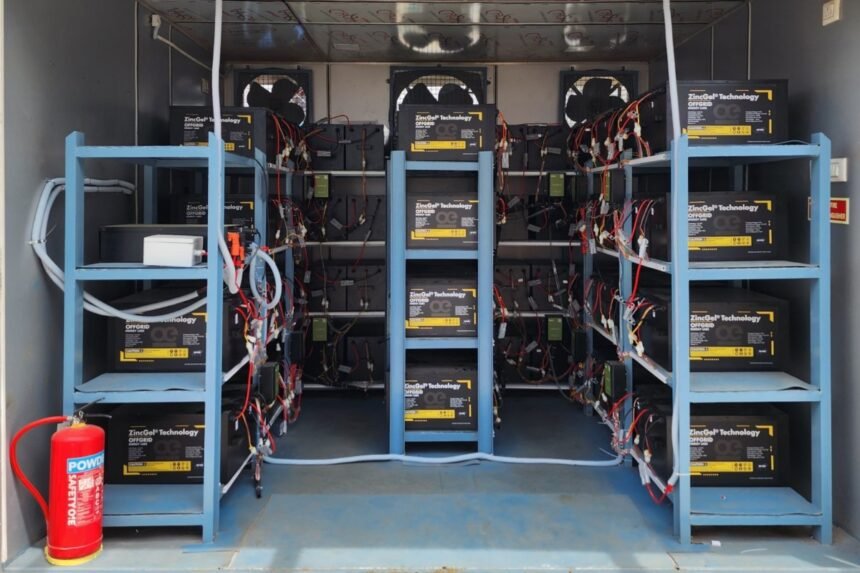
Every evening, as the sun drops and India’s solar farms go quiet, the grid faces the same awkward question: where does the power come from until morning? Lithium-ion batteries, the workhorse of today’s storage, typically cover two to four hours. A Gurugram-born deep-tech company called Offgrid Energy Labs has spent eight years building a battery designed for the much longer gap in between — one that stores renewable power for six to sixteen hours, cannot catch fire, and uses none of the lithium, cobalt or nickel the world is fighting over.
The battery is called ZincGel, and it is built on zinc-bromine chemistry — one of the oldest battery chemistries in the book, re-engineered with a proprietary water-based gel electrolyte. The company says the gel design tames the two classic weaknesses of zinc-bromine systems, controlling how zinc deposits during charging and limiting bromine movement inside the cell. The result, the company says, is a stationary storage battery that is non-flammable by design, because its electrolyte is water-based rather than flammable.
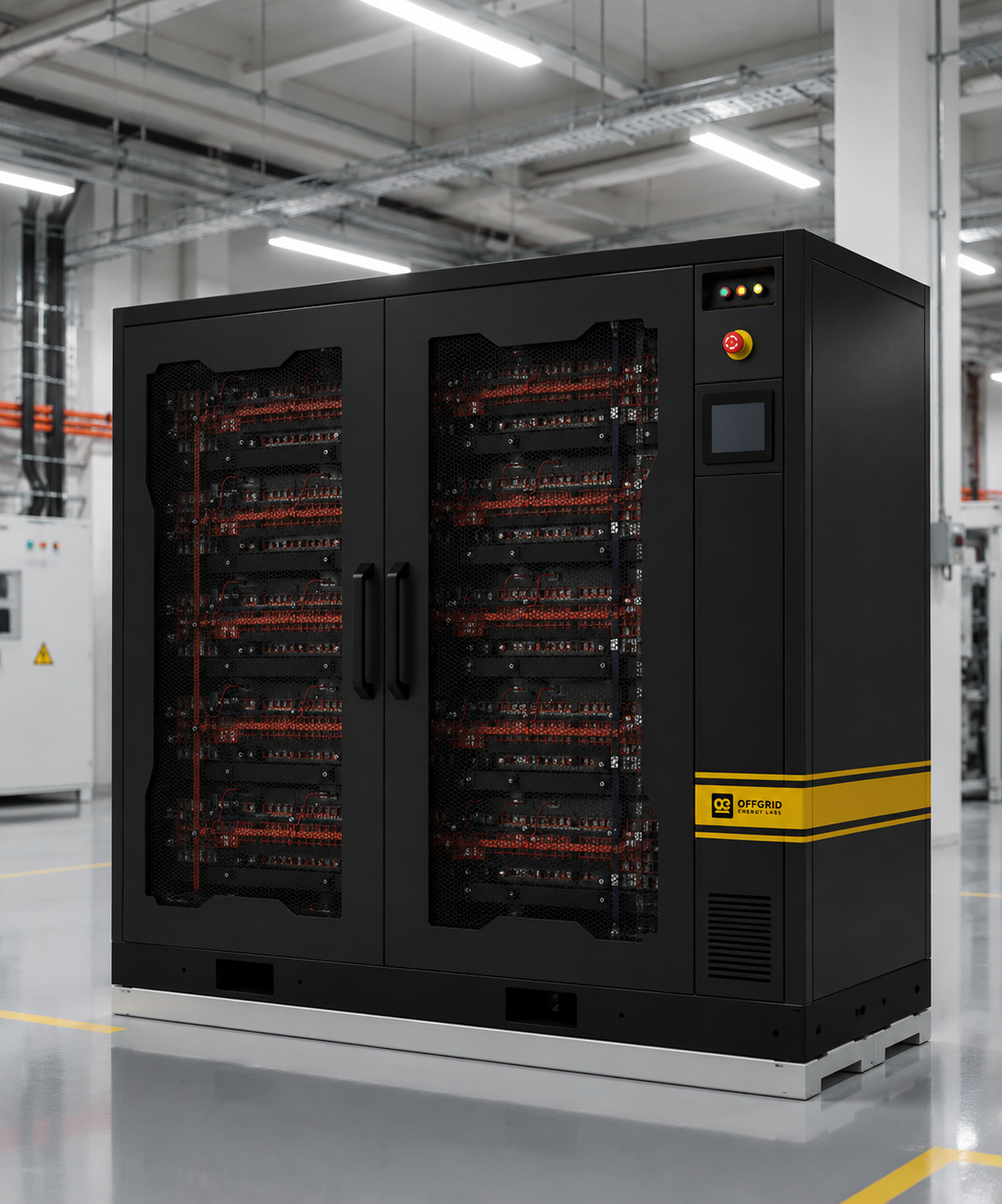
Offgrid’s ZincGel battery cabinet, as shown on the company’s website.
Built for the whole night, not just the evening peak
ZincGel is designed for infrastructure-scale jobs: renewable integration, peak-load management, microgrids and industrial backup. The company says a ZincGel system can discharge fully — 100 per cent depth of discharge — every single day, and ships at zero volts, so it can be fully drained and recharged daily without degrading its life. It is rated for more than 7,000 cycles and a 20-year operating life, delivers 80 to 90 per cent of the energy efficiency of a conventional lithium battery, and keeps working in temperatures as low as minus 10 degrees Celsius. It has passed strict tests for overcharging, deep discharge, extreme heat and puncture, the company says.
Just as important is what is not inside it. ZincGel uses zinc, carbon and bromine — materials the company describes as widely available across the world. India is one of the largest producers of zinc, and bromine comes with a ready-made Indian anchor: Archean Chemical Industries, India’s largest bromine exporter, is both a strategic investor in Offgrid and its Series A lead. That matters because it frees long-duration storage from supply chains concentrated around a handful of critical minerals and geographies.
More Read

From an IIT Kanpur lab to a factory in England
Offgrid Energy Labs was founded in 2018 at IIT Kanpur’s Startup Incubation and Innovation Center by Tejas Kusurkar, Brindan Tulachan, Rishi Srivastava and Ankur Agarwal. Kusurkar, the company’s chief executive, holds a PhD from IIT Kanpur. The team spent its first six years in research and development, building a portfolio of more than 25 intellectual-property families and over 50 IP assets across markets including the United States, the United Kingdom, India, China, Australia and Japan.
In September 2025 the company raised $15 million in a Series A round led by Archean Chemical Industries, which took a 21 per cent stake, with participation from Ankur Capital; Shell’s corporate venture arm had backed the company at seed stage. The round funded the company’s first manufacturing line: a 10 MWh ZincGel pilot facility in Hook, Hampshire, in the United Kingdom, which opened on 7 July 2026. The company says the plant, its first commercial-scale production line, carries a manufacturing carbon footprint 50 per cent lower than a typical lithium battery gigafactory, thanks to simpler processes that need far less capital-intensive infrastructure. Gigawatt-scale factories in Britain and India are planned as the next phase, with manufacturing done through qualified partners rather than one giant plant.
Now proving itself on a live campus
The next milestone is already running. In September 2026, Offgrid signed an agreement with Keele University to deploy a ZincGel long-duration storage system on the university’s campus in the UK — described by the university as the country’s first zinc-based long-duration storage deployment using a battery manufactured entirely in the country. The pilot will capture and store around 1 MWh of surplus renewable energy each month from the campus’s Low Carbon Energy Generation Park, which includes two wind turbines and thousands of solar panels, and the results are expected to support a proposal for a larger, multi-megawatt-hour ZincGel deployment at Keele.
Back home, the technology has already been through controlled field trials with Shell India and a small group of commercial partners, and Shell and Tata Power are among its early testers. The company’s three target markets tell the story of where long-duration storage is heading: renewable energy projects, AI data centres, and industrial power users chasing net-zero goals. India itself is targeting 236 GWh of battery energy storage capacity by 2031-32 — a build-out that will need far more than one chemistry to succeed.
Offgrid’s bet is a simple one: the battery of the renewable age does not have to be the battery of the electric car. Sometimes the most exciting engineering is the quiet box in the corner that lets the sun’s power work all night long — safely, cheaply, and built on materials the world already has in abundance.
Keep reading: No Water, No Rails, No Crane: Inside SudoYantra, the Delhi Startup Building a 20-kg Robot to Clean India’s Solar Farms · An Artificial Tree That Eats Carbon: Inside Greengine, the Kanpur Startup Turning Algae Into Climate Infrastructure · More Energy & Power stories
Like stories like this? Add Exceptional Technology as a preferred source on Google to see more of our reporting in your search results and Discover feed.