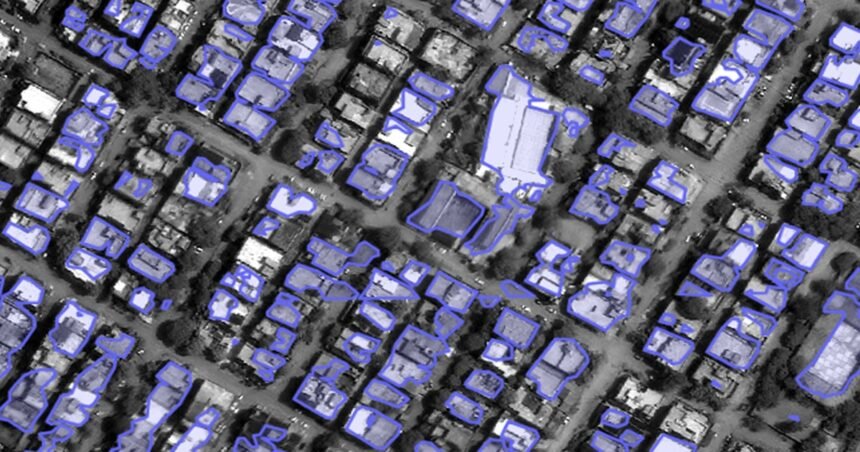
Image credit: NVIDIA case study image of CYRAN AI’s SpatialFuse edge AI inference on satellite imagery.
Most artificial intelligence lives far away from the thing it is watching. A satellite photographs the Earth, a drone films a border, a factory sensor records a vibration — and the data travels to a distant server before anyone gets an answer. That round trip works until the connection is slow, the power budget is tiny, or the data is simply not allowed to leave the site at all. An IIT Delhi spin-off called CYRAN AI Solutions is building the alternative: intelligence that runs exactly where the data is born.
CYRAN, founded in 2018 out of IIT Delhi’s NVM and Neuromorphic Hardware Research Group, builds enterprise-grade hardware-software AI for geospatial intelligence, Industry 4.0 and education. Its founder, Professor Manan Suri, was named to MIT Technology Review’s global list of 35 innovators under 35 in 2018 and has published more than 85 papers on the memory and computing hardware the company is built on. In June 2026 the work drew two of the strongest validations a young deep-tech company can get: an agreement with Safran Aircraft Engines to develop AI solutions for aerospace and defence, and an expanded collaboration with Dutch neuromorphic chipmaker Innatera, announced at Bharat Innovates 2026.

The problem with sending everything to the cloud
Satellites, drones and ground sensors are generating geospatial data at a pace that has outrun the tools built to handle it. A single satellite scene can exceed 10 gigabytes uncompressed, and the dominant compression format across Earth observation, JPEG 2000, is slow to decode on ordinary processors. For CYRAN’s customers in defence and sovereign intelligence, where cloud round-trips are not an option, the only path forward was local hardware fast enough to keep pace with the sensors.
That is the gap CYRAN’s SpatialFuse platform is built to close. The platform fuses data from orbit, air and ground into real-time geospatial intelligence, and the company says it carries pre-trained models across more than 20 sensor types, deployable in the cloud, at the edge or in fully air-gapped environments. The point is sovereignty as much as speed: a stack that does not depend on foreign infrastructure or export permissions to work.
From five minutes to two
The clearest proof of the approach comes from NVIDIA, which published a case study of CYRAN’s work on its DGX Spark system. CYRAN built PixelFlux, a GPU-accelerated JPEG 2000 decode library, and paired it with the unified memory architecture of NVIDIA DGX Spark to attack the slowest step in the pipeline: decoding. The result was striking — a 26 gigabyte satellite scene that took over five minutes to decode on a CPU pipeline now completes in just over two minutes, about three times faster than the CPU baseline and twice as fast as a discrete-GPU workstation at large image sizes, with no cloud in sight.
More Read

“NVIDIA DGX Spark’s unified memory architecture is a revolutionary improvement — removing a fundamental compute bottleneck at the hardware layer from geospatial processing pipelines,” says Dr Vivek Parmar, CYRAN’s chief technology officer. “Further bundling CYRAN’s indigenized SpatialFuse platform with Spark unleashes new optimized full-stack solutions for end-to-end GeoAI processing, all the way from orbit to ground stations.” The company is now exploring porting its edge AI capabilities to satellite payloads for on-orbit inference, where the compute constraints are even more severe than on the ground.
A brain-inspired bet
Underneath the products sits a research idea borrowed from the brain. In neuromorphic hardware, memory and computation sit together rather than shuttling data between separate units, and the efficiency gain matters most where power and space are constrained — on a drone, inside a satellite payload or on a factory sensor. CYRAN grew directly out of the IIT Delhi laboratory working on exactly this hardware, and it remains the thread running through everything the company builds.
The Innatera collaboration takes that thread into wearables and intelligent devices. The two companies have already delivered an EMG-based application prototype that reads muscle activity and gestures, and jointly showcased the technology at CES and SEMICON India. The expanded collaboration, announced in June 2026, broadens the work into audio intelligence and other ultra-low-power applications — devices that continuously sense, interpret and respond to the world around them while running on a whisper of power.
From classrooms to the front line
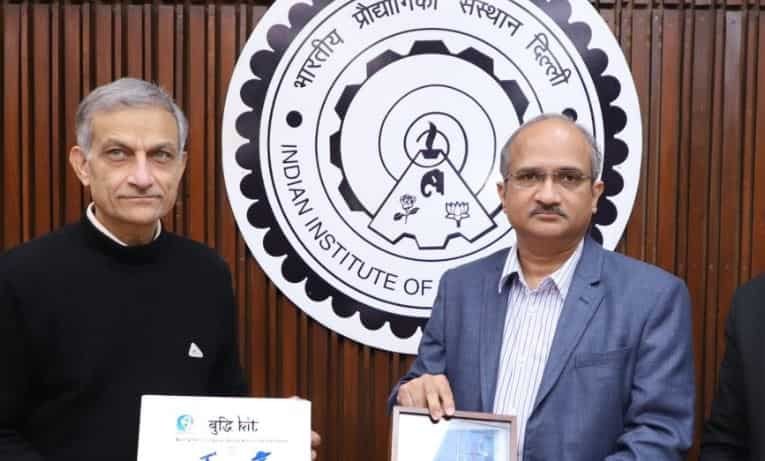
CYRAN’s work reaches well beyond the lab bench. Its BUDDHI kit, which the company calls the world’s first do-it-yourself AI kit, was launched at IIT Delhi to let school students learn the basics of artificial intelligence and build AI-based projects with no prior training — a complete learning ecosystem of hardware, software and projects, designed and developed entirely in India.
On the defence side, the Indian Army has signed a contract with CYRAN, as an iDEX winner, for the development of AI-based satellite imaging, according to defence trade reports. The honours have followed the same path: the iDEX challenge in 2021, the National Startup Technology Award the same year, the Raksha Mantri’s Award for Excellence in Defence and Aerospace in 2022, the IDEX ADITI Award in 2024 and the ISPA and IN-SPACe Excellence in Space Ecosystem Award in 2024. The company’s partners and customers include Maxar, JSW Energy, Vedanta and NVIDIA, whose Inception programme CYRAN is a member of.
From a laboratory at IIT Delhi to Safran’s aerospace programmes, from gigapixel satellite scenes decoded on a desktop to a kit that puts AI into a schoolchild’s hands, CYRAN is showing what Indian deep tech looks like when the intelligence stays where the action is — at the edge, in orbit, and in Indian hands.
Keep reading: The Pune Robots Cleaning Floors in 9 Countries: Inside Peppermint Robotics’ Autonomous Fleet · Every Word, Even the Mixed Ones: Inside Fonada’s Kapture V3, India’s Chart-Topping Hindi Speech AI · More Industrial Automation & Technology stories
Like stories like this? Add Exceptional Technology as a preferred source on Google to see more of our reporting in your search results and Discover feed.