


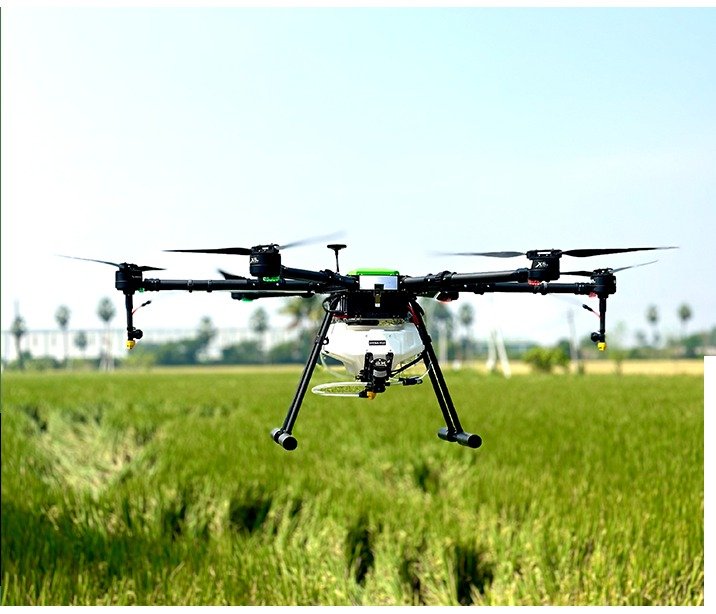
Over a paddy field in Andhra Pradesh, a black hexacopter hangs in the air with its rotors a blur, a fine mist settling evenly over the crop below. In an hour it will have covered six to eight acres — work that would take a team of labourers the better part of a day, carrying heavy tanks of pesticide on their backs. The drone is the SYENA-H10i, and the company behind it, Thanos Technologies of Hyderabad, has spent a decade turning a single idea — Indian-built drones, designed for Indian fields — into one of the country’s most quietly capable drone makers. This year, the same engineering took a sharper turn: the company demonstrated a drone firing a weapon in flight.
Thanos Technologies was founded in May 2016 by Pradeep Palelli and Prathyush Akepati, and it began life as an aerial surveying company, flying drones to capture images and turn them into useful maps and measurements for customers. The founders quickly saw a bigger opening in agriculture, where spraying was still done by hand — slow, uneven, and with the operator walking through the very chemicals being sprayed. In December 2017, the company unveiled its first product at the AP Agritech Summit: the SYENA-H10, a five-litre agricultural spraying drone. Feedback from farmers at the exhibition and in demonstrations over the following months shaped what came next — a larger, smarter machine with a ten-litre tank, radar for terrain following and GPS for fully autonomous spraying.
That machine is the SYENA-H10i, and the company says it spent nearly three years of trials, demonstrations and field operations arriving at the ten-litre size as the ideal balance of battery, flight time, portability and spraying efficiency. The drone is a hexacopter built on a 3K carbon-fibre frame, measuring 2.39 by 2.17 metres and weighing up to 30.3 kg fully loaded. It carries ten litres of spray liquid, flies for 22 minutes on a charge, and lays down a three-to-five-metre swath at speeds of up to 10 metres per second. It can fly manual, semi-autonomous or fully autonomous missions, holds steady in winds up to Beaufort force 5, and carries radar obstacle avoidance, a live video camera and a radio with a built-in screen and 4G SIM slot. In December 2023, the SYENA-H10i received its DGCA type certificate — the regulator’s formal stamp that the design is airworthy and ready for commercial use.
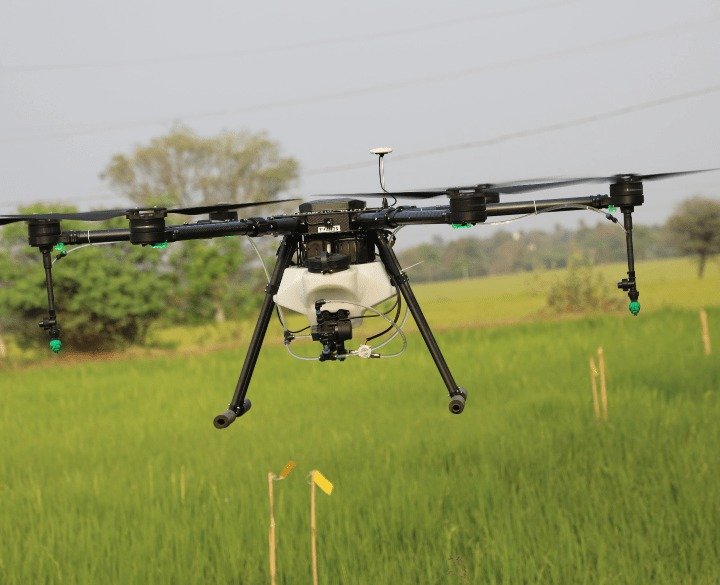
The engineering choices are deliberate. The SYENA was built from the ground up with larger motors for efficiency and longevity, and in-house lithium-ion batteries designed for long life and low maintenance; the heavier, larger design was intentional, built to survive Indian field conditions. The company offers spraying drones in 5, 10 and 15-litre capacities, and says its drones have covered thousands of acres in spraying pilots and demonstrations over the past five years.
The numbers that matter to a farmer are simpler. The company says the SYENA-H10i covers six to eight acres an hour, around ten times faster than manual spraying, with uniform coverage and up to 80% less water than hand spraying, and the operator never comes into direct contact with the chemical. The drone has now covered more than 50,000 acres through the company’s spraying-as-a-service operations, and Thanos works across nine states with some of the world’s largest agrochemical companies — Bayer, Syngenta and Coromandel among them — alongside custom drone builds for institutions including IIT Hyderabad, IIIT Hyderabad and TCS.
Behind the flying machines is a deliberately self-reliant operation. Thanos designs and manufactures its drones in-house in Hyderabad, which the company says gives it control over quality, components and future upgrades. The team of around 50 people works from a 10,000 sq. ft. facility, and a new manufacturing plant inaugurated in 2024 gives the company capacity to build 3,000 drones a year. The company has stayed bootstrapped while growing revenue 50–70% a year, and has sold more than 300 drones since 2021. Its stated ambition is simple and vast at once: a drone in every village.
More Read

The journey has collected its share of recognition along the way. Thanos won first prize at the inaugural Drone Olympics Challenge organised by India’s Ministry of Defence in Bengaluru in February 2019, was one of ten startups chosen by the Telangana government for mentorship and pilot projects the same year, and was named one of Hyderabad’s ten hottest startups at the HYSEA Awards in 2018. Its payload-delivery drone was invited to the Lockheed Martin-backed Global UAV Challenge at Aero India 2019.
That defence connection has now become a second line of business. In June 2026, reports confirmed that Thanos had successfully demonstrated in-flight test firing of a UAV-integrated weapon platform — a drone carrying, stabilising and firing a weapon system while airborne. The trial validated the technologies that make such a shot possible: platform stability during weapon release, flight-control accuracy, payload integration and targeting. The company’s defence portfolio now includes hand-launched kamikaze UAVs and tactical drones built for reconnaissance and precision missions, and Thanos is looking beyond India, with plans to expand into Southeast Asia and Africa.
Watch the SYENA-H10i at work in Andhra Pradesh:
From a five-litre sprayer shown at a farm exhibition to a certified agricultural workhorse and now a weapon-carrying UAV, Thanos Technologies has followed the same thread for ten years: build the drone in India, prove it in Indian conditions, and keep pushing it into harder jobs. The paddy fields came first. The skies above them are next.
Keep reading: Five Thousand Drones and a Million Hours in the Sky: Inside Garuda Aerospace · Growing Medicines in Orbit: Inside Vellon Space, the Bengaluru Startup Building Laboratories Above Earth · More Aerospace & Defense stories
Like stories like this? Add Exceptional Technology as a preferred source on Google to see more of our reporting in your search results and Discover feed.







