Every rocket India has ever launched has been thrown away after a single flight. The booster that lifts a satellite into orbit burns, falls and is gone — along with most of the cost of getting there. SpanTrik, a startup from Hyderabad, thinks that is a waste of a perfectly good machine. It is building a rocket designed to come home.
The company’s name blends “space” with antriksh, the Sanskrit word for the cosmos, and its ambition matches the name. SpanTrik is building Raven, a fully reusable two-stage rocket that would lift off, deliver its satellites, and land both of its stages back on Earth — ready, the company says, to be refuelled and flown again within days.
Founded in May 2022 by Kajal Rajbhar and Hitendra Singh, SpanTrik works out of T-Works, Hyderabad’s prototyping hub, with a small core team that builds nearly everything itself. “When we interacted with different people and organisations in the sector, we realised that most rocket components were being sourced from outside,” co-founder Hitendra Singh told The Hindu BusinessLine. “So, we decided to take a different approach and develop everything ourselves, from raw materials to the final product.” That in-house list includes the rocket engines, flight computers, avionics and guidance systems.
The proof that the approach works came in December 2025, when SpanTrik’s mini test vehicle Hopstone lifted off from a private test site near Hyderabad, hovered, and landed back where it started. The short, low-altitude hops were the first time the company’s flight systems had flown in the air rather than in a laboratory or a simulation — and they passed. The hops validated the avionics, the thrust-vector control that steers the vehicle by tilting its engine, and the guidance, navigation and control software that keeps it balanced and brings it home.

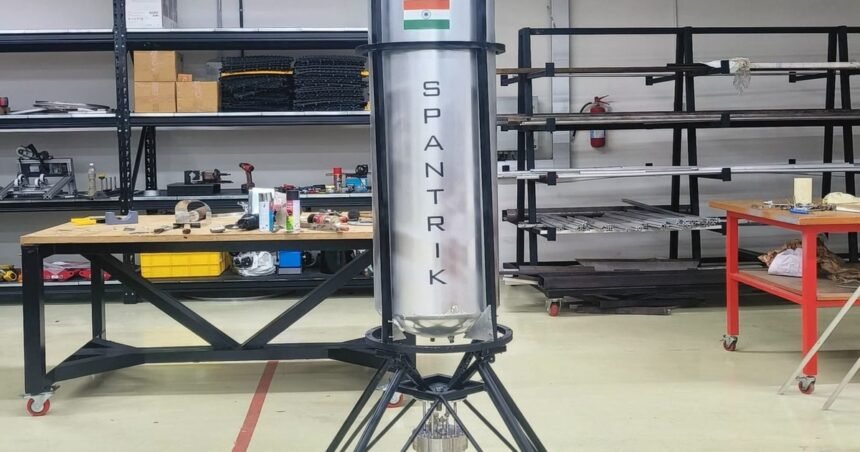
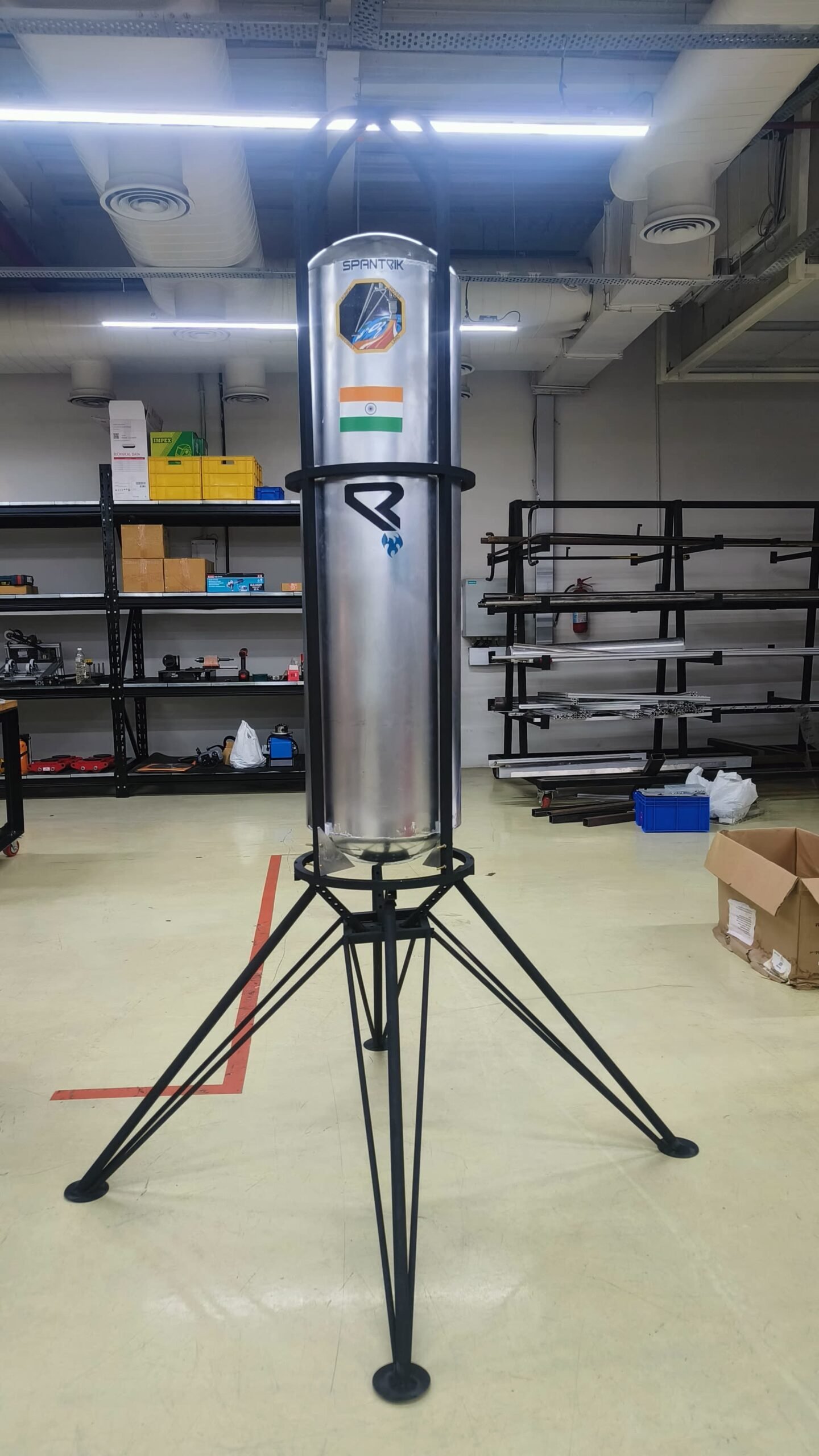
Hopstone is a stepping stone, not the destination. It is the smallest rung of a ladder the company has been climbing methodically. The first rung was Eureka, its 5 kN liquid oxygen and liquefied natural gas (LOX-LNG) cryogenic engine, which completed a hot-fire test in July 2024. The next rung is Leapfrogger, a roughly three-metre test vehicle built to a tenth of the scale of Raven’s first stage, on which the company plans more than a hundred test flights to perfect the launch, descent and precision landing. Leapfrogger is the machine in the workshop photographs the company shares — a stainless-steel cylinder standing on spindly landing legs, its engine nozzle peeking out below.
Then comes Raven itself. The company describes a 60-metre, two-stage rocket built from stainless steel, which it says grows stronger when chilled by its cryogenic propellants. Raven is designed to carry 8,000 kg to low Earth orbit in fully reusable form and up to 16,000 kg when flown expendable, serving the mega-constellations and rideshare missions that now dominate the small-satellite market. Its first stage would return to the launch site under its own power, landing vertically like Hopstone. Its second stage would come home too, slowed by an orbital inflatable decelerator — a heat shield that unfurls in space. The company is aiming to recover the whole rocket within six hours of launch and to turn it around for the next flight in under a week.
More Read

The work has drawn recognition along the way. SpanTrik was named to YourStory’s Tech30 list of India’s most promising startups in 2024, joined the AWS Space Accelerator’s India programme, and has won government grants and Startup India recognition. It has signed an agreement with the Institute of Aeronautical Engineering in Hyderabad to set up a test facility on campus, and its first flight of Raven is targeted for 2028.
If Raven flies as designed, it would put India in a small club of countries with a fully reusable rocket — and it would do it with a machine built almost entirely in-house, from its engines to its flight computers. The hops Hopstone made in December were only a few metres high. The idea they were testing is much bigger: a rocket that lands, refuels and flies again, the way an aeroplane does.
Keep reading: From Paddy Fields to the Front Line: Inside Thanos Technologies, the Hyderabad Startup Whose Drones Spray Crops — and Fire in Flight · Five Thousand Drones and a Million Hours in the Sky: Inside Garuda Aerospace · More Aerospace & Defense stories
Like stories like this? Add Exceptional Technology as a preferred source on Google to see more of our reporting in your search results and Discover feed.