



An electric car plugged in at home can draw seven to ten times the electricity of the whole house. That single fact is why Akshay Shekhar, the co-founder and CEO of Kazam, calls EV charging the wedge for digitising energy in India — and why his Bengaluru company has spent the last six years turning every parking spot in the country into a potential charge point.
Kazam began in 2020, in the first wave of Covid, when Shekhar flew into India for a holiday from a job in the United States and could not get back. He and his co-founder Vaibhav Tyagi, a colleague from his Pepsi days, started not with a product but with a YouTube channel, interviewing owners of two-, three- and four-wheelers to test whether India would really adopt electric vehicles. The answer came back loud enough to build on: the company’s first charging station went up in Bengaluru’s JP Nagar in April 2021, and by July that year Kazam had won a contract with Delhi’s power distribution companies to deploy more than 30,000 subsidised charging stations.
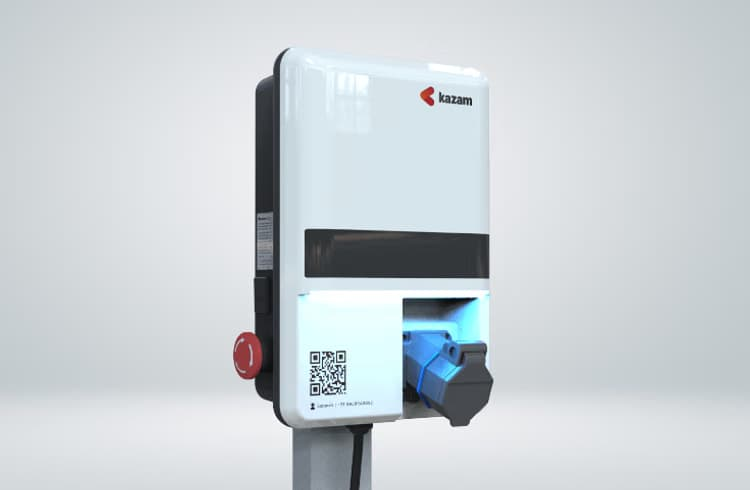
The hardware is deliberately unglamorous and built to disappear into daily life. Kazam’s charge points — the 3.3 kW LEVAC Pro home charger, the portable Kazam Mini and the LEV-DC fast-charging range — are OCPP-compliant, connected over GSM, Wi-Fi and Bluetooth, and built to IP54 protection. The company’s 7.4 kW home charger earned ARAI certification in November 2024. A Kazam charge point arrives with the software already on it, and Kazam installs it too — the company says its installer network can reach 12,000 pin codes within 48 hours.
The software is where the scale lives. Kazam’s charger management system connects more than 100 charger brands and models, so one dashboard can monitor chargers, set tariffs, run campaigns and manage revenue across different partners. The Kazam app lets drivers discover and book chargers, plan trips around charging stops, and pay through the wallet of their choice. Behind it sits managed charging: the system charges at midnight automatically, identifies the user, and settles payment with whoever operates the charger — the driver never has to think about any of it. The same platform runs battery-swapping networks and EV leasing, tying the whole ecosystem together.
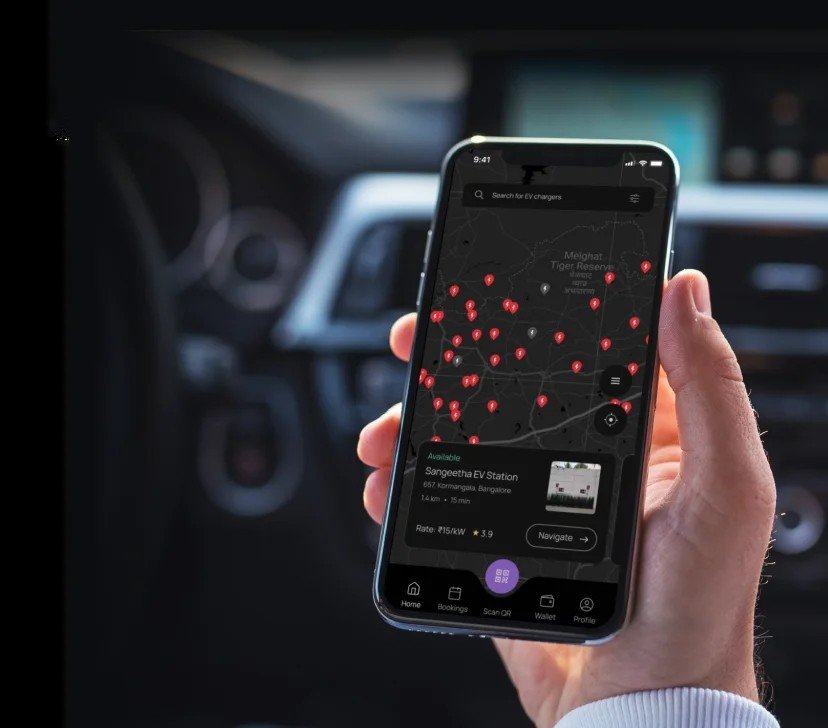
The most ambitious layer is the one Kazam is giving away. Unified Bharat e-Charge is an open interoperability layer being built with the Ministry of Heavy Industries, BHEL and NPCI — the UPI moment, applied to EV charging. Through Kazam’s Beckn Provider Platform, any charge point operator can join the network using its existing charger management system, app and pricing, and drivers can discover, book, charge and pay across networks from a single app. Kazam is already live on the network with BHIM, and in July 2026 it opened a free seven-day onboarding programme to bring more operators in at no integration cost. Alongside it, Kazam is part of the founding alliance behind the Unified Energy Interface and the India Energy Stack, a UPI-modelled layer for energy itself, backed by Nandan Nilekani.
The network behind all of this is now one of the largest in the country. The company says it has more than 120,000 chargers onboarded, has enabled over 7 million charging sessions, and orchestrates more than 9,000 MWh of energy transactions a month across 3,900 pin codes. Fourteen vehicle makers use the platform, including Maruti Suzuki, which named Kazam among the charging partners for its first electric car, the e-Vitara, along with Mahindra and Bajaj. BigBasket has run its electric fleet on Kazam for four years, across close to 25,000 vehicles, and Kazam’s chargers sit inside 45 bus depots covering around 7,000 of India’s 12,000 electric buses. The company says it powers 60 to 70 percent of India’s two- and three-wheeler makers, and its platform now runs in 80 cities across 10 countries.
More Read

In July 2026 Kazam turned its attention to the place where most charging actually happens: the home. Its EV-Ready Ghar campaign, built on a study with the Alliance for an Energy Efficient Economy covering more than 80,000 residential charger installations, found that only 55 percent of Indian homes are ready for safe EV charging — and set out to fix that with a home-readiness quiz and trained technicians, the Kazam Rangers, who assess a home before a charger goes in. It is the same instinct that took Kazam’s chargers to the Prime Minister at the Bharat Mobility Global Expo in 2024: charging is not a gadget, it is infrastructure, and infrastructure has to be safe, boring and everywhere.
The money has followed the same curve. Kazam raised a $6.2 million Series B in June 2025, led by the International Finance Corporation with Vertex Ventures and Avaana Capital, taking its total funding to $19.2 million. Revenue grew fourfold in FY25 to $6 million, and the company is targeting $12 million this year. Six years after two founders started with a camera and a question, the Bengaluru company that began by asking Indians whether they would ever buy an EV is now building the layer that lets them charge one anywhere — and, if its bet on open networks pays off, the layer that lets India’s whole energy system talk to itself.
Keep reading: Saving the Sun for After Dark: Inside AmpereHour Energy, the Pune Company Building India’s Grid Batteries · Solar Paint: Inside Pavakah Energy’s Printable Thin Film That Turns Any Surface Into a Power Plant · More Energy & Power stories
Like stories like this? Add Exceptional Technology as a preferred source on Google to see more of our reporting in your search results and Discover feed.








