



Every Bengalurean knows the maths of the airport run. Electronic City to Kempegowda International Airport is roughly 50 kilometres, and on a bad evening it eats two and a half hours of your life. Now imagine the same journey in under twenty minutes — not in a faster car, but above the traffic entirely, in an aircraft that takes off vertically from a rooftop, cruises at 250 kilometres an hour, and lands on the other side of the city before your cab would have cleared the first flyover.
That is the journey Sarla Aviation is building for. The Bengaluru startup is developing Shunya, a six-passenger electric air taxi designed from the ground up for Indian cities — and unlike most flying-taxi dreams, this one has already flown. Its half-scale demonstrator, Sylla, completed more than 500 test flights over six months, logging over 18 hours in the air and becoming, the company says, the heaviest electric aircraft ever to take off in India.
Sarla was founded in October 2023 by Adrian Schmidt, Rakesh Gaonkar and Shivam Chauhan. Schmidt and Gaonkar had spent years at Lilium, the German eVTOL pioneer, and they brought that experience home — more than 30 per cent of Sarla’s team has previously worked at global aviation pioneers including Lilium, Joby, Tesla and Volocopter. The company is named after Sarla Thakral, who earned her pilot’s licence in 1936 at the age of 21 and became India’s first woman pilot. It is a fitting namesake: the team likes to say this century belongs to India, and they are building the aircraft to prove it.

Shunya itself is a study in deliberate simplicity. Seven electric propulsion units power the aircraft — six motors lift it straight up, and a seventh at the rear pushes it forward into wing-borne flight. Two double-isolated battery packs and a sustainable aviation fuel tank give it up to 150 kilometres of fully electric range, stretching to 800 kilometres in hybrid mode, while the aircraft is optimised for the short urban hops of 20 to 30 kilometres where it will do most of its work. Top speed is 250 kilometres an hour, and the payload is 680 kilograms — the highest the company claims of any eVTOL in its class — with room for six passengers, a pilot, and everyone’s luggage.
The cabin is where Sarla’s mass-transport ambition shows. The company says Shunya has the largest flying-taxi cabin ever designed, and it comes in several configurations: a six-seat layout for busy routes, a four-seat club layout for premium commutes, a cargo version, and even an ambulance version for rapid medical response. The seats are designed to aviation certification standards, the cabin is actively sound-managed for quiet travel, and the interior uses recycled materials, including fabrics made from recycled plastic bottles.
Before building the full-size aircraft, Sarla built Sylla — a half-scale technology demonstrator with a 7.5-metre wingspan, in the 700-kilogram class, designed to answer the engineering questions that simulations alone cannot. Ground testing began in December 2025 at the company’s Bengaluru facility, and the flight-test campaign wrapped up on 1 July 2026. Across six months of field testing, Sylla put its electric propulsion, battery architecture, distributed-propulsion wing, flight controls, airframe and landing gear through their paces as one integrated system. The programme was the first in India to fly a 400-volt electric powertrain architecture and a distributed-propulsion wing system, and the first to complete full-stack ground testing in line with airworthiness regulations. The whole demonstrator went from drawing board to mid-air in under a year, on a budget of less than $13 million for the full-scale mock-up and the demonstrator combined.
More Read

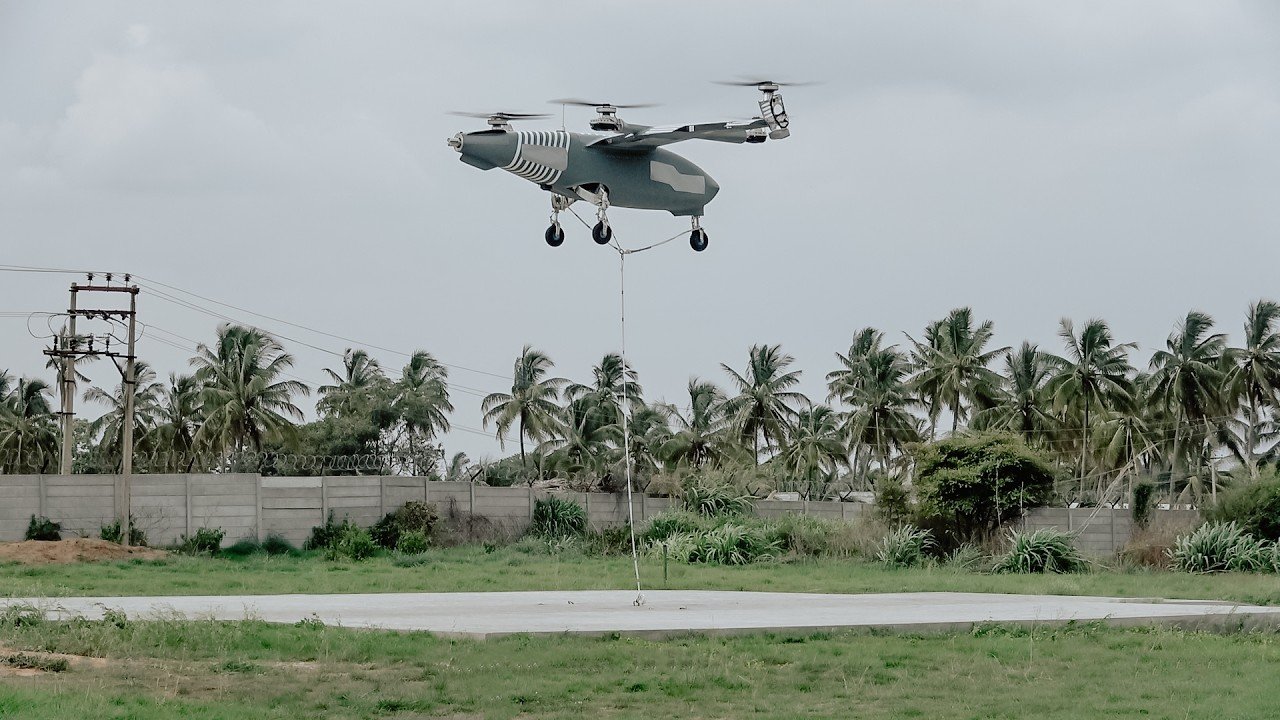
That flight data is already shaping what comes next. Sylla 2.0, now in development, will pursue controlled transition from hover to sustained wing-borne flight — the defining milestone on the road to a certifiable passenger aircraft. And the regulators are already on board: in August 2026, the Directorate General of Civil Aviation handed Sarla its Design Organisation Approval at the inauguration of the company’s new Bengaluru headquarters, a key step toward type certification.
The backing is serious. Sarla has raised $10 million in a Series A round led by Accel with participation from Nikhil Kamath, and in September 2026 it signed an agreement with Tata Elxsi to support engineering and certification work on Shunya. Siemens is supplying its Xcelerator software portfolio for the aircraft’s development. And the company is thinking at manufacturing scale from the start: it is setting up a large production facility in Thimmasamudram, Andhra Pradesh, designed to build up to 1,000 aircraft a year.

The plan for the service itself is laid out in Sarla’s masterplan, and it starts with the journeys that hurt most. Phase one targets airport transfers — that two-and-a-half-hour Electronic City run, cut to under twenty minutes — alongside medical transport that the company says will be free of cost. Phase two connects neighbourhoods and communities directly, from a landing pad on your building to the office, the university or the cricket stadium. And by 2035, the company envisions flying taxis as mass transportation, with fares competitive with premium ride-hailing on the ground. Commercial operations are targeted for 2028, starting in Bengaluru and then expanding to Mumbai, Delhi and Pune.
It is an audacious timeline, and the skies above Indian cities will not change overnight. But Sarla has already done the hardest part of any aircraft programme: it designed, built and flew a real machine, gathered real flight data, and earned the regulator’s formal recognition — all in under three years. The traffic below is not going anywhere. The question is how soon we start flying over it.
Keep reading: Land, Refuel, Fly Again: Inside SpanTrik’s Hopstone and the Raven, India’s Fully Reusable Rocket · From Paddy Fields to the Front Line: Inside Thanos Technologies, the Hyderabad Startup Whose Drones Spray Crops — and Fire in Flight · More Aerospace & Defense stories
Like stories like this? Add Exceptional Technology as a preferred source on Google to see more of our reporting in your search results and Discover feed.







