


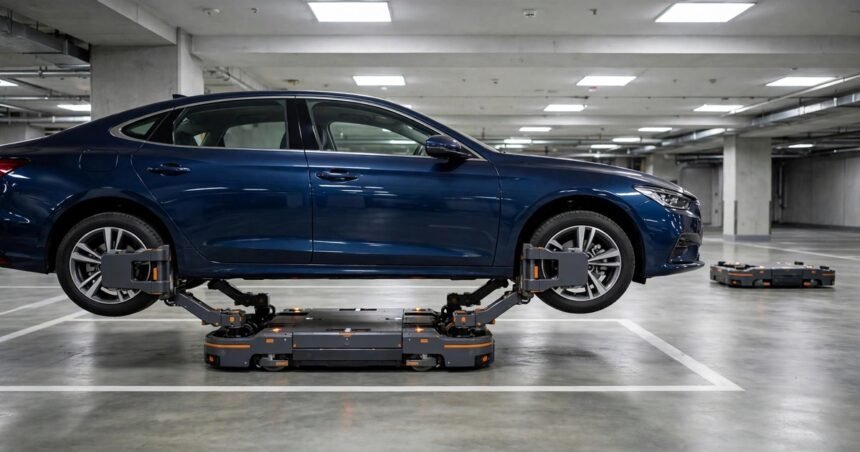
Finding a parking spot in an Indian city has become a small daily negotiation — circle the block, squeeze into a gap, reverse into a basement pillar’s shadow and hope nobody needs to leave before you do. Affordable Robotic & Automation Ltd (ARAPL), a Pune automation company listed on the NSE, has a different answer: don’t park the car at all. Hand it to a robot.
Its Relipark system, commercially launched in September 2026, works on a simple promise — drive in, walk away, the robot parks it. A driver pulls into an entry bay, guided by lights and screens, and switches off. Scanners check the car’s size and confirm nobody is still inside, the driver taps a card or the app, and the car is the robot’s problem from there.
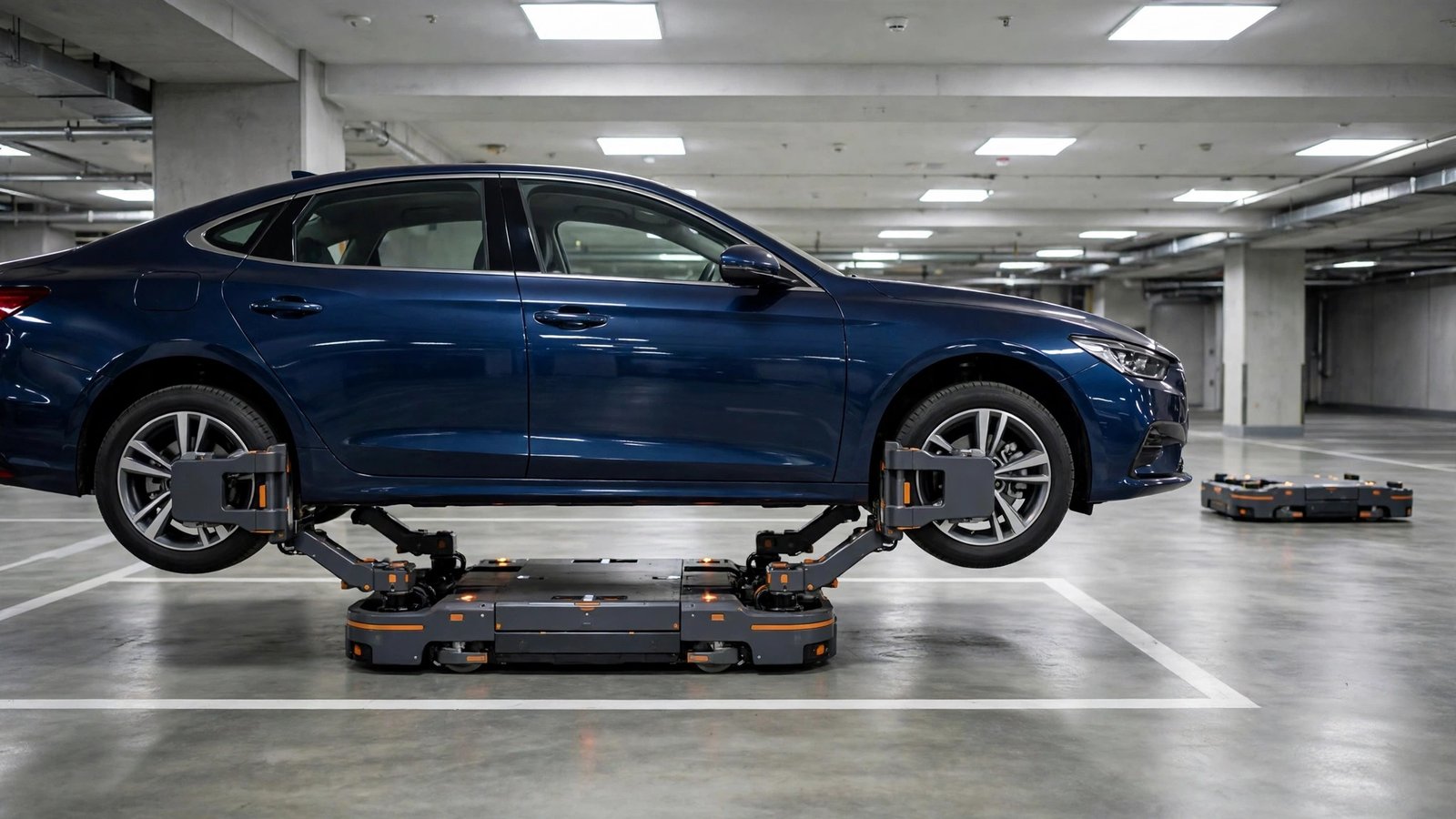
The two-minute handover
A low, battery-powered robot slides under the car, lifts it gently by the tyres and carries it sideways into a free bay in a dense, ramp-free grid. There are no driving lanes to navigate and no ramps to climb — the cars sit packed edge to edge, two rows deep, and the company says the same slab holds up to twice as many cars as a conventional car park. When the driver wants the car back, a tap on the app or kiosk sends it to the exit bay, facing forward, ready to drive out.
The first robot in the fleet is called the 2M, named for the goal the company set it: get a parked car back to its driver in as little as two minutes. The company says the robots handle cars of up to 2,500 kg and 5,300 mm long — sedans and most SUVs — with average retrieval in about two to four minutes depending on the layout and fleet size. Fleet-control software assigns the bays, routes the robots and even pre-fetches cars before the evening rush, while the robots dock and charge themselves between moves. And if one robot pauses, the others take over — the fleet keeps moving.
Twenty years behind every bay
Relipark is a new brand, but the engineering behind it is not. ARAPL was founded in Pune in 2005 by Milind Padole and has spent two decades building robotic welding lines, warehouse robotics and automated parking for manufacturers and developers across India. The company has been in automated parking since 2012 and began developing its parking robots in 2019. It listed on the BSE SME board in 2018 and moved to the NSE main board in 2023.
That heritage is the point. Conventional mechanical parking stacks cars on chains, bearings, conveyors and pallets, with motors at every turn — a chain of parts where one failure can stall the whole tower. Relipark’s answer is to remove the machinery from the building and put it on wheels: a fleet of free-moving robots on a flat slab, with no rails to lay and no floor channels to cut, so the system fits new buildings and existing basements alike.
More Read

The order that says it’s real
On 9 November 2026, ARAPL told the stock exchanges it had won a domestic work order worth about ₹19 crore for its AGV car parking system — design, manufacture, supply, installation and commissioning, to be executed over 18 months. The company says it is the largest single order its AGV parking business has won since the product’s commercial launch in September.
It is not the company’s only win this month. Its subsidiary ARAPL RaaS, which builds autonomous forklifts under the Humro brand, secured a $5.47 million order for 103 autonomous robots on 4 November 2026, and on 30 October its autonomous pallet trucks and forklifts received conditional approval from the US Federal Communications Commission — the company says it is the only Indian company to clear that bar under the new US framework for foreign-built advanced robotic devices.
What’s next
The roadmap moves fast. A slimmer robot, the 2M Slim, is due by the end of 2026, and the third and most advanced model, VaLe — built around a valet-parking concept — is expected by October 2027, with two outdoor models planned for 2028. Relipark will show the system at the Airport Parking Network exhibition in London from 18 to 20 November 2026 and at ACETECH Mumbai from 19 to 22 November.
Parking is the most ordinary part of owning a car, and the most stubbornly unimproved. Relipark’s bet is that the basement of the future has no ramps, no aisles and no circling — just a flat floor, a fleet of quiet robots, and a car that is already waiting at the door when its driver walks back.
Keep reading: Robots on the Hospital Floor: Inside Alphadroid, the Noida Startup Putting Service Robots to Work · Every Kilometre Counts: Inside Dispatch Network, the Pune Startup Building an AI Brain for the Last Mile · More Industrial Automation & Technology stories
Like stories like this? Add Exceptional Technology as a preferred source on Google to see more of our reporting in your search results and Discover feed.







