


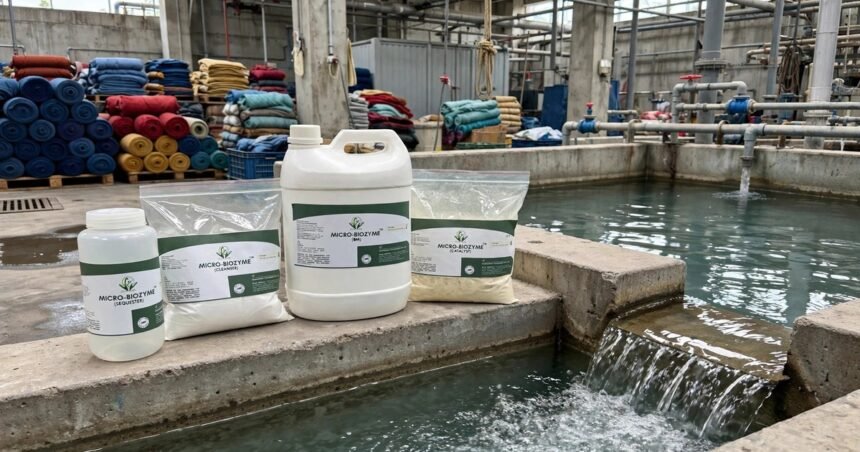
India dyes the world’s clothes — and the rivers near its textile towns have paid the price. In the printing clusters around Jaipur, the same vivid azo dyes that make fabrics beautiful turn wastewater into a toxic, brightly coloured soup that conventional treatment struggles to clean. A Jaipur company called Greenathon Technologies decided to fight the dye with something far smaller than a chemical plant: microbes.
A living alternative to harsh chemistry
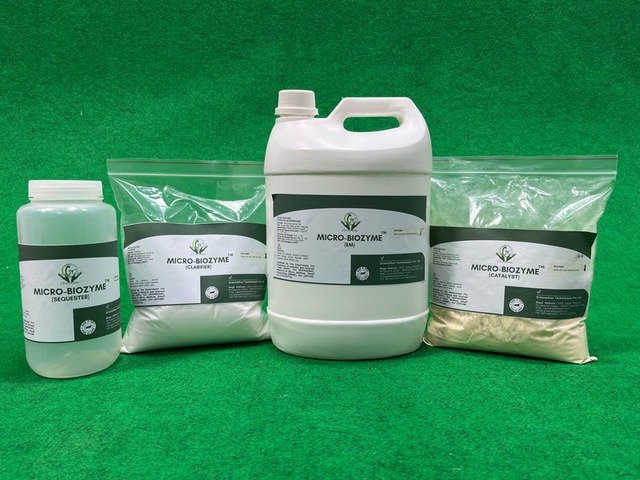
Azo dyes are engineered to resist fading from water, light and soap — which is exactly what makes them so stubborn in wastewater. Greenathon’s answer is Micro-Biozyme, a formulation of naturally occurring bacteria and enzymes that biodegrades, decolourises and detoxifies dye effluent. The microbes do the work that harsh chemicals used to do, breaking the dye molecules down instead of merely moving the colour somewhere else.
The formulation drops straight into a mill’s existing effluent treatment plant, so factories don’t need to build anything new. And because the treatment runs on a static model rather than energy-hungry aeration, the company says it uses far less electricity than conventional systems. The treated water comes out clean enough to reuse — the company says up to 80% of it goes straight back into the same facility — and the sludge left behind is repurposed for use in electroplating industries. The product also cuts the organic load of the effluent, reducing BOD, COD, total suspended solids and oil and grease, helping plants meet pollution norms.
From a microbiology lab to 280 factories
Greenathon began in the research of Dr Sarika Gupta, a microbiologist who spent years watching polluted water bodies near Rajasthan’s textile clusters and wondering why the problem persisted despite all the available technology. She started translating her laboratory work into an industrial product in 2015, and Greenathon Technologies was formally incorporated in Jaipur in 2020, with Dr Ashish Kumar Dubey as co-founder and the research team based at Banasthali Vidyapeeth.
The road from lab bench to factory floor took roughly ₹2.5 crore of research and development and more than two lakh man-hours of scientific effort. The work earned a process patent in 2023 and a product patent in 2024, along with funding from the Ministry of Micro, Small and Medium Enterprises, the Department of Science and Technology’s NIDHI Prayas programme and the Biotechnology Ignition Grant from BIRAC. The company is DPIIT-certified, incubated at the Atal Incubation Centre at Banasthali Vidyapith, and now runs a pilot-scale manufacturing unit in Jaipur.
The validation came factory by factory. The company says it has run more than 350 industrial trials across 280 industries in Rajasthan, and the mills that adopted Micro-Biozyme report operating-expenditure reductions of 40–45%, along with nearly 70% lower electricity consumption. Treatment costs, the company says, fell from around 20 paise per litre to 10–12 paise per litre — a price point that makes clean water the cheaper option, not the expensive one.
More Read

Beyond the dye house
Textiles are only the first stop. Greenathon’s second product, Bio-De-Ink Solve, carries the same microbe-assisted approach into paper recycling, stripping ink from waste paper so it can be pulped and reused. The company is now preparing to take its formulations beyond Rajasthan to the other textile hubs across India, with global markets in its sights.
India’s textile industry colours fabric for the whole world. Thanks to a team of microbiologists in Jaipur, the colour no longer has to end up in the water.
Keep reading: Six Minutes to Save a Heart: Inside Tricog Health, the Bengaluru Startup Turning Every Clinic Into a Cardiac Centre · The Machine That Breathes for the Heart: Inside Mediyant Technologies, the Vadodara Company Building India’s First USFDA-Cleared Heart-Lung Machine · More Chemicals, Materials & Life Sciences stories
Like stories like this? Add Exceptional Technology as a preferred source on Google to see more of our reporting in your search results and Discover feed.







