India has written down more knowledge than almost any civilisation on Earth — and most of it is sitting unread. The country holds over a crore manuscripts, in dozens of languages and more than sixty ancient scripts, carrying everything from surgery and mathematics to astronomy and architecture. For centuries, that knowledge was locked behind fragile palm leaves, fading ink and scripts almost nobody alive can read. A Nagpur company called ImmverseAI decided to teach a machine to read them all.
A library no one could read
The scale of the problem is what makes the work so audacious. The company says it has built its entire data pipeline from the ground up: collecting Indic manuscripts, digitising them, and training AI models on the resulting corpus — more than 50 terabytes of data, spanning over ten lakh manuscripts across 23 languages. The goal is to decode 64 ancient scripts, from Devanagari and Sharada to Modi, Kharosthi and Grantha, unlocking what the company describes as over a trillion unique Indic tokens.
The work has already earned national recognition. In September 2025, ImmverseAI won first prize at the Gyan-Bharatam National AI Innovation Challenge, run by the Ministry of Culture, beating more than 50 AI startups from around the world. The company works with the National Manuscript Mission, and its team has published an open Ayurveda dataset drawn from the Charak Samhita and Sushruta Samhita, with sutra-by-sutra questions, transliterations and translations. It was also the only Indian startup invited to showcase its technology to Prime Minister Narendra Modi at the Global Partnership on Artificial Intelligence, alongside Google, Meta and Microsoft.
Manuscript to Mantrana
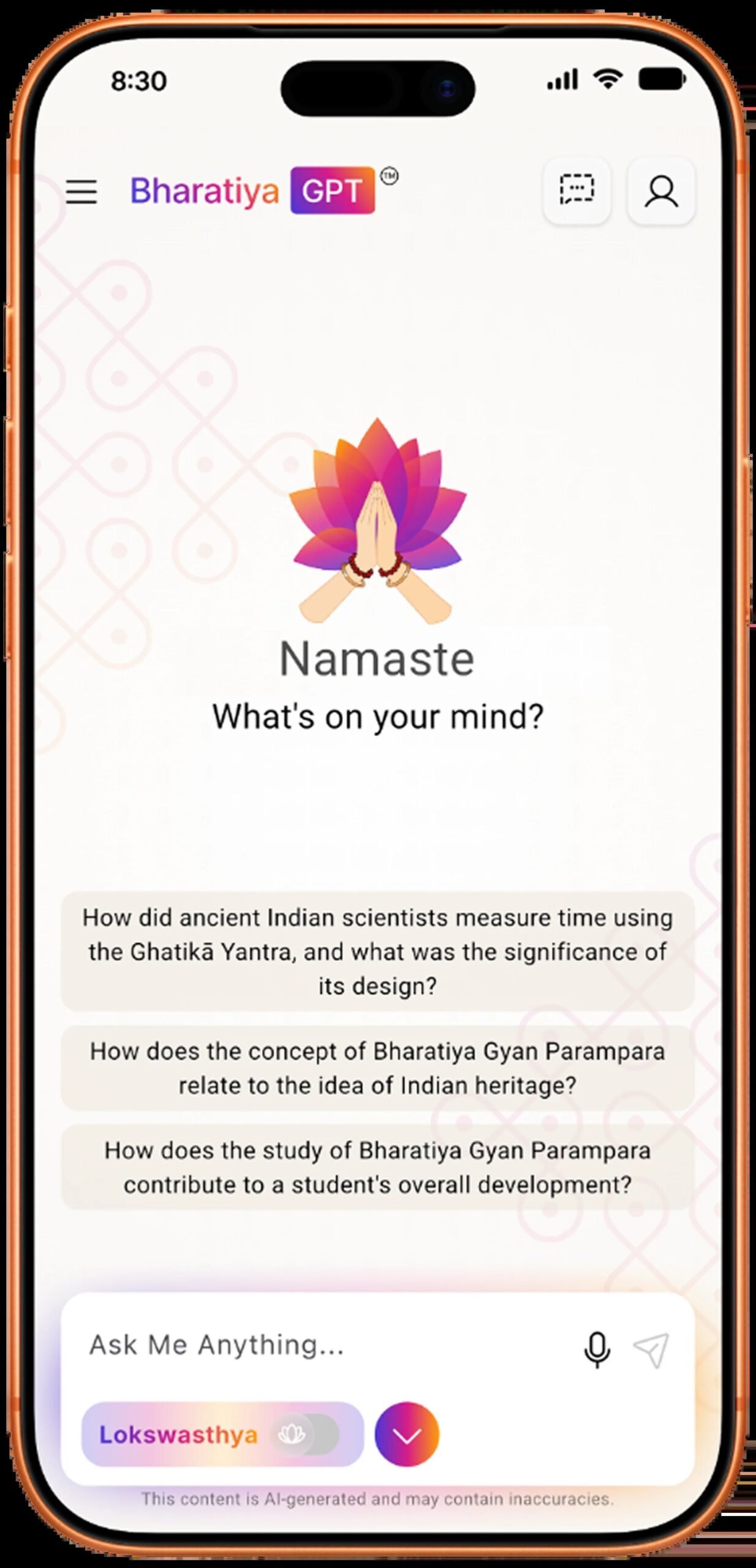
At the heart of the platform is BharatiyaGPT, a custom large language model built on eight billion parameters and trained on that manuscript corpus. The company calls its approach “Manuscript to Conversational AI”: fragile pages are first restored with AI-driven imaging, then converted into structured, machine-readable text with advanced Indic OCR and handwritten-text recognition, and finally delivered through a conversational interface — including an AI-powered avatar — with multilingual translation so the content travels across Indian and global audiences.
The platform is not one model but a family. AyurvedaGPT draws on traditional healthcare texts, GanitGPT on Vedic mathematics and geometry, and SthapatyaGPT on architecture — each grounded in the manuscripts rather than in generic web text. The company says BharatiyaGPT works in 22-plus Indian languages and over 100 languages worldwide, and it has built what it calls the world’s first AI-infused guided learning book, where readers can read, listen, watch and directly converse with foundational texts like the Vedas, the Upanishads and the Samhitas.
From Nagpur to the world’s stage
The moment that carried BharatiyaGPT from a Nagpur lab to the national conversation came at the India AI Impact Summit in New Delhi in February 2026. At Bharat Mandapam, Prime Minister Narendra Modi and more than 20 world leaders were introduced to the platform, with the demonstration led by ImmverseAI co-founder and CEO R Ramakrishnan. The Prime Minister went on to feature BharatiyaGPT in the 131st episode of Mann Ki Baat, describing the pipeline demonstrated on the classical medical text Sushruta Samhita — restoration, recognition, and conversation with the original source.
More Read

One of those leaders stayed longer than most. French President Emmanuel Macron spent 40 minutes exploring BharatiyaGPT at the summit, a stretch of attention few demos at a global gathering ever receive.
Ancient answers, modern questions
What ImmverseAI is building is bigger than a chatbot. It is a new kind of library — one where a student in Nagpur can ask how ancient Indian scientists measured time with the Ghatika Yantra, a doctor can trace a remedy to its sutra, and a curious reader anywhere can hold a conversation with a thousand years of Indian thought. The app is live on Google Play and the App Store, and the team continues to add manuscripts, scripts and languages to the corpus.
India’s manuscripts waited centuries for readers. Now, thanks to a team in Nagpur, they are learning to answer back.
Keep reading: India’s First National-Security Fab: Inside Bharat Semi, the Delhi Startup Building the Sensors India Couldn’t Buy · India’s First Quantum-Safe Algorithm: Inside Fortytwo Labs, the Pune Company Building Cryptography for the Quantum Age · More Industrial Automation & Technology stories
Like stories like this? Add Exceptional Technology as a preferred source on Google to see more of our reporting in your search results and Discover feed.