


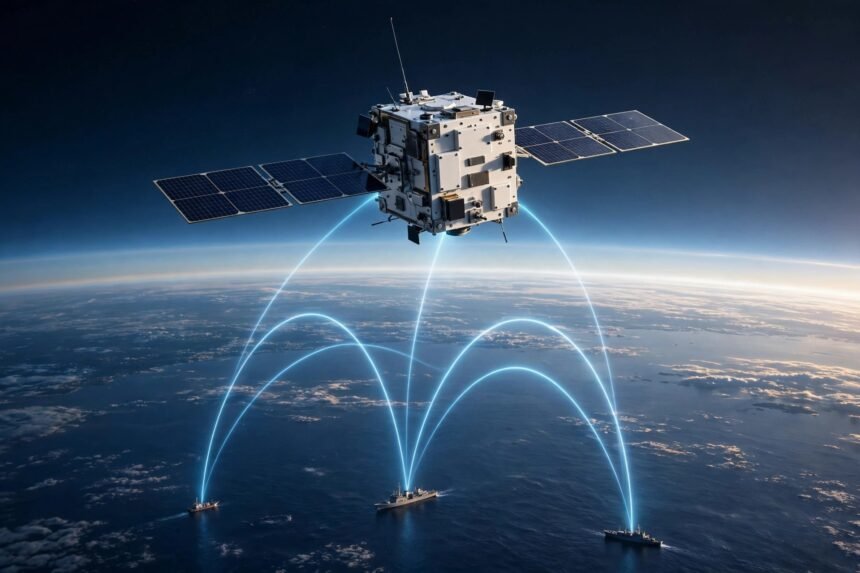
Every ship, aircraft and radar on Earth is constantly talking in radio waves — and most of that chatter is invisible. A camera in orbit can photograph a vessel, but it cannot tell you whether that vessel has switched off its tracker, spoofed its identity, or is broadcasting where it should not be. A small team in Bengaluru is building a different kind of eye in the sky: satellites that do not take pictures at all, but listen. That is the mission of ULOOK Technologies, a Bengaluru space startup building constellations of radio-frequency sensing satellites that map the hidden spectrum from orbit.
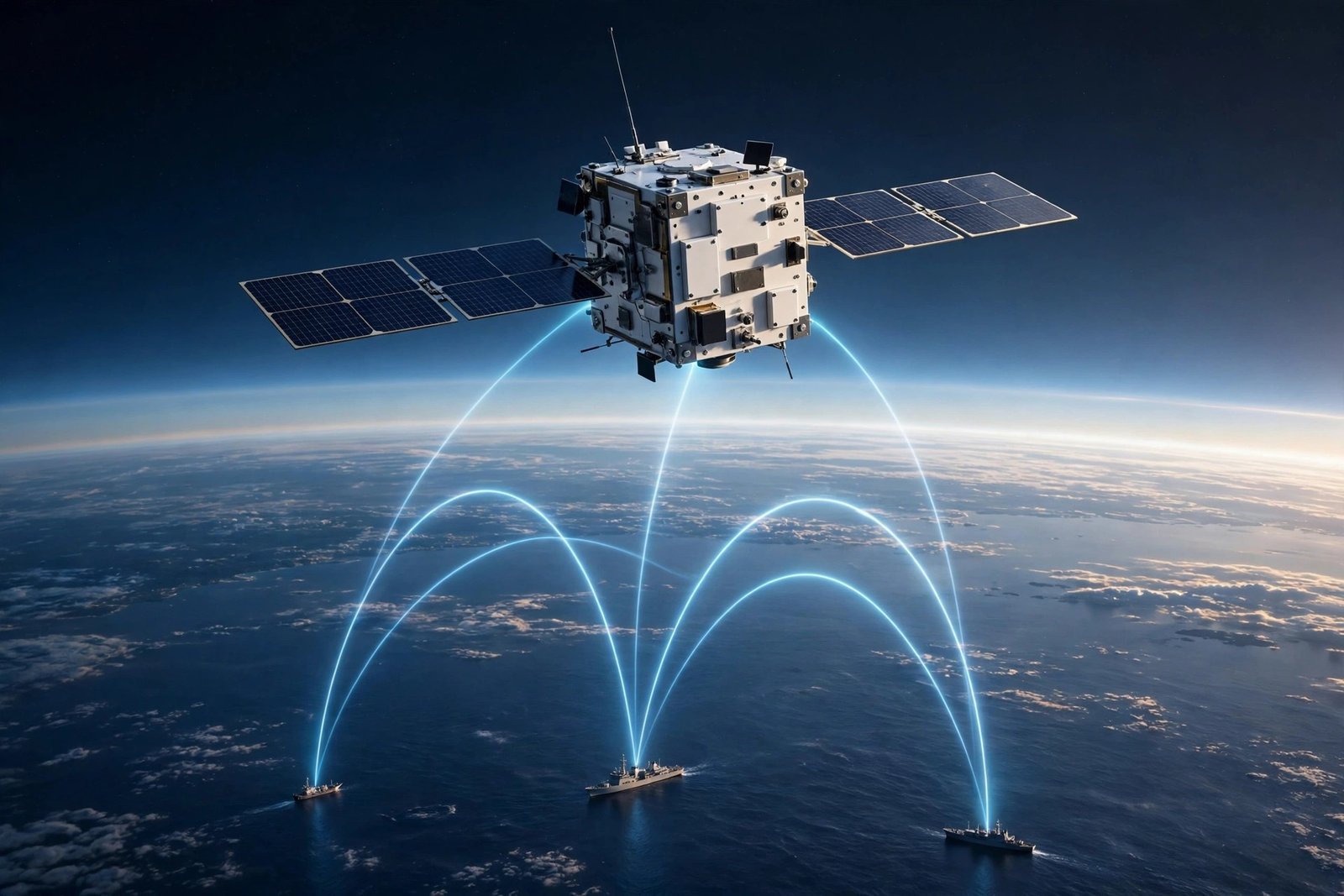
An illustration of ULOOK’s RF-sensing satellite listening to the radio spectrum from orbit. (Illustration: Exceptional Technology, based on ULOOK’s satellite design)
Hearing what cameras cannot see
ULook’s satellites capture what the company calls RF snapshots — patterns of radio-frequency activity picked up from orbit, rather than optical images. Every emitter has a signature, so the same pass that finds a target also identifies it. A ship broadcasting an AIS signal, a maritime radar sweeping the horizon, a satellite phone calling from the middle of nowhere: each one leaves a fingerprint in the spectrum, and ULOOK’s payload reads it, classifies it and pins down where it came from.
The heart of the system is the company’s proprietary payload suite, PulseTrack, which the company says delivers real-time RF situational awareness across small satellites, drones and high-altitude platforms. Onboard edge-AI interprets emissions as they arrive, and the satellites triangulate every source with what the company describes as sub-kilometre accuracy. Over repeated passes, the system builds a pattern of life for each emitter — not just where it is, but how it behaves over time.
That matters most where the picture goes dark. A vessel that switches off its AIS transponder vanishes from conventional tracking, but it cannot switch off every radio it carries. By listening for the signals a ship cannot hide — its radar, its satcom, its satphone — ULOOK’s constellation can find dark ships, expose spoofed identities and keep watch over waters where cameras and conventional tracking go blind.
More Read
A swarm that thinks together
ULook is not building a single satellite. It is building autonomous satellite swarms — constellations that communicate and coordinate with each other, creating what the company describes as a swarm intelligence system capable of monitoring large areas at once. Inter-satellite links and onboard AI let the swarm decide for itself what to watch, so coverage stays persistent around the clock rather than waiting for a ground station to task each pass.

ULook’s satellites listen for radio signals from ships, aircraft and devices on the ground. (Image: ULOOK)
The first customers the company has in mind are governments and defence organisations, which the company says will use the constellation for signal intelligence, mission planning and threat detection. The same listening layer serves commercial operators tracking fleets and safeguarding trade routes, and environmental teams exposing illegal fishing and protecting critical habitats. In a disaster, the satellites can locate distress signals and help reconnect responders when terrestrial networks are down.
Two engineers, a dozen missions
ULook was founded in 2024 by Siddhesh Ravindra Naik and Adheesh Boratkar, two engineers whose careers were already written in orbit before the company existed. Between them, the founders have worked on more than twelve satellite missions. Adheesh studied at the University of Toronto and has worked across North America on small satellites, lunar landers, robotic arms and aircraft. Siddhesh studied at the University of Colorado Boulder, worked on the MinXSS CubeSat, and then spent nearly six years at NewSpace Research & Technologies building autonomous aerospace systems, including UAV swarms and high-altitude pseudo-satellite platforms.
That heritage is the company’s shortcut: the team is not learning spaceflight from scratch, it is applying a decade of mission experience to a sensing problem that has never had a dedicated Indian constellation. The company is hiring from ISRO, DRDO and India’s scientific institutions as it grows, and it is building its first prototype at a facility in North Bengaluru.
From a North Bengaluru lab to orbit
The prototype now taking shape in North Bengaluru is being put through rigorous ground testing before it ever leaves the ground — the company’s path from laboratory validation towards operational deployment, maturing the technology from TRL-3 to TRL-7. The first RF-sensing satellite swarm is targeted to launch within twelve to eighteen months of the company’s seed round, setting the stage for a persistent, searchable intelligence layer over the world’s oceans and borders.
The backing is already in place. In November 2025, ULOOK raised ₹19 crore in a seed round co-led by growX Ventures and InfoEdge Ventures, with the funding going into building the first prototype, expanding the engineering team and advancing onboard AI and swarm autonomy. In September 2026, the company joined Peak XV Partners’ Surge 12 cohort, placing it among a select group of early-stage deep-tech companies from India and Southeast Asia.
India already watches the Earth from orbit with cameras and radar. ULOOK is adding a sense the country has never had in space: hearing. When its swarm is aloft, a ship that goes dark, a signal that should not be there, a distress call from a storm-tossed sea — none of them will be able to hide in the noise. The invisible is about to become known, and a Bengaluru startup is building the ears to hear it.
Keep reading: The Box That Knows Where It Is When GPS Goes Dark: Inside Aeron Systems · Built to Catch Drones Mid-Air: Inside ASTRA’s High-Speed Interceptor · More Aerospace & Defense stories
Like stories like this? Add Exceptional Technology as a preferred source on Google to see more of our reporting in your search results and Discover feed.







