


On a September morning at Yashobhoomi in New Delhi, the queues at SEMICON India 2026 wound past booth after booth of global chip giants — and stopped at a 72-square-metre stand from a company that did not exist three years ago. L&T Semiconductor Technologies had brought forty products to the show, and two of them marked firsts for Indian chip design: a silicon carbide power platform built for the country’s EV chargers and grids, and a motor controller designed entirely in India. The message on the stand said it plainly: “Silicon to Systems.”
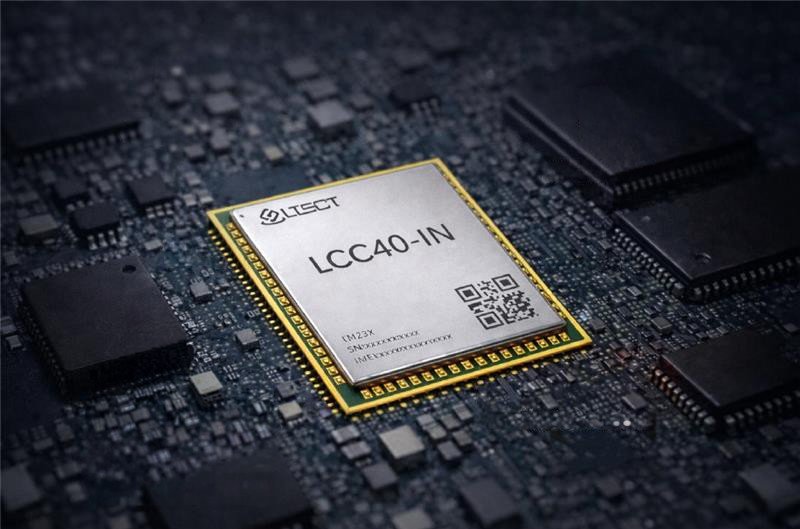
LTSCT’s LCC40-IN cellular IoT module, one of the company’s India-designed products. (Image: L&T Semiconductor Technologies)
The two milestones that matter
The first is LTSCT’s debut silicon carbide platform, a high-performance 1200V SiC MOSFET line built for next-generation power conversion. The company says it is designed for EV fast chargers, microgrids, solid-state transformers and traction inverters, where efficiency and performance matter more each year — and it showed its first in-house SiC power modules and devices alongside it. Silicon carbide switches faster and wastes less energy than the silicon it replaces, which is exactly what high-voltage power systems need.
The second is the tape-out of a highly integrated BLDC motor controller, a chip the company says was designed entirely in India — and which it calls an industry-first fully integrated single-chip BLDC fan motor controller. Its advanced protection features can support longer product warranties, and its flexible architecture lets one platform serve several models, cutting bill-of-materials costs and supporting India’s shift to energy-efficient BLDC ceiling fans.
Forty products, four portfolios
The forty products span four portfolios. The Power line-up runs from MOSFETs, diodes and bridge rectifiers to the new SiC modules. The Compute portfolio includes an indigenous Vision Camera SoC that combines advanced image processing with on-device AI acceleration — the company says it pairs a RISC-V dual-core CPU with a dedicated neural processor, advanced image signal processing and high-efficiency video encoding, supporting up to 8MP at 30 frames per second for object detection, classification and tracking at the edge — alongside a Secure Identity Platform for e-passports, payment cards and national ID systems, with hardware-rooted security and cryptographic acceleration. The Analog & Mixed Signal showcase includes the integrated BLDC controller and an in-house designed USB-C GaN charger. And the Connectivity & RF portfolio offers four indigenously designed modules for smart metering, automotive applications and digital payments, including the LCC43 Dynamic QR and a Soundbox proof of concept for NPCI’s proposed Trusted Device Layer. The LCC40 IoT module at the heart of the connectivity story supports LTE Cat 1 bis, with data rates of up to 10 Mbps downlink and 5 Mbps uplink, built for low-power connected devices.
More Read

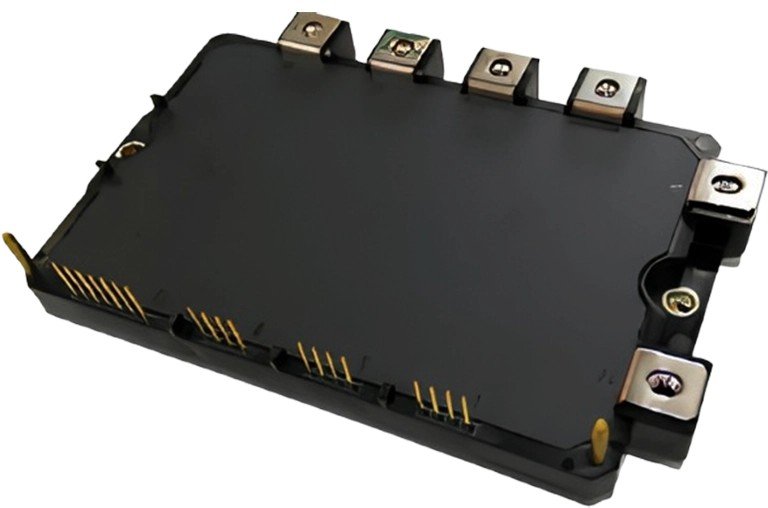
One of LTSCT’s in-house power semiconductor modules. (Image: L&T Semiconductor Technologies)
From design to the factory floor
Designing chips is only half the story, and LTSCT used the same week to close the loop on manufacturing. On 18 September 2026 the company announced a strategic partnership with Tata Electronics to expand indigenous manufacturing of market-leading chip products in India for global customers, pairing LTSCT’s fabless design innovation with Tata Electronics’ semiconductor packaging and foundry capabilities. The two companies will jointly explore chip fabrication and packaging across Tata Electronics’ fab process technologies, with design-to-fabrication optimisations aimed at efficient manufacturing at scale, for next-generation products across automotive, industrial, communications, security and intelligent-edge sectors. “Semiconductor leadership will increasingly be defined not only by design breakthroughs but also by the ability to industrialise those designs through advanced packaging and manufacturing,” said Dr Sandeep Kumar, Chief Executive of LTSCT. Dr Randhir Thakur, CEO & MD of Tata Electronics, said Tata Electronics is establishing world-class semiconductor manufacturing capabilities in India to provide trusted, high-quality solutions across the value chain.
The same week brought partnerships with four organisations across key sectors, including Virtual Forest, collaborating on indigenous SiC power module solutions for high-voltage direct-current transmission, and Newen Systems, developing SiC power modules for next-generation renewable energy systems. And the Vision SoC already has volume behind it: CP PLUS will manufacture nine million CCTV IP cameras over three years powered by LTSCT’s indigenously designed Vision System-on-Chip technology.
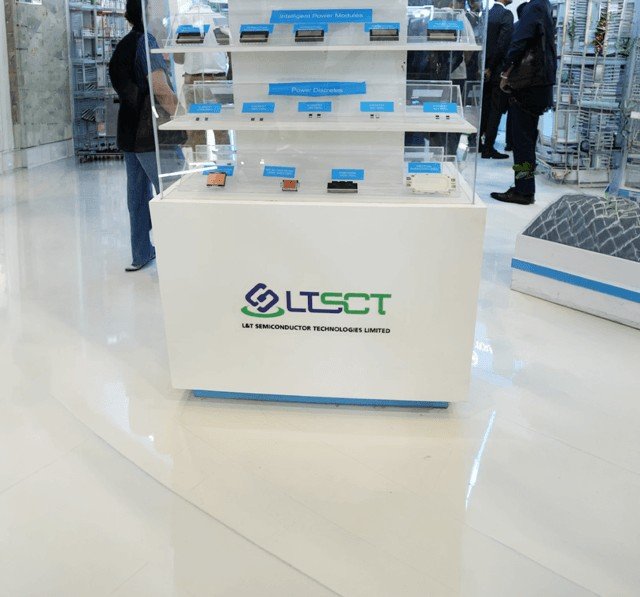
LTSCT’s product showcase at SEMICON India 2026 in New Delhi. (Photo: DataBizTimes)
Three years from a blank page
LTSCT was formed in November 2023 as a wholly-owned subsidiary of Larsen & Toubro, launched with an ₹830 crore capital outlay for fabless chip design and more than $300 million committed overall, including $100 million for research and development. The company, led by Chief Executive Dr Sandeep Kumar, designs its chips in India and outsources manufacturing, and it has spent its first three years building the partnerships a fabless company needs to scale: an IBM alliance on advanced processor designs, a place in imec’s Automotive Chiplet Program, advanced power design work with Synopsys, a RISC-V IP licensing agreement with Andes Technology, a secure chip with a smart operating system for digital identities built with C-DAC and IIT Gandhinagar, and the acquisition of the power module design assets of Fujitsu General Electronics of Japan. The company describes itself as India’s largest semiconductor product company, and it is targeting $500 million in revenue by FY31.
From megastructures to microchips, the engineering house that built India’s biggest infrastructure is now building the silicon that will run its EVs, its grids, its cameras and its connected devices. “We firmly believe that India’s next growth chapter will be driven as much by digital technologies as by megastructures,” Dr Sandeep Kumar said at SEMICON India 2026. “LTSCT is how we back that belief with investment, engineering talent and long-term commitment.” Forty products in, that belief has silicon behind it.
Keep reading: Every Pothole, Mapped: Inside HanuAI, the Delhi Startup Teaching AI to Read India’s Roads · Twelve Languages, One Voice: Inside Navana.ai’s Bodhi, the Speech AI Built for Real India · More Industrial Automation & Technology stories
Like stories like this? Add Exceptional Technology as a preferred source on Google to see more of our reporting in your search results and Discover feed.







