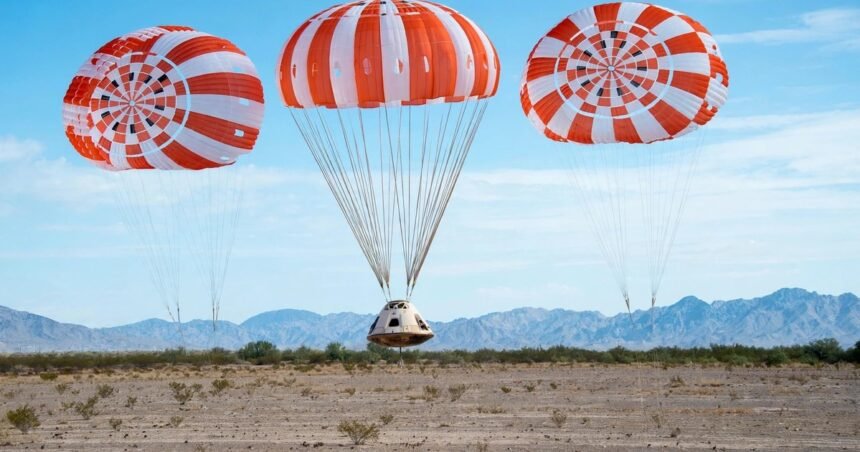
Image credit: Exceptional Technology — AI-generated illustrative scene for Kusumgar’s space-module recovery parachutes, based on the company’s official product photograph.
When India’s first astronauts return from orbit aboard Gaganyaan, the final minutes of their journey will depend on fabric. Three great canopies will bloom above the crew module, slow it from a hurtling fall to a gentle descent, and set it down safely. The fabric in those canopies is woven in India, by a company that has spent more than five decades learning how to make cloth do things cloth was never supposed to do. That company is Kusumgar, and in October 2026 it signed its way into the global aerospace supply chain with a long-term supply agreement with Safran, one of the world’s great aerospace groups.

Fifty-five years of fabric that refuses to fail
Kusumgar Corporates began in Mumbai in 1970, when founder Yogesh Kantilal Kusumgar saw a future in textiles that had nothing to do with clothes. He started with synthetic filter fabrics, at a time when technical textiles were barely a field in India, and built from there into one of the country’s most specialised manufacturers. Today the company runs three integrated facilities in Gujarat that take yarn through weaving, dyeing, coating, finishing and lamination, turning out fabrics from feather-light 20 gsm to heavy-duty 1,000 gsm.
It is the only technical-textile manufacturer in India to have received the Government of India’s National Award for Indigenisation, recognising its work on nuclear, biological and chemical warfare clothing and on zero-porosity fabrics for parachutes — cloth so tightly woven that air simply cannot pass through it. The company says it holds close to the entire Indian market for parachute and ballistic fabrics, supplying customers including the Ordnance Parachute Factory in Kanpur. Its work spans four verticals — defence, industrial, outdoor and speciality — from parachute fabrics and bullet-proof vest components to geosynthetics, filtration fabrics and inflatables.
The parachutes behind Gaganyaan
The leap from fabric supplier to parachute maker came through a transfer of technology from India’s Ministry of Defence. In 2019 Kusumgar received the technology to manufacture parachutes for the Indian Army, and in February 2020 it acquired the DRDO technology for the Combat Free Fall parachute system — a system designed for jumps from up to 30,000 feet, gliding as far as thirty kilometres to the target. The first commercial project under that transfer of technology is the manufacture of parachutes for ISRO’s Gaganyaan human spaceflight programme.
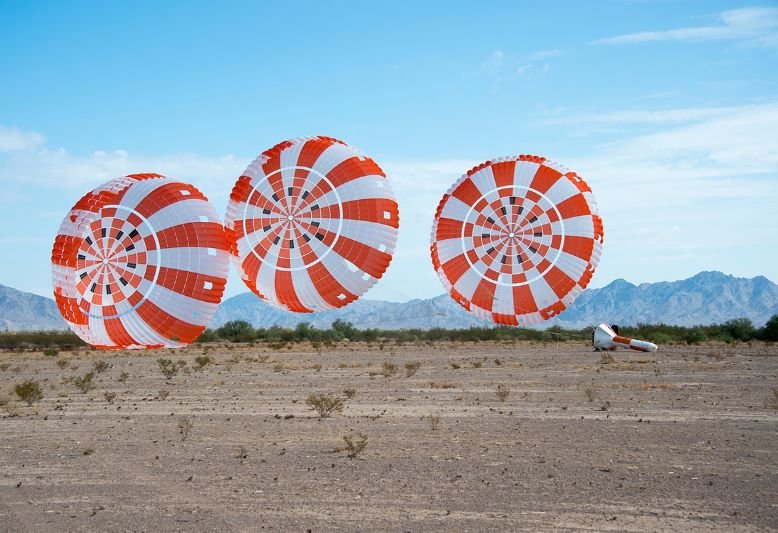
The company’s aerospace portfolio now covers cargo-drop parachutes, tactical assault parachute systems, high-altitude penetrator parachutes, drogue and recovery parachutes, and space-module recovery parachutes, alongside balloon and aerostat fabrics. Every one of them is a piece of engineering in which the fabric itself is the safety system: it must open exactly when asked, hold its shape under violent load, and bring its cargo down gently, every single time.
More Read

From Mumbai to the world’s aerospace supply chain
October 2026 brought Kusumgar’s biggest international validation yet. The company signed a long-term supply agreement with Safran, the French aerospace major, around Safran’s second Supplier Conference India in Bengaluru on 8 October 2026 — an event at which Safran signed fifteen contracts and memoranda of understanding with Indian suppliers. The agreement supports Safran’s supply chain and ongoing production programmes, and deepens Kusumgar’s participation in one of the most demanding supply chains on Earth.
Weeks later, on 21 October 2026, Kusumgar signed a memorandum of understanding with Airbotix Technology to produce aerostat envelopes in India and cooperate on lighter-than-air vehicles for the Indian Armed Forces and other customers — the fabric balloon that carries a surveillance payload, built by the same hands that weave parachutes.
The scale behind the story is considerable. Kusumgar employs more than 1,000 people and produces over five million metres of technical fabrics a month, holding aerospace quality certification AS 9100D alongside ISO 9001:2015 and ISO/IEC 17025:2017. In July 2026 the company listed on the Indian stock exchanges, and its partnerships include a joint venture with Japan’s Toray for advanced textiles. From filter cloth in 1970 to the canopies that will carry Indian astronauts home, Kusumgar has spent fifty-five years proving that the most extraordinary engineering can begin with a thread.
Keep reading: The Copper Inside Every Transformer: Inside Rational Engineers, the Thane Company Winding India’s Power Grid · Cut to a Micron: Inside TASE Global, the Chennai Factory Machining Parts for Boeing, Dassault and Roche · More Manufacturing & Engineering stories
Like stories like this? Add Exceptional Technology as a preferred source on Google to see more of our reporting in your search results and Discover feed.