


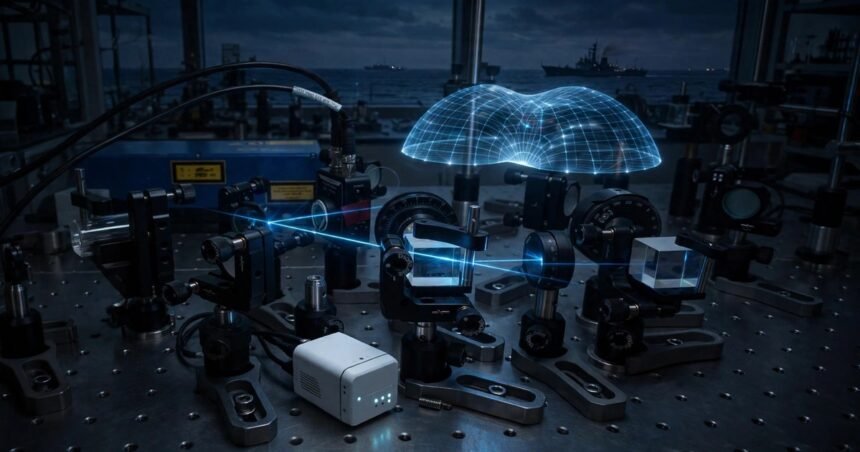
Far below the surface of the ocean, a submarine is running silent — and blind. There is no GPS down there. Radio waves cannot reach through seawater, and satellite signals stop at the surface. For a navy that must move undetected, losing position is not an inconvenience; it is the mission failing. A Hyderabad startup called QuBeats has built its answer to that problem not in orbit, but in the Earth itself: a quantum sensor that reads the planet’s magnetic fingerprint and turns it into a map.
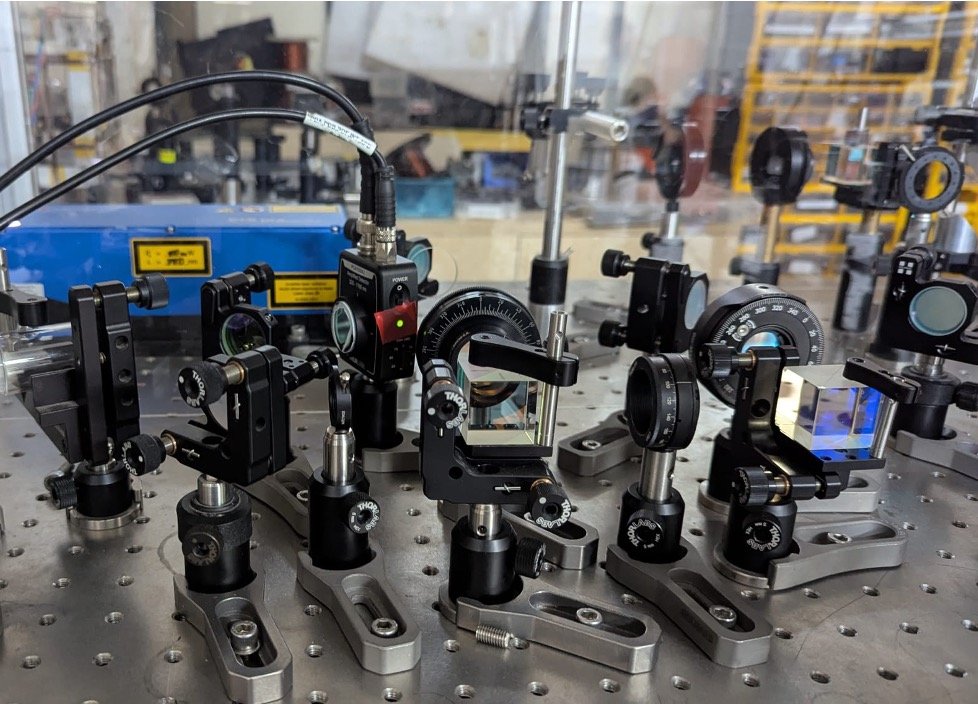
QuBeats’ precision optics assembly in its Hyderabad laboratory. (Image: QuBeats)
Reading Earth’s magnetic fingerprint
Every patch of the Earth’s crust carries its own magnetic signature — tiny variations in the planet’s magnetic field, shaped by the rocks below. QuBeats’ quantum magnetometers detect those variations with extraordinary sensitivity, down to the femtotesla scale, using laser-polarised atoms in a vapour cell. The company’s Cyclops-Q system compares the live readings against pre-loaded magnetic reference maps and fixes the vehicle’s position in real time, with no satellite signal involved at all. The sensors are compact — the company describes them as coffee-bean-sized — and they work day and night, underwater, underground and in zero visibility, because they listen to magnetism, not light.
That is the heart of the Quantum Positioning System the company is building for the Indian Navy: navigation that keeps working precisely when GPS is jammed, spoofed or simply absent. In June 2025 QuBeats won the Defence Ministry’s iDEX ADITI 2.0 Defence Challenge to build the system, with a grant of Rs 25 crore — one of the first serious Indian efforts to put quantum navigation into service.
A full quantum sensing stack
QuBeats is not building a single sensor. Its catalogue runs across the whole quantum sensing stack: the QB-OPM-S scalar magnetometer and QB-OPM-V three-axis vector magnetometer for magnetic map-matching navigation, the QB-OptiTime optical atomic clock for timing that holds steady when satellite time disappears, and the QB-Spectrum Rydberg atom-based RF receiver, which passively detects radio signals from megahertz to terahertz frequencies without a conventional antenna. The company’s Trinetra mission software fuses those sensors into one navigation picture, with auto-calibration and anomaly tagging across a fleet.
More Read

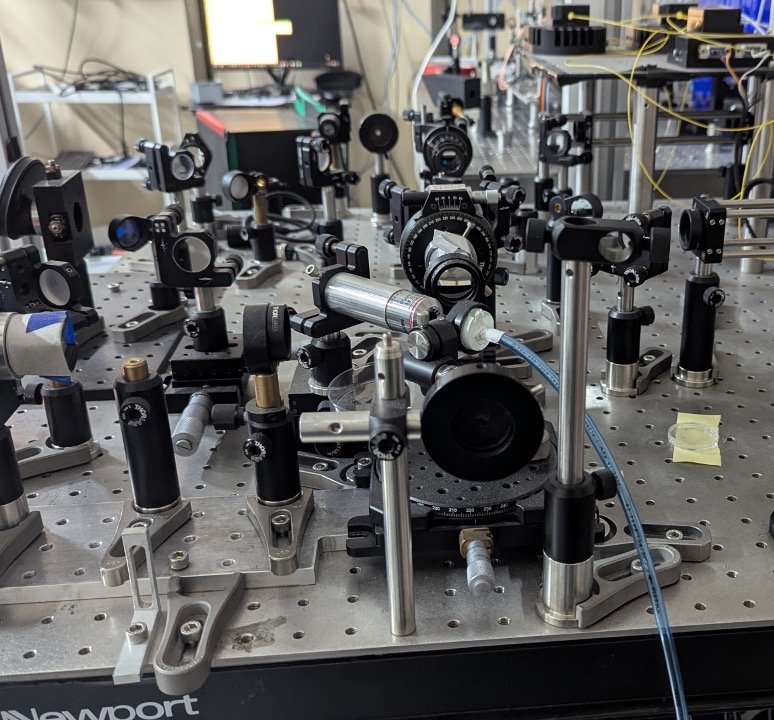
QuBeats’ Rydberg experiment setup. (Image: QuBeats)
The same physics reaches far beyond warships. The company says its sensors serve mineral exploration and subsurface mapping, maritime anomaly detection, structural health monitoring, and even brain and cardiac mapping, where the same ultrasensitive magnetometers can pick up the magnetic whisper of firing neurons.
From a Rs 25 crore grant to a $15 million raise
The momentum behind QuBeats has gathered fast. In April 2026 the startup joined the National Quantum Mission’s startup cohort, and on 27 April 2026 it announced a $15 million first institutional round backed by Zoho Corporation, IndusBridge Ventures and the National Quantum Mission itself. In June 2026, the Council of Scientific and Industrial Research formally transferred its Rydberg-systems broadband e-field sensing technology from the National Physical Laboratory to QuBeats’ legal entity, Nostradamus Technologies. And in October 2025 the company signed an agreement with Chennai drone maker Zuppa Geo Navigation Technologies to put quantum-assured navigation onto Zuppa’s unmanned aircraft.
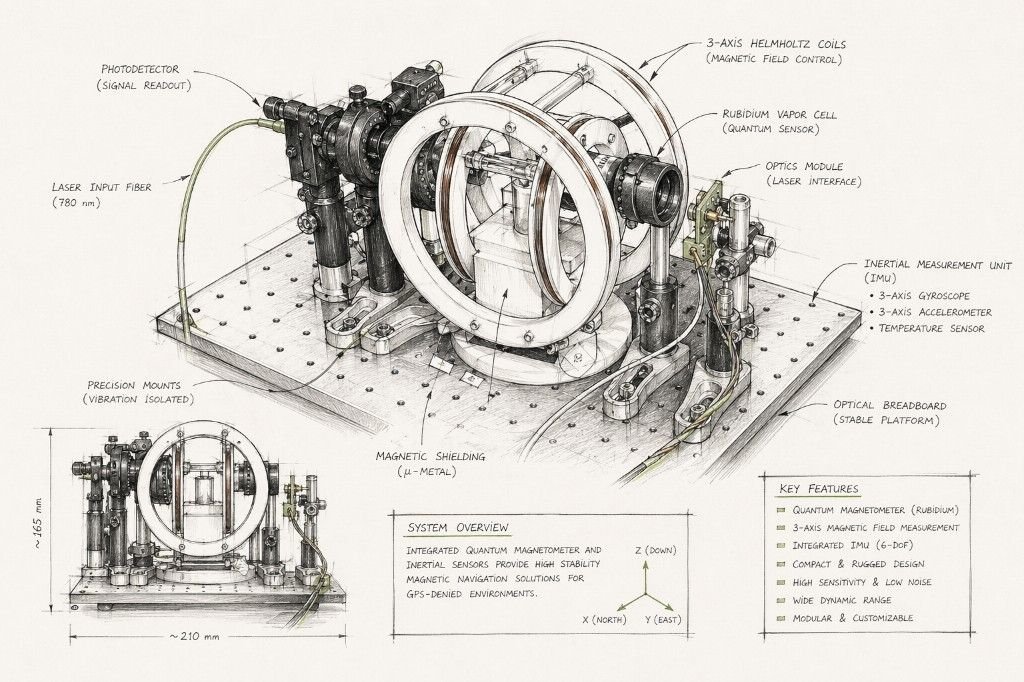
QuBeats’ quantum magnetometer navigation system. (Image: QuBeats)
The physicists behind it
QuBeats was founded in 2023 by four researchers who came home from some of the world’s top quantum labs: Mallikarjun Karra, a PhD researcher at the Max Planck Society; Madhu Trivikram Talluri, a postdoctoral researcher at Lawrence Berkeley Lab; Shouvik Mukherjee, a postdoc at the Joint Quantum Institute at the University of Maryland; and Rajat Sethi, a graduate of MIT, Harvard and IIT Kharagpur. The team works from T-Hub in Hyderabad and a research lab at the University of Hyderabad, with a second research lab at the Quantum Startup Foundry at the University of Maryland — a bridge between Indian engineering and the global frontier of quantum science.
For India, the prize is sovereign navigation: the ability for its Navy, its aircraft and its drones to know exactly where they are even when an adversary is trying to blind them. QuBeats is building that ability atom by atom, in a laboratory in Hyderabad, with sensors small enough to hold between two fingers and sensitive enough to hear the Earth itself.
Keep reading: The Plane That Never Lands: Inside Alteon, the Bengaluru Startup Teaching Aircraft to Fly on Wind Alone · The Jet Drone That Hunts in Swarms: Inside VEDA Aeronautics’ Sureshastra, the Loitering Munition the IAF Ordered Twice · More Aerospace & Defense stories
Like stories like this? Add Exceptional Technology as a preferred source on Google to see more of our reporting in your search results and Discover feed.







