A jet-powered drone that needs no runway, hunts in packs of more than twenty, and keeps flying even when GPS goes dark. That is the Sureshastra Mk1, and it has quietly become one of the Indian Air Force’s most important new weapons. The Delhi startup behind it, VEDA Aeronautics, won a &rupee;300-crore order for 200 of them in 2023 — reported at the time as the largest order any Indian startup had received from the government for unmanned systems — and in early 2026 the Air Force came back for more, ordering an upgraded 300-kilometre version under a second &rupee;300-crore contract.
VEDA Aeronautics was founded in 2020 by Dipesh Gupta and Shagun Gupta, and it has built its whole identity around one idea: India should be able to design, build and field its own high-speed unmanned strike aircraft, without depending on anyone else’s engines, airframes or electronics. The Sureshastra is the proof of that idea, and the order book behind it keeps growing.
The drone that hunts in packs
The Sureshastra Mk1 — short for Smart Unmanned Munitions System, or S-UMS — is a jet-powered, fixed-wing aircraft with a low-observable V-tail, built for long-range precision strike. It measures about 3.5 metres long with a 3-metre wingspan, weighs around 90 kilograms fully loaded, and carries a 30- to 40-kilogram warhead at cruising speeds of 350 to 400 kilometres per hour. It launches from a rail or catapult, so it needs no airbase at all.
What makes it different is the swarm. More than 20 Sureshastras can coordinate in a single mission, exchanging targeting data in real time and striking together in a way designed to saturate and overwhelm enemy air defences. The aircraft navigates by satellite and by its own AI-enabled systems, and it can keep flying its mission in GPS-denied environments, where hostile jamming has switched satellite guidance off. The same airframe can be reconfigured for intelligence, surveillance and reconnaissance, for electronic warfare, or as a decoy that draws out enemy air defences before the strike arrives.
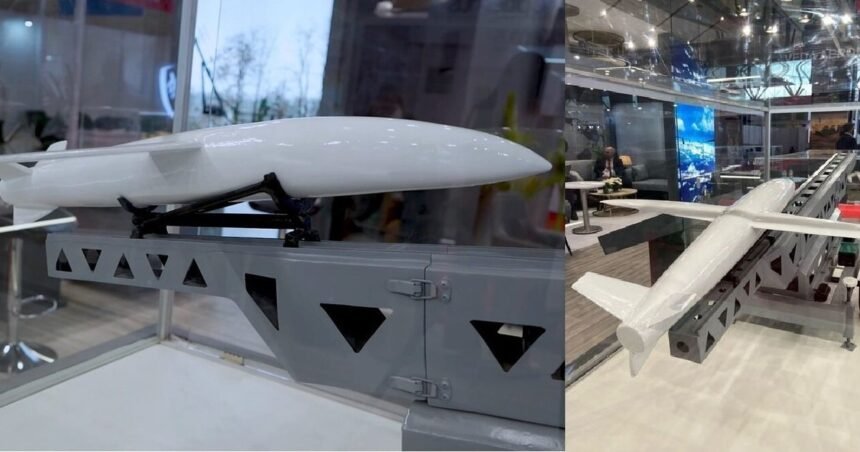
The Sureshastra Mk1 on its catapult launcher. (Image: The Defense News)
More Read

From a competition to a contract
The Sureshastra began life in the Indian Air Force’s Mehar Baba Swarm Drone competition, launched in 2018 to push indigenous development of unmanned combat systems. VEDA developed the platform in close collaboration with the Air Force and put it through extensive user trials in the Thar Desert, testing swarm coordination, strike capability and desert performance, before the contract was awarded in August 2023. Deliveries of the first batch are now under way.
The second order tells the rest of the story. The upgraded Mk1 now in supply flies more than 300 kilometres, double the original’s reach, and was developed in response to user feedback and emerging requirements, the company told Janes in July 2026. The next generation is already flying: the Mk2, with a range beyond 500 kilometres, has begun flight tests, and the company has plans for a longer-range variant that can fly more than 1,500 kilometres. An air-dropped canisterised swarm variant is also in development, designed to be released in canisters of eight or more from heavy transport aircraft such as the C-17 Globemaster III, the C-130J Super Hercules or the Airbus C-295, pushing the strike range beyond 500 kilometres.
The family keeps growing
VEDA is not stopping at one aircraft. The company has unveiled the VEDA Interceptor, an autonomous counter-drone system that destroys hostile drones by hitting them directly, and it is developing APAS, an underwater decoy for the Indian Navy that it plans to evolve into a miniature underwater attack drone. In October 2026 the company put forward SAVITR, its proposal for an airship-based high-altitude pseudo-satellite that would watch over theatres from the stratosphere, building on its partnership with UAE-based Mira Aerospace, whose solar-powered HAPS platform has already flown a technology demonstrator in Indian airspace at around 12 kilometres over the Pokhran test range. In November 2026 the company teased its design for a medium-altitude long-endurance UAV aimed at India’s 87-aircraft MALE drone programme.
The Indian Army has noticed too. When the Defence Acquisition Council approved a &rupee;52,000-crore capital acquisition package in July 2026 that included a jet-based kamikaze drone system for the Army, VEDA confirmed within days that it would bid, and by November it was preparing for the Army’s evaluation trials, with its team photographed at its development centre beside a new jet airframe.

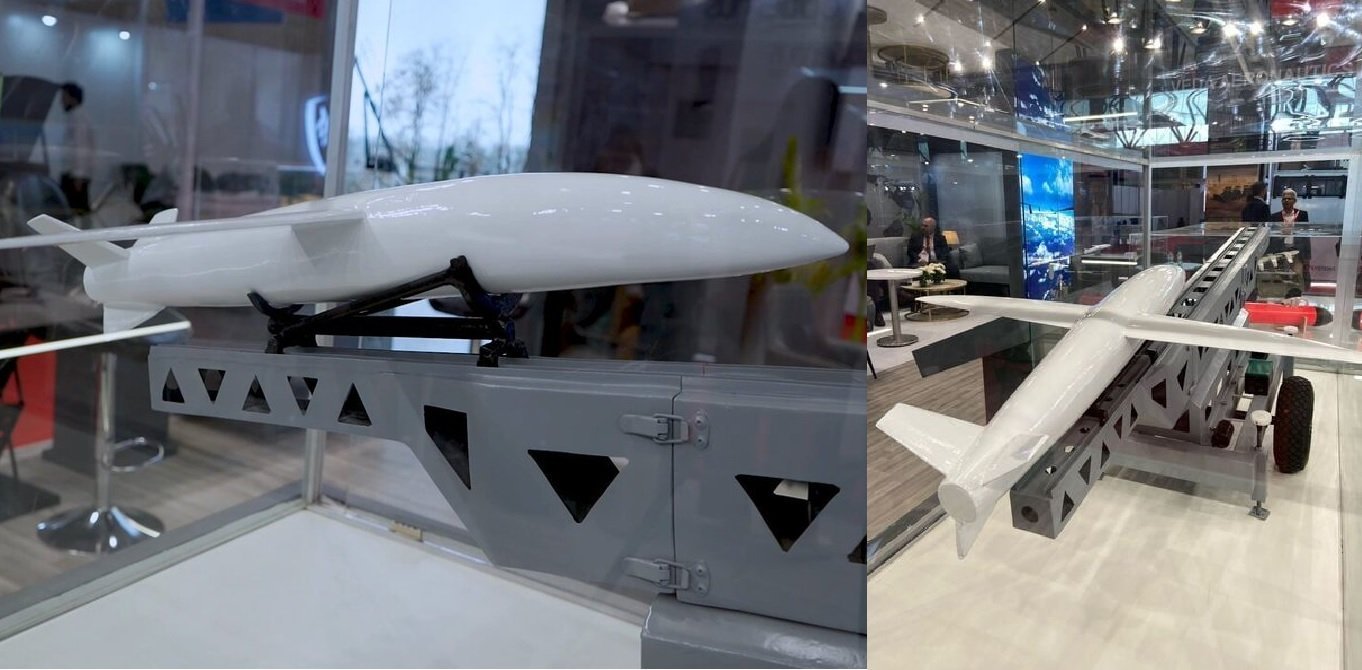
The Sureshastra Mk1 on display. (Image: Chakra Newz)
An Indian supply chain, end to end
Underneath the aircraft is a supply chain the company describes as “zero Chinese, 60% Make in India”. In February 2025, VEDA signed an agreement with Bharat Forge, which now supplies the microjet engines for all of VEDA’s defence projects — its 40 and 45 kgf engines are already in serial production, and engines of up to 400 kgf thrust are in indigenous development. The airframe, the swarm software, the launch systems and the mission electronics are all VEDA’s own work, built with Indian components and domestic small enterprises.
From a 2018 competition entry to two &rupee;300-crore Air Force contracts, a 500-kilometre successor in flight tests, and bids reaching from the Army’s kamikaze-drone programme to stratospheric airships, VEDA Aeronautics has turned a Delhi startup’s drawing board into one of the sharpest edges of India’s indigenous defence arsenal. The Sureshastra is not a prototype waiting for its moment — it is already in the Air Force’s hands, and the orders keep coming.
Keep reading: The Pod That Blinds Enemy Radars: Inside Data Patterns’ TALON SHIELD, the Homegrown Jammer for India’s Su-30MKI Fleet · Listening to the Invisible: Inside ULOOK, the Bengaluru Startup Reading Radio Signals From Orbit · More Aerospace & Defense stories
Like stories like this? Add Exceptional Technology as a preferred source on Google to see more of our reporting in your search results and Discover feed.