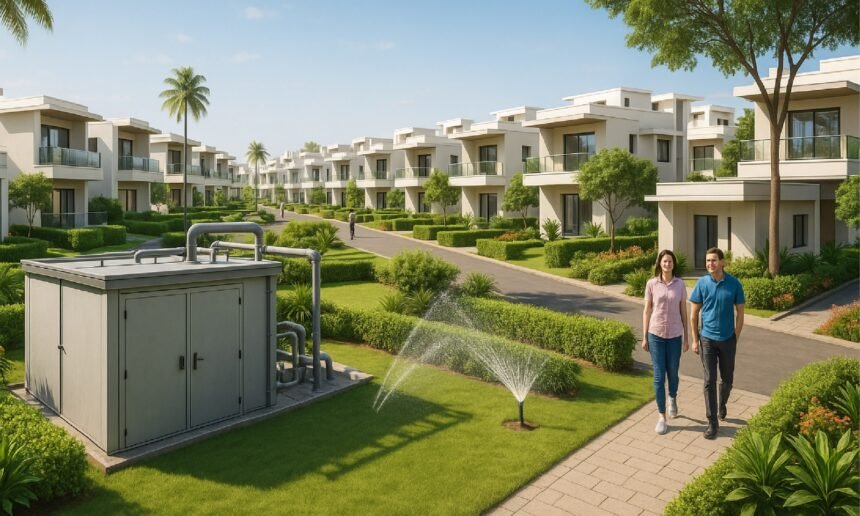
In a villa community on the edge of Bengaluru, the sprinklers that keep the lawns green are running on yesterday’s shower water, kitchen water and laundry water — cleaned, polished and sent back out again by a grey cabinet the size of a wardrobe. Nobody tends it. Nobody hears it. And the water it returns is clean enough to reuse, day after day. That quiet box is the R3H2O, built by Bengaluru startup Tellus Habitat — and more than 60 of them are already running across India, turning the water India throws away into water India can use again.
Tellus Habitat was founded in 2021 by Dr Seema Sukhani, an environmental engineer from the Indian Institute of Science, and Naveen Janardhan, with a team of scientists and researchers drawn from IISc. Their starting point was a simple observation: most of India’s sewage treatment technology was borrowed from the West, where cold water and few microbes make heavy aeration — pumping air into wastewater — the obvious approach. In India’s warmer, microbe-rich water, that same approach wastes enormous amounts of energy. So the team built a system around the microbes already living in the water, instead of fighting them.
The microbe, not the megawatt
At the heart of the R3H2O is a patented anaerobic biofilter. Wastewater passes through several stages: solids are removed, then the water flows through the biofilter, where microbial communities break down the organic load without oxygen, followed by aeration and advanced oxidation from an internal ozone generator. The company says what comes out is ozonated, filtered water, ready for reuse in flushing, gardening and cooling.
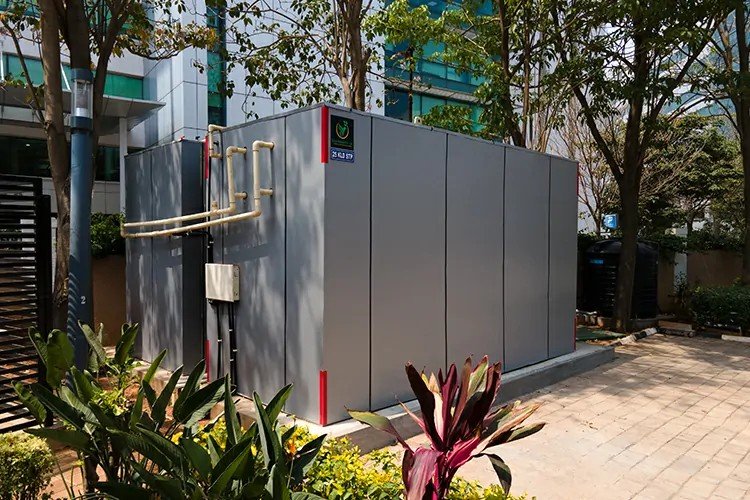
The system runs on a pulse-mode biological process that creates controlled anoxic and oxic conditions, boosting nutrient removal while cutting aeration time, and IoT monitoring keeps watch over every unit. The result, the company says, is treatment that costs under ₹6 per 1,000 litres of recycled water, uses 30 to 50 percent less energy than conventional systems, and cuts operating costs by up to 70 percent. A single unit recovers 97 percent of the water fed into it, and its treated output meets the company’s published specifications of BOD under 10 mg/L and COD under 50 mg/L.
A box that installs in days
Where a conventional sewage treatment plant is a civil construction project, the R3H2O arrives as a pre-engineered, modular unit. The company says a unit can go from delivery to operation in under a week, in capacities from 5,000 litres to 1 lakh litres a day. Once running, it is silent, odour-free and needs no operator on site — a detail that matters enormously in a country where treatment plants so often fall silent the moment their operator walks away.
That reliability shows in the numbers: the company says none of its units has been decommissioned in five years of operation, and each needs only about 18 days of downtime a year. It is the kind of track record that has carried Tellus Habitat from apartments and hotels into industry and government work.
More Read

Sixty units and counting
Today, more than 60 Tellus Habitat units are operating across India, and the company expects to reach around 100 by the end of 2026. Its clients span hospitality, with Radisson and Lotus Sutra among them; residential communities built by Prestige, Century and Concord; industry, including Gokaldas Exports, Lloyd’s and Saint-Gobain; and public health centres. Two major government clients — the Bhubaneswar Municipal Authority and the Bhubaneswar Development Authority — run its systems, and the company has piloted compact blackwater recycling units at public sanitation facilities in Odisha.
The work has drawn support from across India’s innovation ecosystem: the Start-up India Seed Fund, routed through C-CAMP, early mentoring from Forge Innovation & Ventures, grants from the Ministry of Electronics and Information Technology’s TIDE 2.0 programme, and backing from Social Alpha. Tellus Habitat is recognised by the Department for Promotion of Industry and Internal Trade, and its investors include Social Alpha, C-CAMP, Anthill Ventures and Gruhas ASPIRE.
Why it matters
India treats only a fraction of the sewage its cities produce, and every litre that can be cleaned and reused is a litre that does not have to be pumped from a depleting aquifer or a distant reservoir. Tellus Habitat’s bet is that the answer is not a bigger, more power-hungry plant, but a smaller, smarter box that works with India’s own biology — one that a housing society, a hotel or a small town can install in a week and then simply forget about. With 60 units already running and 100 in sight, that bet is quietly paying off, one recycled litre at a time.
Keep reading: The AC That Cleans the Air: Inside Clairco, the Bengaluru Startup Purifying Office Air · The Spray That Stops a Seizure: Inside Biodeal, the Noida Company Behind India’s First Midazolam Nasal Spray · More Chemicals, Materials & Life Sciences stories
Like stories like this? Add Exceptional Technology as a preferred source on Google to see more of our reporting in your search results and Discover feed.