


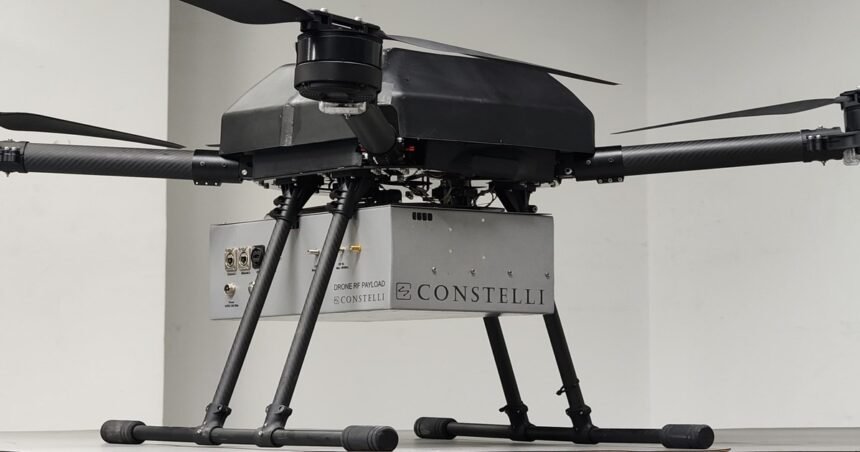
High in the mountains, the most important thing in the sky is often the thing you cannot see. Radar pulses and radio chatter bounce off ridges, hide behind peaks and die in the valleys, and a listening post on the ground can only hear what the terrain lets through. A drone that climbs above the ridgeline, though, can hear everything at once — and that is exactly the idea a Hyderabad startup is now building for the Indian Air Force.
Constelli Signals, founded in November 2017 by Satya Gopal Panigrahi and Avinash Chenreddy, designs the electronic ears of modern warfare: signal-processing systems for radar, electronic warfare, tactical communications and telemetry. The company began as a software-focused team and has since added serious hardware muscle, supplying sub-systems to India’s defence establishment for the past four to five years from its Hyderabad headquarters and its Bengaluru office.
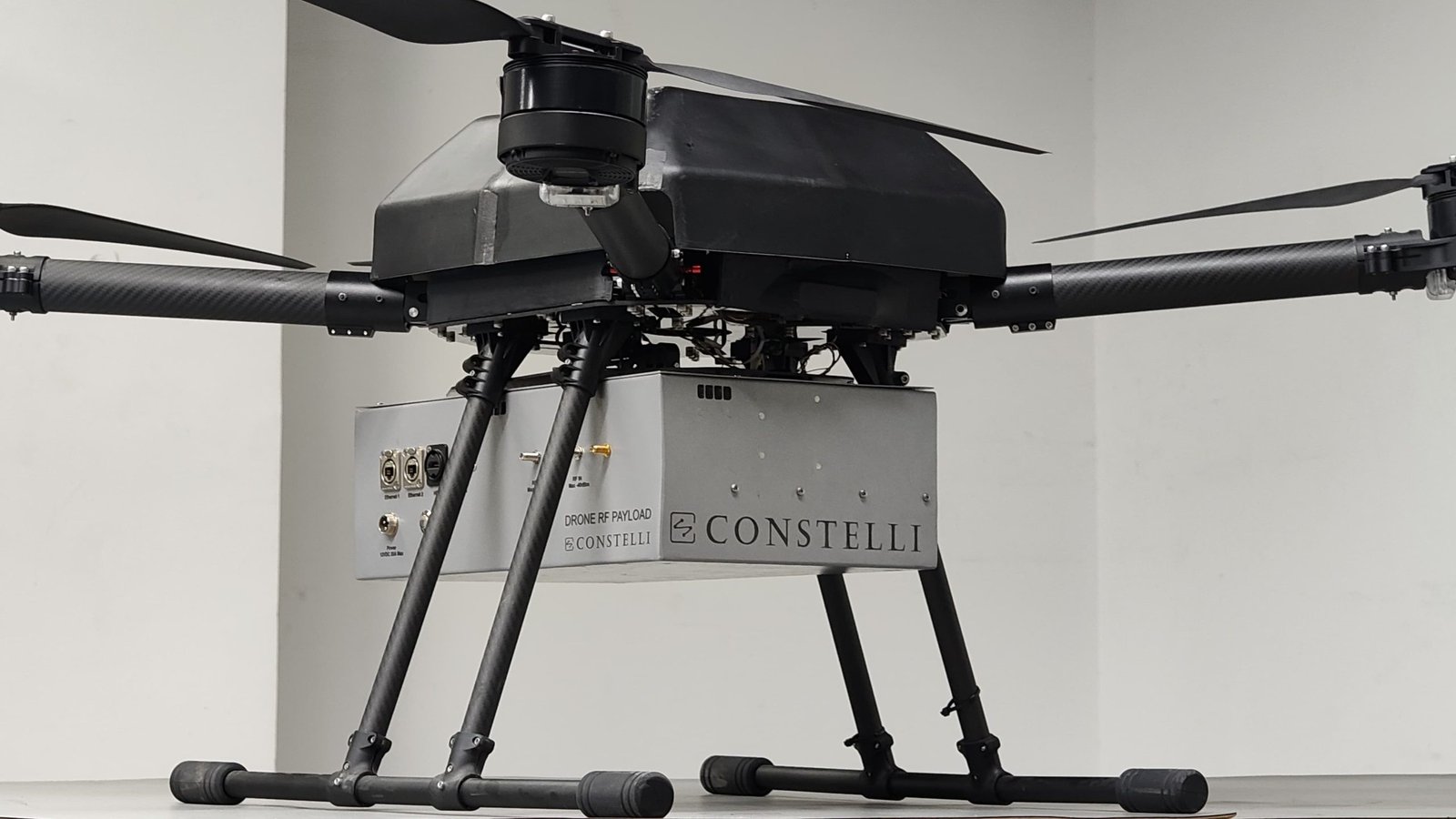
Constelli’s drone RF payload, mounted beneath a multirotor. (Image: Constelli)
The quiet art of listening
Signals intelligence, or SIGINT, is the craft of intercepting and making sense of the electronic signals other people emit — radar transmissions, radio communications, the invisible chatter of a contested sky. Electronic Support Measures, or ESM, is the equipment that does the listening: detecting emitters, working out where they are and what they are doing.
In hilly terrain and at high altitude, that job gets much harder. Ground systems struggle because hills block signals and kill line of sight, and the very places where the Air Force most needs to know what is over the next ridge are the hardest to listen from. A lightweight sensor payload on a drone changes the geometry entirely: it rises above the barriers, watches a wider area and reaches places that are hard to get to on foot or by vehicle.
More Read

That is the system Constelli is now developing under a SPARK grant from the Defence Innovation Organisation. The agreement, signed at the DIO office on 12 November 2026 under the iDEX programme, covers a UAS-based ESM system for SIGINT in hilly terrain and high-altitude areas, with the Indian Air Force’s Maintenance Command as the beneficiary guiding the operational need. SPARK — Support for Prototype and Research Kickstart — helps startups and small firms turn ideas into working prototypes, with funding released against defined milestones.
From simulators to flying hardware
Constelli’s catalogue reads like a tour of the invisible battlefield. Its mission simulators recreate electronic warfare environments in the lab, so radar and EW systems can be tested without burning expensive flight hours. Its ELINT simulators, COMINT simulators, pre-flight message generators and post-mission data analysis tools cover a mission from planning to debrief. Its EW processors chew through raw signal data into real-time threat tracks, and its drone jammers and ELINT receiver processors put that capability into the air.
On the radar side, the company builds target and echo simulators, operator workstations, emulators, ground-penetrating radars and deployable drone payloads. And in telemetry — the science of pulling live data off aircraft and missiles in flight — Constelli says it built India’s first IRIG-standard digital telemetry receiver, with more than 20 of the systems deployed in the field acquiring real-time data from aircraft and missiles.
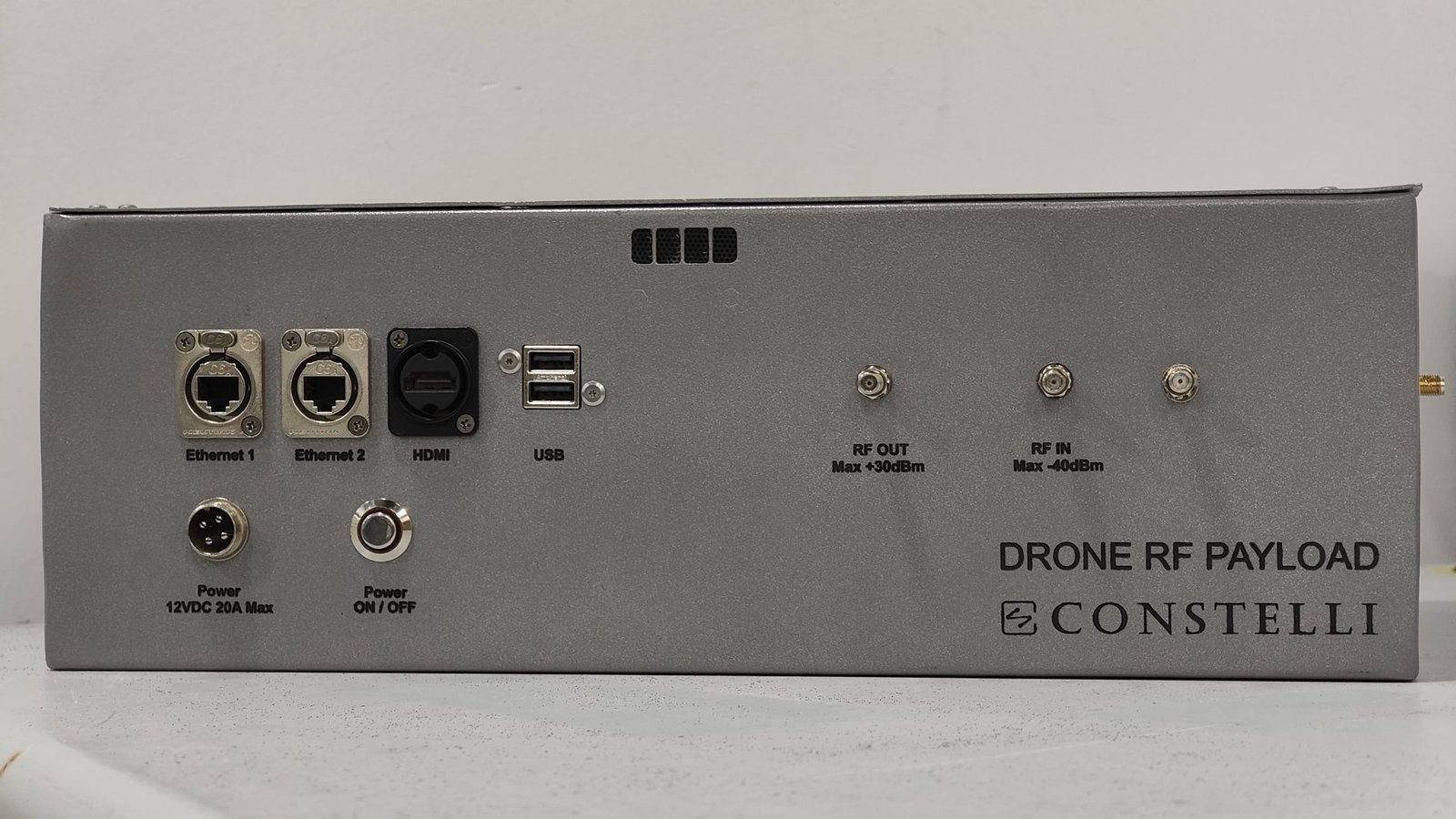
Constelli’s drone RF payload — Ethernet, HDMI, USB and RF in and out in one rugged box. (Image: Constelli)
Small, and built in India
What sets Constelli apart is how much it packs into how little. The company designs both its hardware and its software in-house, with a heavy focus on miniaturisation — the company says that in some categories its prototypes are among the smallest available in the Indian market, benchmarked against international products and comparable in specification.
That compactness is what makes a drone payload possible at all: every gram and every watt matters when the sensor has to fly. The same engineering shows up across the range, from tactical radios and radar subsystems to war-gaming simulators, counter-drone payloads and AI-driven receiver systems.
The customer list tells its own story. Constelli works with the Ministry of Defence, the Defence Research and Development Organisation, the Indian Air Force, Hindustan Aeronautics and Bharat Electronics — and it has been selling beyond India too, with defence customers in South Korea, Australia and Singapore.
The backing behind the build
In February 2026, Constelli raised about $20 million — roughly ₹180 crore — in a round led by General Catalyst, with 360 One Asset Management and existing investor Pravega Ventures joining in. The company says the capital is going into research and development for next-generation electronic warfare and communication payloads across drones, ground systems, naval vessels and satellites, along with infrastructure for rapid prototyping and early-stage production to get field-ready systems out faster.
The new iDEX grant fits that same direction perfectly. It gives Constelli a clear defence user, a sharp operational problem — listening over the Himalayas — and a structured path from prototype to field. For the Air Force, it offers a home-grown option built by a team that already supplies the country’s most sensitive programmes.
India has long imported the high-end systems that watch the electromagnetic spectrum. Constelli is part of the small group of Indian companies now designing and building those systems at home — simulators, receivers, jammers and now a listening drone that can climb above the mountains and hear what the ground cannot.
Keep reading: The Rocket Engine That Lights Itself: Inside Thrustworks Dynetics’ Resonance Ignition · One Launcher, Every Rocket: Inside NIBE’s SuryaAstra, India’s First Universal Rocket Launcher · More Aerospace & Defense stories
Like stories like this? Add Exceptional Technology as a preferred source on Google to see more of our reporting in your search results and Discover feed.







