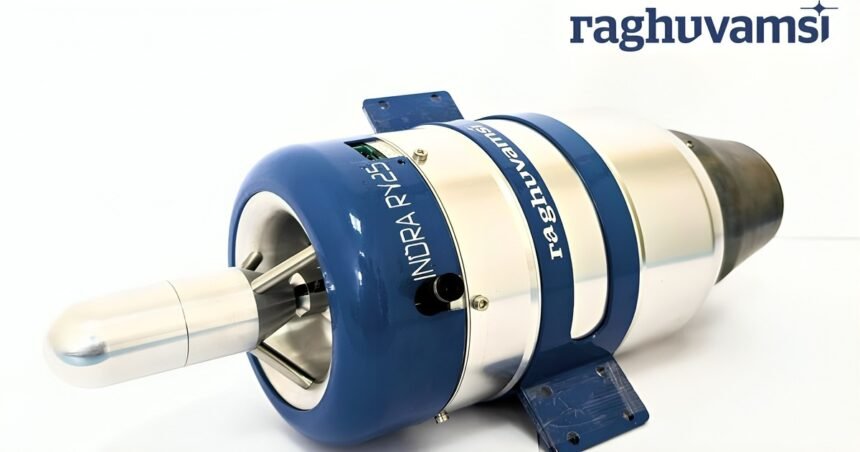
A jet engine you can lift with two hands sounds like a model-maker’s toy — until you learn what it is for. In Hyderabad, Raghu Vamsi Aerospace Group builds micro turbojets small enough to fit in a backpack, yet powerful enough to push a combat drone past 600 kilometres an hour. The engines are designed, developed and manufactured entirely in India, and the company says they are the first fully indigenous micro turbojets the country has produced.
The group is no overnight startup. Its roots go back to 1992, when G. Thrimurthulu began building the precision-engineering business that would become Raghu Vamsi — a group that today employs more than 1,000 people across 10 manufacturing locations in India, the United States and the United Kingdom, supplies aero-engine and missile subsystems to global aerospace leaders including GE Aerospace, Collins Aerospace, Honeywell, Safran, Boeing and Rolls-Royce, and counts ISRO and DRDO among its customers.
Four engines, one idea
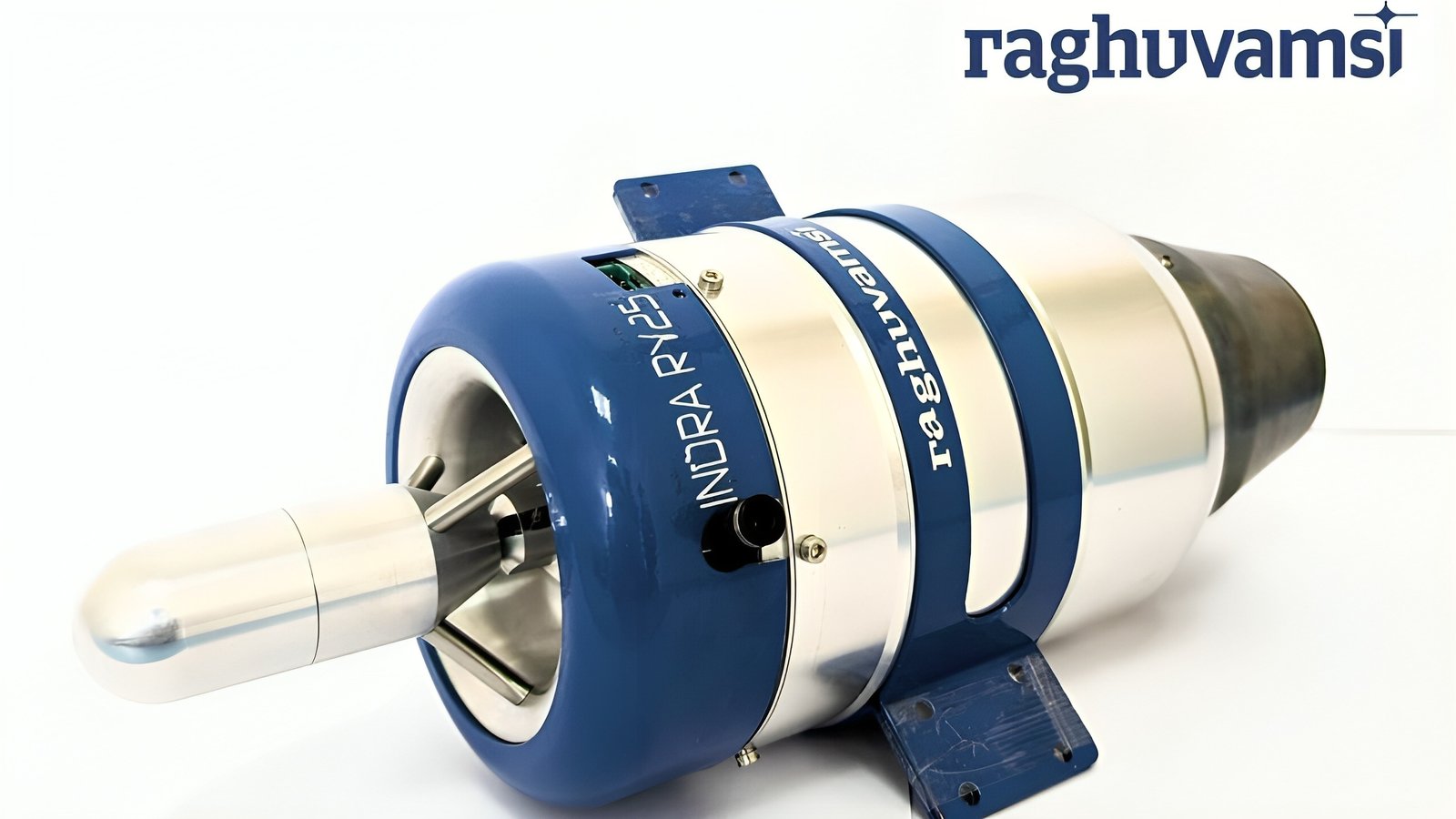
The heart of the story is the Indra family of micro turbojets. The company has built four variants, producing 14, 19, 25 and 40 kilograms of thrust, all designed and manufactured in India. The RV25 is a 240-newton engine, and the most powerful of the family, the 40 kgf Indra, was unveiled at the 55th Paris Air Show in June 2025 after being tested at the company’s Hyderabad facility in the presence of DRDO officials. The engines are built for unmanned aircraft and cruise missiles — the small, fast, expendable flying machines that modern air power increasingly depends on.
That matters because small jet engines have long been one of the hardest things for India to buy, let alone build. Most drone makers around the world still import them. Raghu Vamsi decided to make its own — and then to build the aircraft around them.
From engines to whole aircraft
The most striking of those aircraft is the Astra 100, a jet-powered, fixed-wing kamikaze UAV developed under the group’s deep-tech brand, ARROBOT. The company says it flies 200 kilometres at speeds of up to 450 kilometres an hour, and that it completed successful test trials before its Paris debut. Its flight control, propulsion and telemetry are all indigenous, the company says — the whole aircraft, not just the engine, is Indian.
ARROBOT’s range runs far wider than one aircraft. At Wings India 2026 in Hyderabad, the brand showcased jet-powered, electric and IC-engine drones, including the RV Rudra — a hybrid that uses electric propulsion for vertical take-off and landing and an IC engine for forward flight — and a ground vehicle of the same name, an autonomous UGV that carries payloads of up to 2.5 tonnes and navigates between designated points on its own. The lineup also includes autonomous mobile robots that haul up to four tonnes around factories, and autonomous aircraft tugs and heli-tugs that taxi aircraft and helicopters without a driver. The company’s jet-powered drones, it says, fly above 6,000 metres, exceed 600 kilometres an hour and carry payloads of more than 20 kilograms — and its products are around 90% indigenous, built in-house with more than 200 CNC machines behind them.
More Read

The Citadel Campus
In December 2025, the group raised the stakes again with the Citadel Campus, a new deep-tech design, production and integration facility at Hardware Park near Hyderabad International Airport, backed by an investment of more than Rs 100 crore. Alongside the campus, it unveiled six indigenous UAV and autonomous defence products — the RV Astra, RV Maya, RV Lakshya, RV Rudra, RV Indra, RV Yodha and RV Drishti — spanning jet-powered loitering munitions, decoy and target drones, tethered surveillance, air-launched missile systems, unmanned ground vehicles and robotic aircraft maintenance. The company says the new platforms fly beyond 300 kilometres at speeds of up to 650 kilometres an hour.
The campus also came with four partnerships that show how seriously India’s defence establishment is taking the work: a memorandum of understanding with the Indian Army’s 515 Army Base Workshop to co-design, test and validate drone platforms; one with Bharat Dynamics Limited to co-develop and supply fully indigenised 200 kgf thrust-class engines for next-generation autonomous fighter-aircraft platforms; one with IIIT Hyderabad on AI-based autonomy, perception and swarm intelligence; and one with ARCI on laser cladding, additive manufacturing and thermal barrier coatings for aero engines.
“This investment is about more than building capacity; it is about building core defence technologies in India,” said Vamsi Vikas, the group’s founder and managing director. “We are developing systems that are globally benchmarked and engineered for the next era of warfare, utilising homegrown talent.”
Three decades of precision, now going global
The group has been buying as well as building. It acquired WMT Precision LLC, a 40-year-old aerospace manufacturer in Syracuse in the United States, for $8.5 million, and earlier acquired the UK’s PMC Group — moves that put Indian-owned precision manufacturing on three continents. And it is still expanding at home: the company says a Rs 300 crore manufacturing complex at Hardware Park, spanning eight acres with three buildings totalling 2.5 lakh square feet, was targeted for inauguration by November 2026.
India spent decades importing the small engines that power its drones and missiles. In Hyderabad, Raghu Vamsi is building them at home — and the aircraft, the robots and the factories around them too.
Keep reading: Listening to the World From Orbit: Inside Kawa Space, the Mumbai Company Mapping Radio Signals From Space · Sixty-Four Shots, One Swarm: Inside Bhargavastra, the Nagpur System Built to Stop Drone Attacks · More Aerospace & Defense stories
Like stories like this? Add Exceptional Technology as a preferred source on Google to see more of our reporting in your search results and Discover feed.