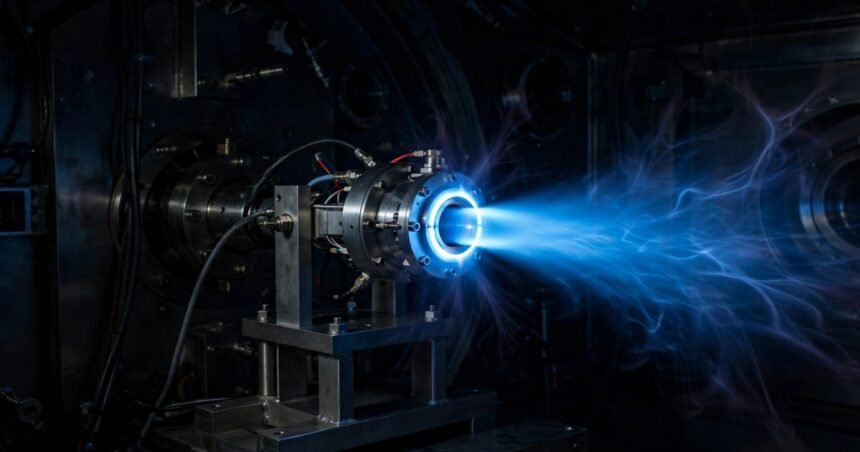
Most small satellites arrive in orbit as passengers. A rocket drops them off, and from then on they mostly drift where they were left — unable to change their orbit, dodge debris, or hold formation with their neighbours. A Hyderabad startup called Kaara Space is building the engine that changes that. Its answer is Hall-E, a compact electric thruster that runs on argon and gives a 200–500 kg satellite the power to steer itself.
Fifteen millinewtons that change the mission
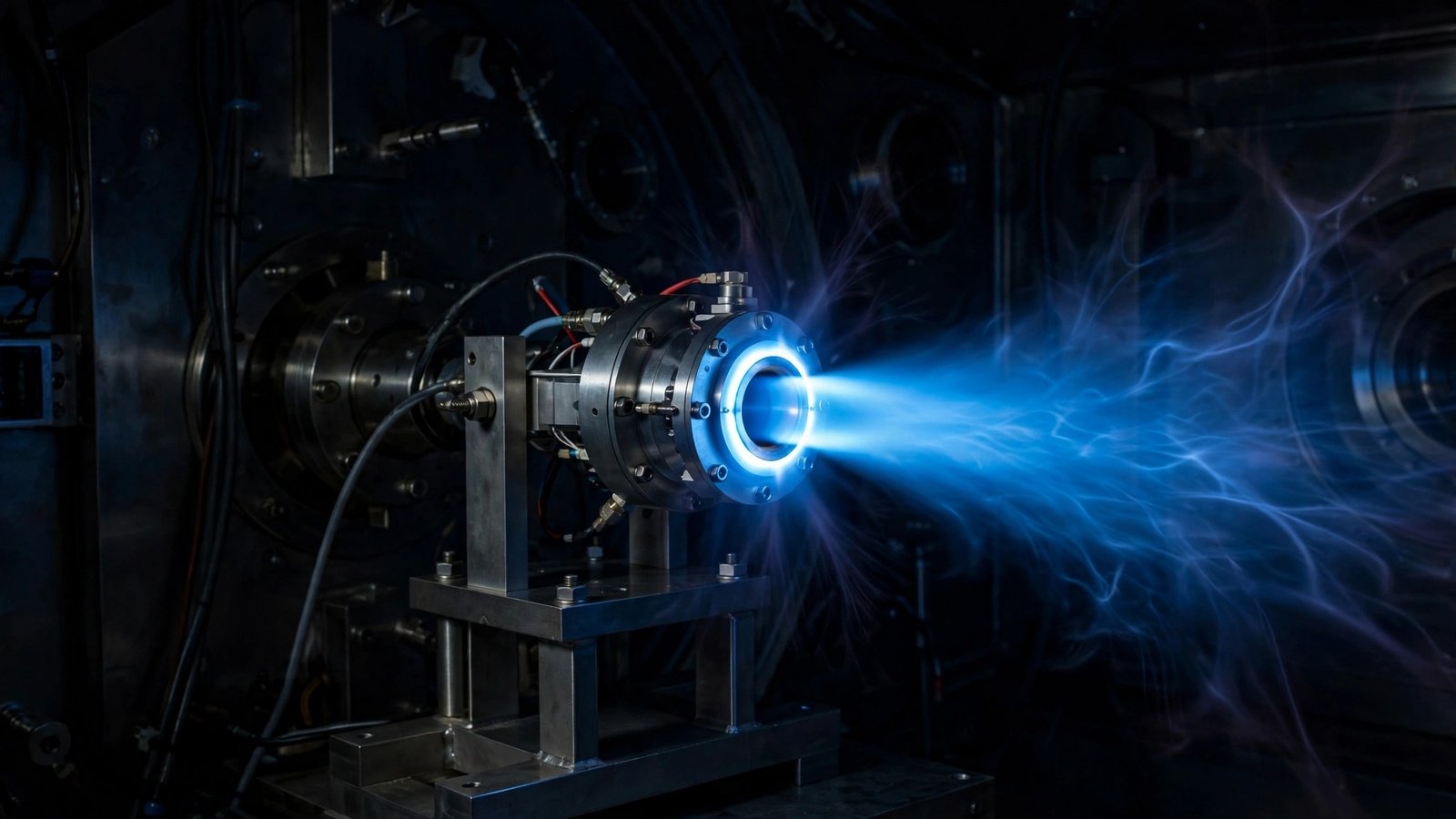
Hall-E is a Hall-effect thruster — a form of electric propulsion. Instead of burning fuel, it uses electrical energy to ionise a propellant gas and accelerate it out of the thruster: an electric field drives the ions forward while a magnetic field traps electrons to keep the gas ionised, and the exhaust produces thrust. The thrust is small — the company says Hall-E is designed to produce 15 millinewtons — but electric propulsion uses propellant far more efficiently than chemical rockets, so that gentle push can keep working for months. It is the difference between a satellite that drifts and one that holds its slot, moves to a new orbit, or brings itself down safely at the end of its life. The thruster runs at 550 watts, and the company is building it for satellites weighing 200 to 500 kg.
Argon, not xenon
Most Hall thrusters in orbit today run on xenon, a rare and expensive gas. Kaara chose argon instead — abundant, far cheaper, and easy to source. That choice runs through the whole design: a propulsion system a small-satellite operator can actually afford to fly, built around a propellant that does not need a fragile supply chain. It is the kind of engineering decision that only looks obvious afterwards: the best propellant is not the most exotic one, it is the one you can count on.
From grant to vacuum chamber in a year
Kaara Space moved fast. The company won a NIDHI-PRAYAS grant from the Government of India in 2025 to support prototype development, and Kaara Space Private Limited was incorporated in Hyderabad in April 2026. By October 2026 its argon Hall-effect thruster prototype had been fired in high vacuum — the first integrated vacuum test, bringing together the propellant feed, power processing, magnetic-field generation, electron source, thermal management and controls into one working system. A vacuum test is where a thruster stops being a collection of parts and starts being an engine: in the chamber, it has to hold its plasma steady and keep firing the way it would in orbit.
The founder and the road ahead
Kaara Space was founded by Nitish Kashyap, who leads its research, engineering and operations. He holds an M.Tech in Aerospace Engineering from IIT Hyderabad, where his research centred on thermoacoustic instability and its mitigation using nanosecond repetitively pulsed plasma discharges — the same plasma physics that now sits at the heart of Hall-E. The company’s next steps are further test campaigns and refinement, with orbit as the destination — and a longer view that stretches beyond Earth orbit, towards propulsion for deep-space missions.
India’s small satellites are getting smarter, cheaper and more numerous every year. What they have been missing is the ability to move. With Hall-E, Kaara Space is giving them a steering wheel — a small, efficient, Indian-built engine that lets a satellite choose its own path. For a country launching constellations of its own, that is the difference between renting a ride to orbit and owning the journey.
More Read

Keep reading: Built to Fly Faster Than Sound: Inside Green Aero, the Bengaluru Startup Building India’s Own Jet Engines · One Grid for the Whole Planet: Inside Aganitha Space, the Hyderabad Startup Teaching AI to Read the Earth · More Aerospace & Defense stories
Like stories like this? Add Exceptional Technology as a preferred source on Google to see more of our reporting in your search results and Discover feed.