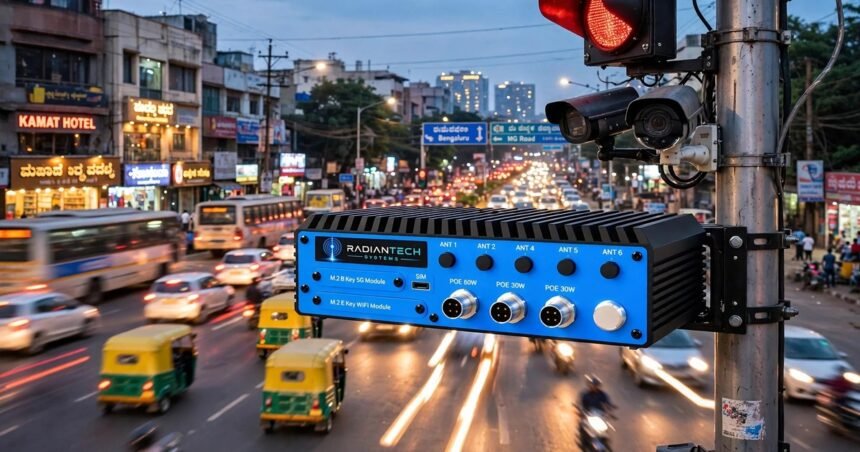
At a busy junction in Bengaluru, the traffic light turns red and a stream of vehicles rolls through it anyway. Above them, cameras watch everything: every lane, every signal, every number plate, twenty-four hours a day. In most Indian cities, every one of those video streams travels all the way back to a distant data centre to be understood — a river of raw video that grows heavier with every camera the city adds. A Bengaluru startup called Radiantech Systems thinks the thinking should happen right there, on the pole, at the junction itself.
The junction is the computer
The device is the RTE-300-R, a Rugged High Performance Edge AI Compute unit that Radiantech showcased at the Bengaluru Tech Summit 2026. Instead of streaming hours of uneventful footage to a central server, the box analyses the camera feeds locally, at the road junction, and sends only the moments that matter to the city command centre — a brief alert when a motorist jumps a red light, for example, rather than a continuous river of raw video.
The company says the difference is what makes city-scale camera networks affordable to run. A network of thousands of cameras streaming continuously pushes a city toward expensive, high-capacity GPU-powered data centres and heavy bandwidth bills. By moving the analysis to the edge, the RTE-300-R lets the existing network do far more with far less infrastructure behind it.
Built for the pole, not the server room
The unit is built for the outdoors. It is a ruggedised, air-cooled box, designed to sit on a pole through heat, dust and rain without the water-intensive cooling that a data-centre rack demands. It also carries its own local storage, holding footage for up to 60 days so that a specific clip can be retrieved when it is needed, before the system clears the storage automatically.
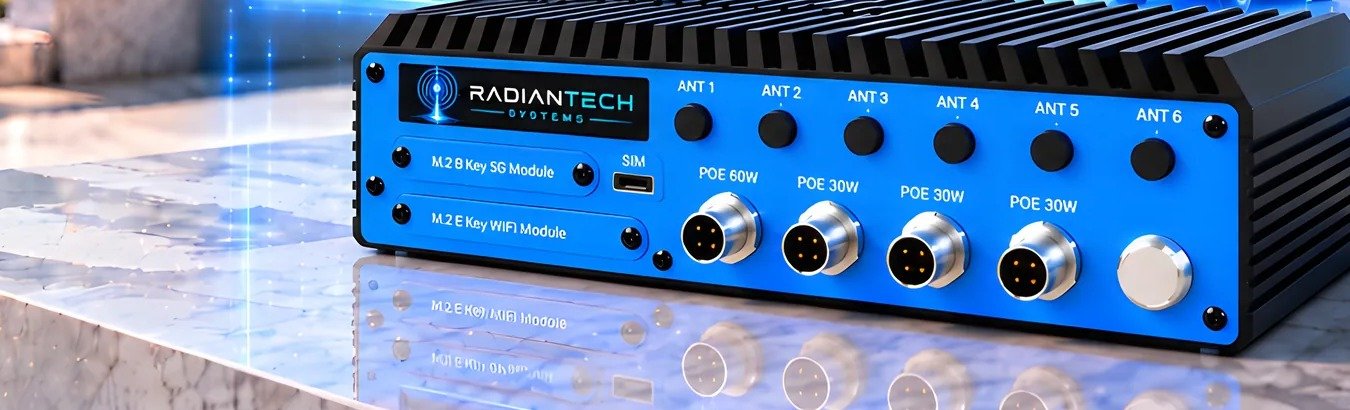
The front panel tells the story of what it is for: six antenna connectors, Power-over-Ethernet ports to run the cameras themselves — one 60W port and three 30W ports — plus M.2 slots for 5G and Wi-Fi modules and a SIM slot, so the box can talk to the city network however the junction allows. It is a small, blue, finned slab of hardware that turns a dumb pole of cameras into a thinking one.
A proposal already on the table
Radiantech has put a formal proposal before the Bengaluru Traffic Police, which has expressed interest in the architecture. The company positions itself as a hardware systems manufacturer: it builds the edge computers, and partners with third-party software developers to run AI-based violation-detection models on them — a combination the company says gives cities a more efficient, scalable and cost-effective way to run AI-driven traffic enforcement.
More Read

The same edge-AI thinking runs through the rest of Radiantech’s work. The company, a DPIIT-recognised startup, also builds edge-AI systems for surveillance in residential and community security and for defence and border operations, camera-and-radar fusion for traffic flow and incident detection, and camera-based AI for industrial sites — all of it designed to see, understand and act on site, without depending on the cloud.
Why it matters
Indian cities are adding cameras far faster than they are adding the networks and data centres to carry them. Every new camera makes the centralised model heavier, and every junction that can think for itself lightens it. The RTE-300-R is a small piece of hardware with a large idea inside it: that the intelligence of a smart city does not have to live in a distant server hall. It can live on the pole, at the junction, where the traffic actually is — built in India, for Indian streets.
Keep reading: Every Camera, an Agent: Inside WiredLeap, the Bengaluru Startup Turning CCTV Into Real-Time Intelligence · Every Number Shows Its Source: Inside AION, the Bengaluru Startup Making India’s Big Decisions Auditable · More Industrial Automation & Technology stories
Like stories like this? Add Exceptional Technology as a preferred source on Google to see more of our reporting in your search results and Discover feed.