


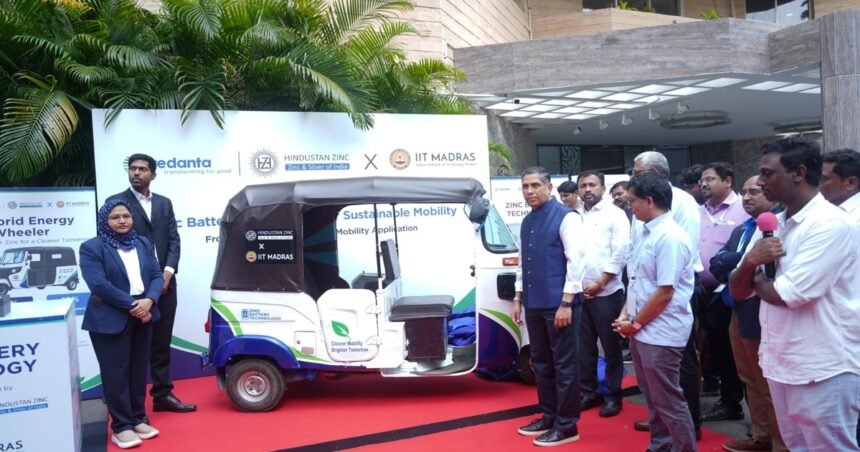
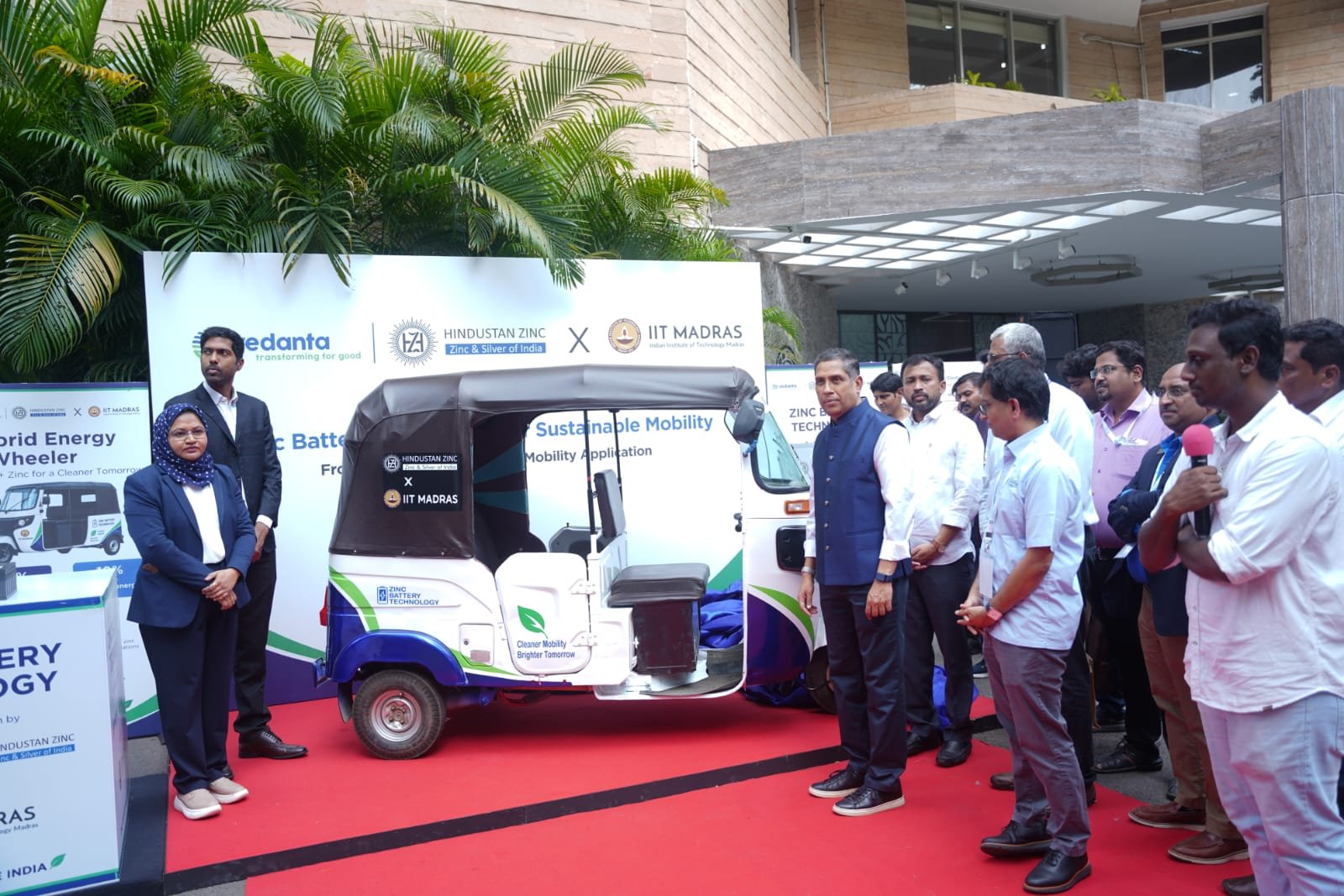
A white electric three-wheeler glides across the IIT Madras campus, and the battery quietly topping up its range is not lithium at all — it is zinc, breathing in oxygen from the air around it. That is the prototype Hindustan Zinc and IIT Madras unveiled at the IIT Madras Energy Summit 2026, and it points to a future where India’s electric vehicles run on a metal India already produces in abundance.
Hindustan Zinc, the world’s largest integrated zinc producer and a Vedanta Group company, has been working with IIT Madras since 2024 on zinc-air battery technology. The collaboration has now moved from laboratory-scale research to a vehicle on the road: an electric three-wheeler carrying an approximately 1 kWh zinc-air battery as a range extender, announced on 26 November 2026.
A battery that breathes
Zinc-air batteries generate electricity by reacting zinc with oxygen drawn from the surrounding air. They use a non-flammable, water-based electrolyte and a metal that is abundantly available and recyclable — a combination the partners say offers real advantages in safety, affordability and environmental sustainability over chemistries that rely on flammable organic electrolytes.
The prototype pairs the two chemistries in a dual-battery configuration. The existing lithium-ion battery handles acceleration and peak power, while the zinc-air unit provides a steady supply of energy during operation. The company says the 1 kWh zinc-air battery currently contributes nearly 10% of the vehicle’s total energy requirements — a first, working demonstration of the two systems sharing the load in a real vehicle.
“One of the challenges facing electric mobility is the development of battery systems that can deliver adequate energy capacity without significantly increasing vehicle costs, weight or safety risks,” said Dr Aravind Kumar Chandiran, associate professor in the Department of Chemical Engineering at IIT Madras, who led the project.
From the lab to the road
The prototype was unveiled in the presence of Praveen Chakravarty, Member of Parliament (Rajya Sabha), Amarendu Prakash, CEO and Whole-time Director of Hindustan Zinc, Prof. Manu Santhanam, Dean (ICSR) at IIT Madras, and Dr Chandiran, along with Prof. V. Kamakoti, Director of IIT Madras.
More Read

“At Hindustan Zinc, we are constantly exploring opportunities to expand the applications of zinc and unlock greater value from this versatile metal,” said Amarendu Prakash. “With zinc being abundantly available in India, there is an opportunity to explore indigenous energy storage solutions that can contribute to the vision of Viksit Bharat. Our collaboration with IIT Madras reflects our commitment to translating scientific research into practical applications, creating new demand avenues for zinc and strengthening its role in the global clean energy transition.”
Prof. V. Kamakoti added: “Ensuring generation, storage and distribution of energy from different sources, specifically the renewable ones is the most important topic for research, development and commercialization. Our collaboration with Hindustan Zinc is yet another important effort towards this goal.”
Why zinc, why now
India’s electric mobility story runs on imported lithium, and that dependence is exactly what this project is designed to loosen. India holds abundant zinc resources, and Hindustan Zinc supplies more than 30 countries and holds about 74% of India’s primary zinc market. A battery chemistry built on a metal India mines, refines and recycles at home could make electric mobility cheaper, safer and far more self-reliant.
For Hindustan Zinc, the collaboration is part of a broader push under its HZL 2.0 growth strategy to find new, value-added applications for zinc — from renewable energy storage to electric mobility — and to strengthen zinc’s role as a critical enabler of the global energy transition.
Why it matters
Three-wheelers are the workhorses of Indian cities — millions of them ferry passengers and goods through every town in the country. They are the perfect first home for a new battery chemistry: the volumes are enormous, the duty cycles are punishing, and every rupee saved on the battery goes straight to the driver who owns the vehicle. A zinc-air range extender that grows from 10% of the energy mix today into a larger share tomorrow could put cleaner, cheaper, safer mobility within reach of the drivers who need it most — powered by a metal dug from Indian soil.
Keep reading: The Motorcycle That Runs on Hydrogen: Inside Hydrovert Energy’s Fuel-Cell Powertrains · The Liquid Battery Built for Decades: Inside Leep Flow Energies, the Hosur Company Betting on Vanadium · More Energy & Power stories
Like stories like this? Add Exceptional Technology as a preferred source on Google to see more of our reporting in your search results and Discover feed.







