


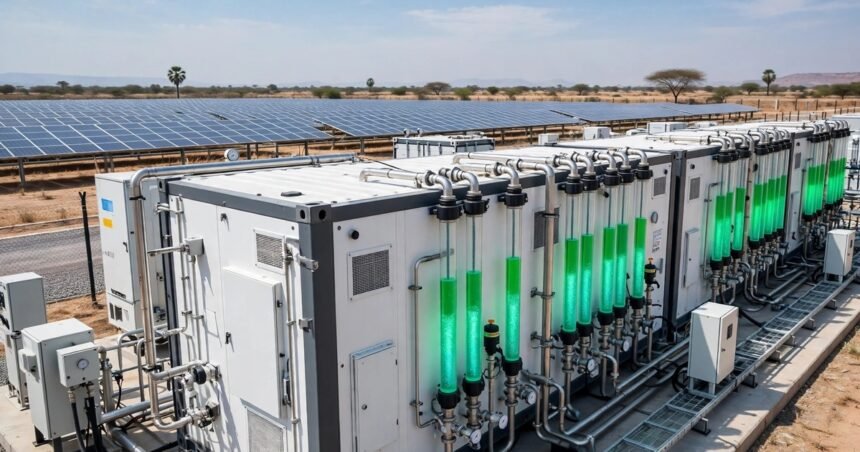
India’s solar panels now soak up more sunshine than ever before, but the sun still sets every evening. The power the country makes at noon has to be there at night, and that is the quiet problem sitting underneath the whole renewable energy boom. Lithium-ion batteries do the job, yet they wear out after a few thousand cycles and carry the fire risk that comes with their chemistry. In Hosur, Tamil Nadu, a company called Leep Flow Energies has spent years building a very different answer: a battery that stores its energy in liquid, and barely ages at all.
The battery that is mostly liquid
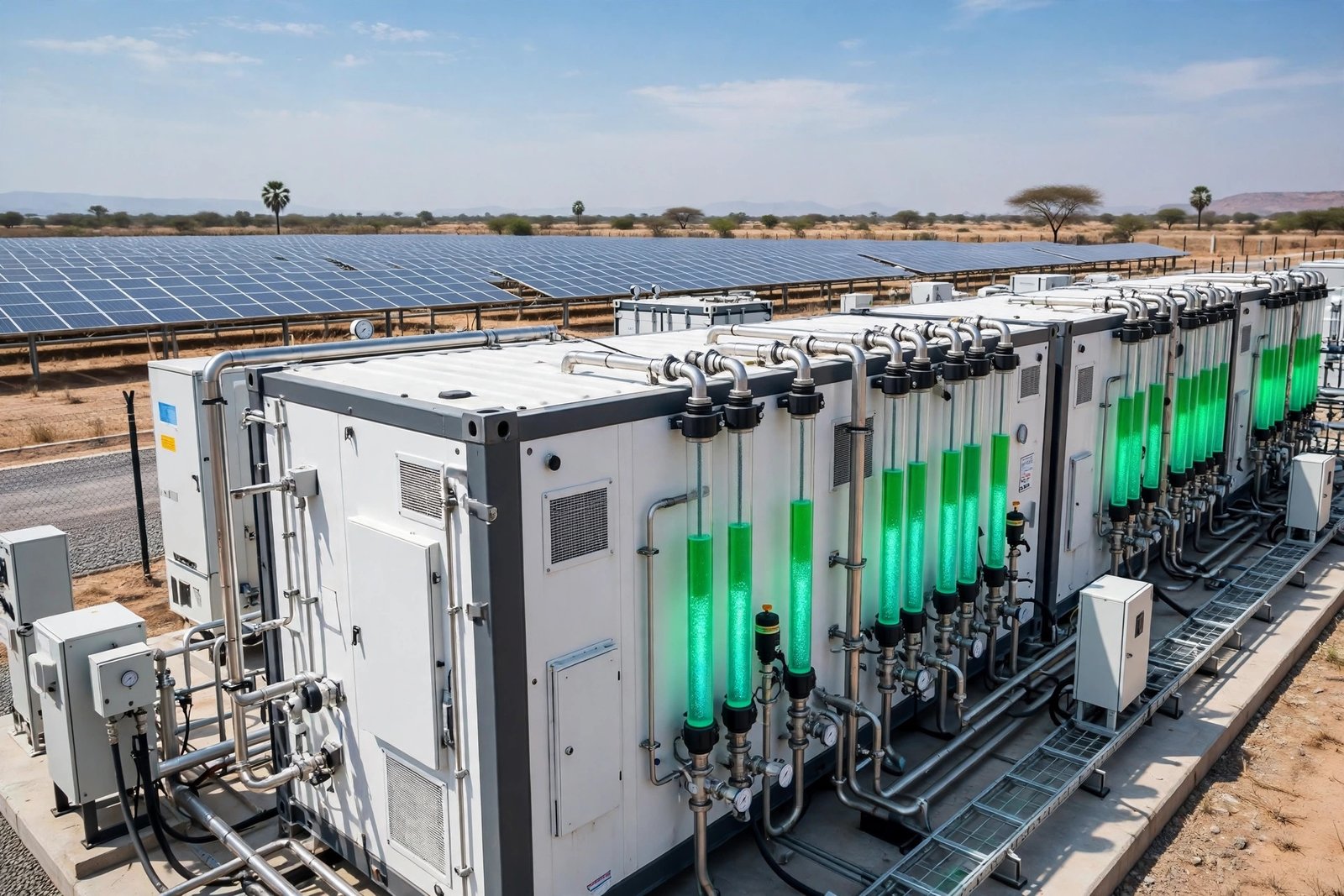
Leep Flow Energies builds vanadium redox flow batteries, or VRFBs. Instead of packing energy into solid cells, a flow battery keeps its energy in liquid vanadium electrolyte held in external tanks. Pumps circulate the positive and negative electrolytes through reactor stacks, and that is where the electricity is made. The design splits the two jobs a battery normally has to do at once: the size of the stacks decides how much power the system delivers, while the volume of liquid in the tanks decides how much energy it holds. Want a longer backup? Add more liquid, not more batteries.
The liquid itself is the safety story. The electrolyte is water-based, so it cannot catch fire, and there is no thermal runaway to guard against. Flow batteries are built for the long haul too: the same electrolyte can be cycled day after day for decades, and the company says its systems are engineered for reliable operation over decades. For a grid that needs to charge and discharge every single day, that durability changes the economics completely.
An electrolyte made in India
Leep Flow Energies operates as Leep eDrive Private Limited and has been based in Hosur since 2018. Its founder and managing director, K S Ramanujan, is an alumnus of IIT Madras from the class of 1980, and the company’s technology grew out of deep research with the institute. The company says it developed its proprietary vanadium electrolyte formulation in collaboration with scientists at IIT Madras, under a programme supported by the Department of Science and Technology.
That matters because India currently depends on imports for its vanadium electrolyte. Building the liquid at home is what turns a clever battery design into an indigenous supply chain, and the company’s new plant is designed to do exactly that, bringing electrolyte production and full battery system manufacturing under one roof.
The technology is already running. The company says a solar-powered vanadium flow battery system at its Hosur facility has been operating for more than a year, and its website describes a 5 kW / 20 kWh VRFB system built for a 13-acre temple trust in Hosur. It is the kind of steady, unglamorous proof that long-duration storage needs: a real system, in real service, day after day.
More Read
A ₹100-crore vote of confidence
On 27 November 2026, Leep Flow Energies signed a memorandum of understanding with Guidance Tamil Nadu to build a ₹100-crore vanadium flow battery manufacturing facility at SIPCOT Gummidipoondi in Tiruvallur district. The agreement was exchanged by Ramanujan and Deepak Jacob, IAS, managing director and chief executive of Guidance Tamil Nadu, in the presence of Tamil Nadu Chief Minister C. Joseph Vijay. The investment will be made over three years and is expected to generate around 150 jobs.
The facility will manufacture vanadium electrolyte alongside complete battery energy storage systems, and the company says it plans to supply 100 MWh of storage projects in its first year, scaling up to an annual manufacturing capacity of 1 GWh by the third year. It is a manufacturing bet on a simple idea: as India adds more solar and wind, the country will need somewhere to put all that daytime power, and flow batteries are built for exactly that job.
Where the batteries go
Long-duration storage is the missing piece of the renewable puzzle. Solar power peaks at midday and fades by evening, just as homes and factories switch their lights on. A flow battery soaks up the afternoon surplus and hands it back after sunset, smoothing out the grid and letting renewable plants sell power when it is actually needed. The same systems can back up industrial sites, microgrids and remote facilities that need hours of reliable power, not minutes.
The appetite is already visible at the top of the system. NTPC has planned a 100 MWh flow battery project at Khavda in Gujarat, a sign that India’s largest power producer sees flow batteries as a serious part of the storage mix. Leep Flow Energies is positioning itself to supply that wave from Tamil Nadu, with the electrolyte, the stacks and the systems all made in India.
India’s energy transition will be won as much by storage as by generation. In Hosur, the liquid is already flowing, and a ₹100-crore plant is about to scale it up.
Keep reading: The Battery That Never Fades: Inside Arkle Energy’s Vanadium Flow Battery Built for 25 Years · Thorium, Bottled: Inside SUK-M, the Pune Startup Building India’s First Thorium Microreactor · More Energy & Power stories
Like stories like this? Add Exceptional Technology as a preferred source on Google to see more of our reporting in your search results and Discover feed.







