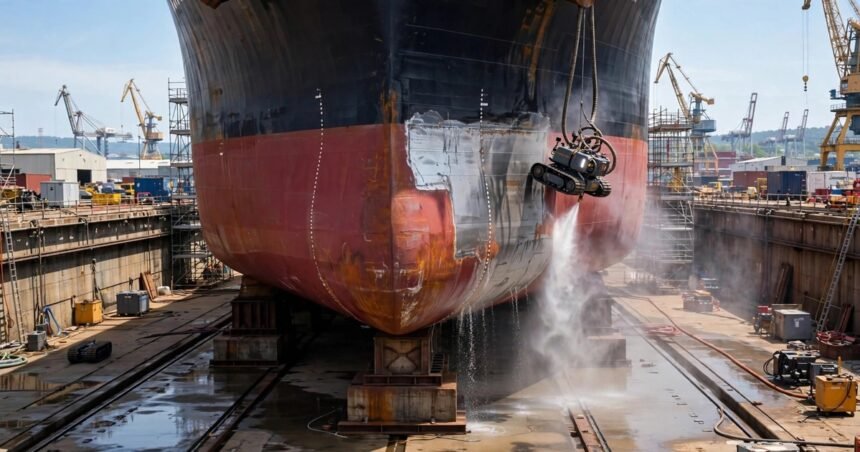
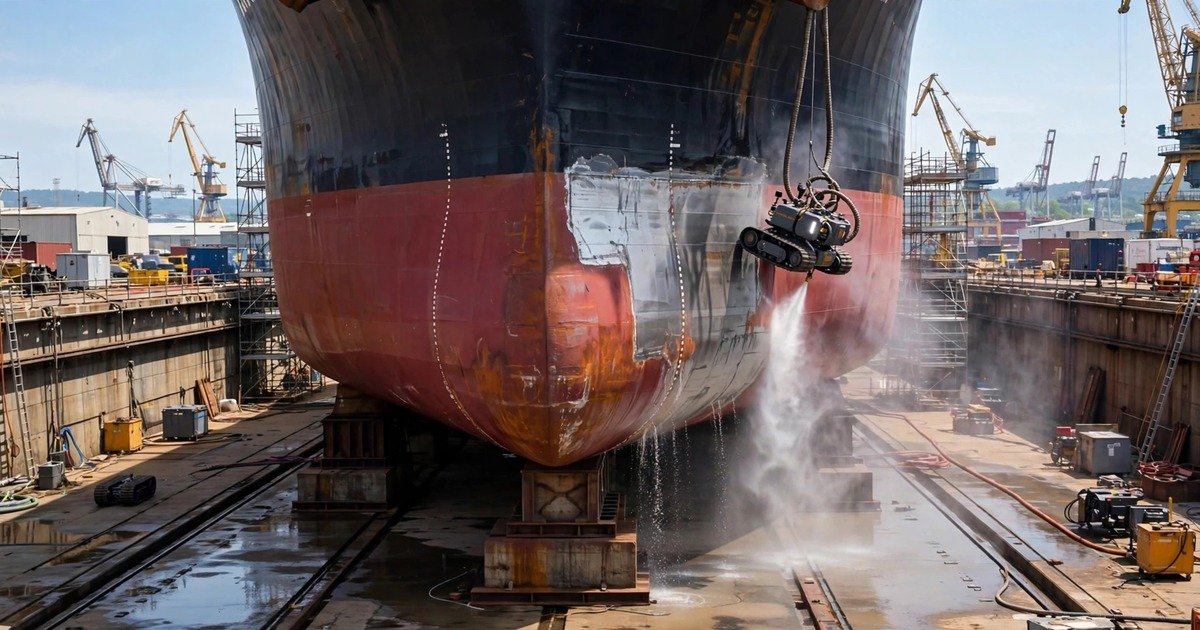
In a dry dock in India, a ship the length of two football fields sits on blocks, its hull a wall of rust-red steel rising above the dock floor. Clinging to that wall is a machine no bigger than a suitcase, crawling slowly upward on magnetic tracks. Behind it, a jet of water strips away rust and old paint, leaving a clean silver swath on the steel. Nobody is standing on scaffolding. Nobody is holding a blasting hose. That is a BlueForge rover at work, and it is the way a young Indian company thinks the hulls of the world’s cargo ships should be cared for.
BlueForge Robotics builds autonomous robots that clean, prepare, coat and inspect ship hulls, so a vessel leaves dry dock sooner and its crew stays out of harm’s way. The company says its rovers are designed and built in India, and they work under remote supervision, taking on the hardest, dirtiest jobs in the dock while people watch from a safe distance.
Four rovers, one hull
The BlueForge fleet is four purpose-built rovers, each designed around a single job on the hull. The hydro-blasting rover climbs the hull and clears marine growth, salt and loose coating using water alone, with no abrasive and no dust cloud. The grit-blasting rover strips failed coating and rust evenly across large areas, taking the hull back to bare steel so the new coating goes onto a sound, consistent base. The painting rover applies coating in steady, overlapping passes to the paint maker’s specification, for an even film with less overspray and fewer touch-ups. And the inspection rover surveys the condition of steel and coating and pins every finding to its exact place on the hull, so owners, superintendents and surveyors all see the same picture.
All four rovers are built on the same magnetic-crawler platform, which the company says works on vertical and even inverted hull surfaces. Together they take a hull from first wash to final record in a single docking.
From first wash to final record
BlueForge runs a hull job in five steps: inspect, wash, blast, paint and record. The inspection rover first maps the starting condition of the steel and coating. Then the washing and blasting rovers clear marine growth, salt, loose paint and failed coating. The painting rover puts the new coating on. And at the end of the job, the company hands over a verified record of everything that was done.
That record is the part the company is proudest of. Every service its rovers carry out goes into what BlueForge calls the Digital Hull Passport, a full maintenance record across the vessel’s lifecycle, so the hull’s history can be tracked from one docking to the next and the next docking starts with facts instead of guesswork.
More Read

The work is priced as a service: the customer pays for the job, not the robot. The company says its robots work steadily through every shift, so hull work takes fewer days in dock, and crews supervise remotely instead of standing in dust, noise and heat.
Built by people who know heavy industry
BlueForge is led by chief executive Shivam Panwar, who studied at IIT Gandhinagar and worked at Tata Boeing, and leads the company’s product, vision and artificial intelligence work. Around him is a compact team drawn from the worlds the company works in: chief operating officer Avinash Mishra, also an IIT Gandhinagar alumnus, who worked at the Railway research organisation RDSO; chief technology officer Sangam Sahu, who has spent more than seven years building robotics and rovers; and chief information officer Rahul Giri, who holds a master’s degree from IIT Bombay and a doctorate from IISc Bengaluru.
The company is incubated at three of India’s leading deep-tech homes: the Technology Business Incubator at IIT Ropar, the Innovation and Entrepreneurship Centre at IIT Gandhinagar, and ARTPARK at IISc Bengaluru, where its working office sits. Its registered office is in Ahmedabad, and its robots are made in India for the world’s shipyards and fleets.
Why it matters
Blasting, painting and inspecting a ship’s hull is still done largely by hand today, and it is some of the hardest work in shipping: abrasive dust, paint fumes, heights, and days lost in dry dock while a cargo ship earns nothing. A robot that climbs the hull and does the blasting, the painting and the inspection turns that work into something faster, cleaner and safer.
India builds and repairs ships for the world, and its yards compete on how fast they can turn a vessel around. A fleet of Indian-built hull robots that shortens dockings, stretches the life of every coating and leaves a digital record of every plate is exactly the kind of quiet engineering that keeps the world’s cargo moving. From capesize bulkers to product tankers, BlueForge is building the robots that keep the hulls carrying the world in shape.
Keep reading: The Boat That Sails Itself: Inside i4 Marine’s Robot Fleet Mapping India’s Waters · The Manta Ray That Watches the Ocean: Inside BlackVolt’s 45-Day AUV · More Shipbuilding & Maritime stories
Like stories like this? Add Exceptional Technology as a preferred source on Google to see more of our reporting in your search results and Discover feed.