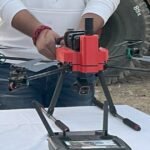
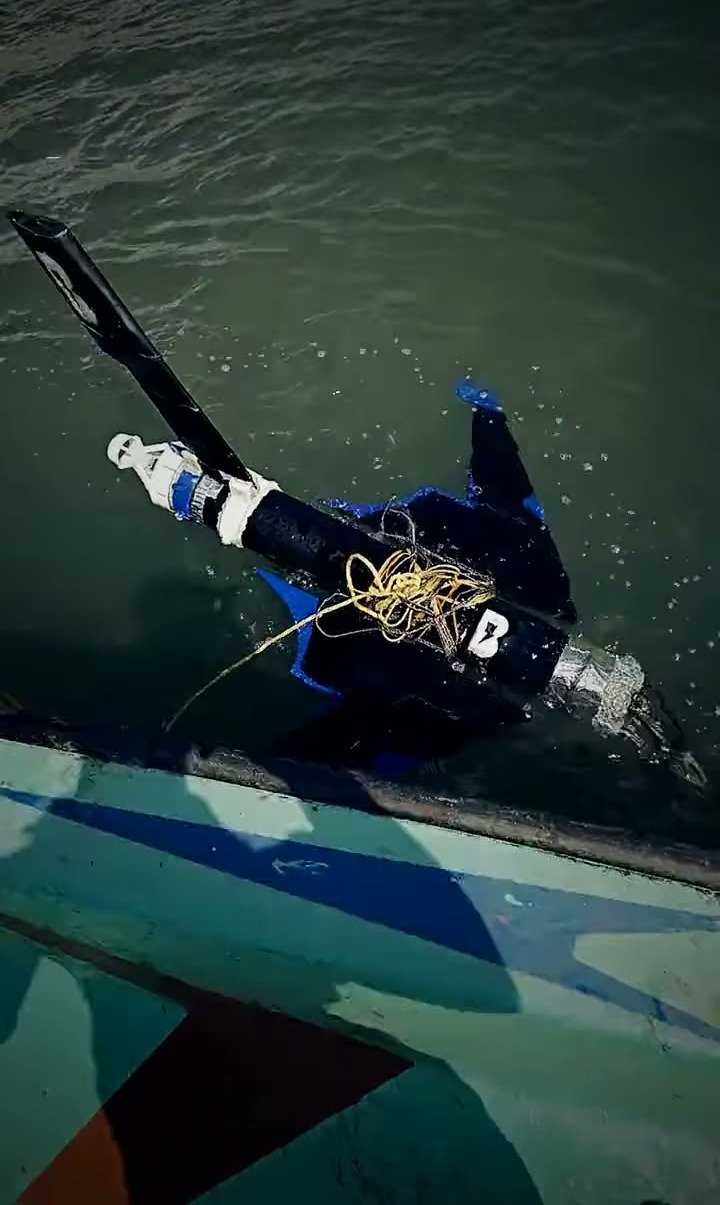
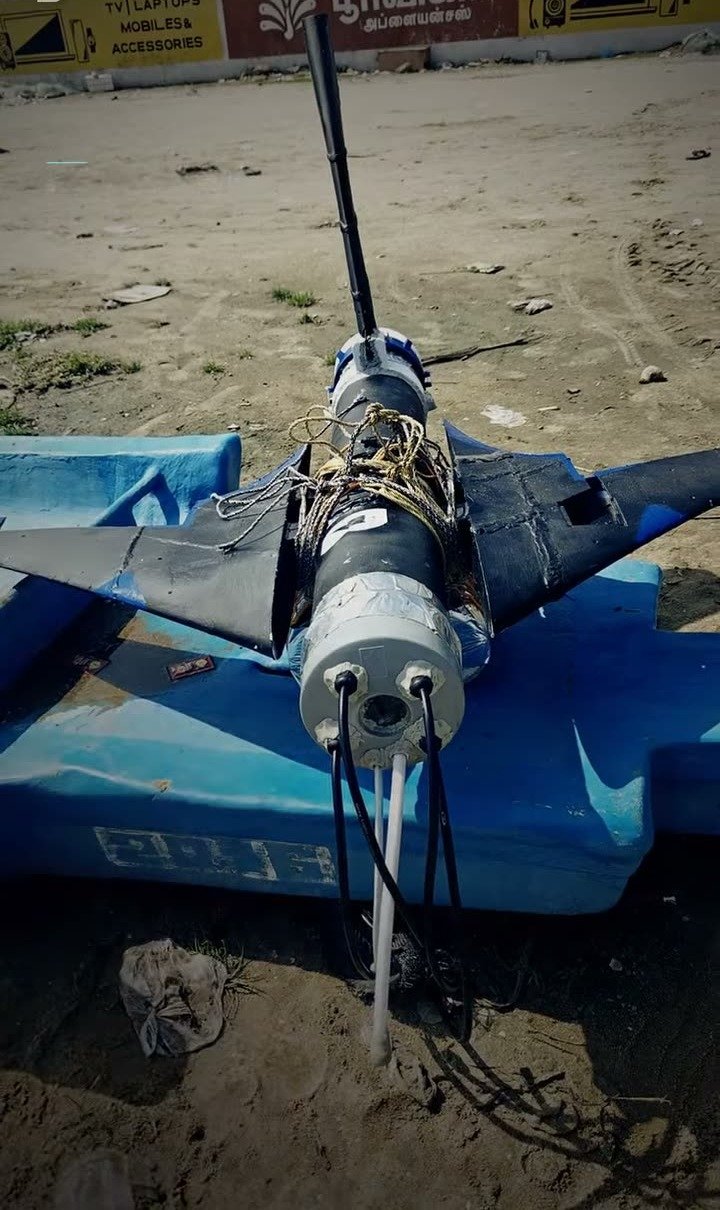
On the morning of 4 November 2026, a small team of young engineers in Chennai carried their first underwater vehicle down a beach on their shoulders, loaded it onto a fishing boat, and lowered it into the sea. The vehicle was P0, the first prototype of the BlackVolt AUV — a manta-ray-shaped autonomous underwater vehicle designed to stay at sea for up to 45 days, gliding on buoyancy alone and keeping a persistent watch under India’s waters.
A wing, not a torpedo
Most underwater vehicles are torpedoes with propellers. BlackVolt’s is a wing. The whole body is one blended-wing planform, shaped after the manta ray, so the entire hull generates lift as it moves through the water. The company says that shape is the key to its endurance: instead of running a propeller all the time, the vehicle glides.
The glide works on a buoyancy engine. The vehicle pushes oil out to grow more buoyant and rise, nose up; it draws the oil back in to grow heavier and sink, nose down. The wing turns that repeated rise and fall — a sawtooth path through the water — into forward motion, so the vehicle travels without continuously running its propulsion. A folding stern propeller is there for the moments that need speed or station-keeping, and it folds away to cut drag while the vehicle glides.
Designed to stay down for 45 days
The full-scale BlackVolt AUV is designed for up to 45 days underwater, a range of 1,000 nautical miles — about 1,852 kilometres — and an operating depth of 300 metres, the company says. Its job is intelligence, surveillance and reconnaissance: watching maritime activity, tracking vessels that sail without broadcasting AIS signals, and listening for underwater threats such as submarines, with a towed-array sonar among the payloads the company is developing.
The vehicle is also designed to carry the watch above the water. A modular payload bay is being built to launch small aerial drones, so the AUV can send eyes into the sky while it stays below — the first concepts carry around four drones, with room to grow. Every so often the vehicle surfaces, raises its mast and reports home by satellite. And if anything goes wrong, a drop weight releases and the vehicle rises to the surface on its own buoyancy. BlackVolt is building the platform in two configurations: a free-swimming AUV that runs on stored energy, and a tethered ROV that draws power and data through a cable from a support vessel.
From workbench to water
P0 is a small test bed for that much larger machine, and it was built fast. The team had the hull tube in hand and was running first sensor tests on 17 October 2026; the next day they were sealing the hull and working on the electronics late into the night. By the early morning of 4 November the prototype was built, sealed and painted, and by 10:14 am it was in the sea. That first trial tested the sensors, the sealed hull’s thermals, battery load, communications and GPS, buoyancy and surface stability — and the company says depth trials are next.
More Read

The engineering behind the design has already been put through its paces on screen. BlackVolt says it evaluated the hull through 44 computational fluid dynamics cases and checked its simulation method against the DARPA SUBOFF submarine-hull benchmark, reporting agreement within 4%. Its autonomous navigation software is being tested in simulation, and energy-efficient route planning is already running in software.
A young team building for the Navy
BlackVolt Technologies was founded in 2025 by Garv Pathak and Sarthak Varchasvi — Pathak runs the company as co-founder and CEO, Varchasvi leads the technology as co-founder and CTO. The company was incorporated in August 2025 and is incubated at V-NEST, VIT Chennai, where a team of engineers works across three project lines: autonomous underwater systems, airframes, avionics and software. Guiding them on naval operations is Commodore Anurag Srivastava (Retd), who spent three decades in the Indian Navy’s submarine service. The company’s line is simple: it is building for the Indian Navy first, and for partner navies after.
“The ocean is the last place we cannot watch,” the company says — and with P0 already in the water, BlackVolt’s answer to that is taking shape in Chennai, one glide at a time.
Keep reading: No Dry Dock, No Divers: Inside Stingray Robotix’s Hull Crawler, the Robot That Cleans Ships While They Sail · The Robot Submarine That Patrols Alone for 45 Days: Inside Rekise Marine’s Jalkapi · More Shipbuilding & Maritime stories
Like stories like this? Add Exceptional Technology as a preferred source on Google to see more of our reporting in your search results and Discover feed.