


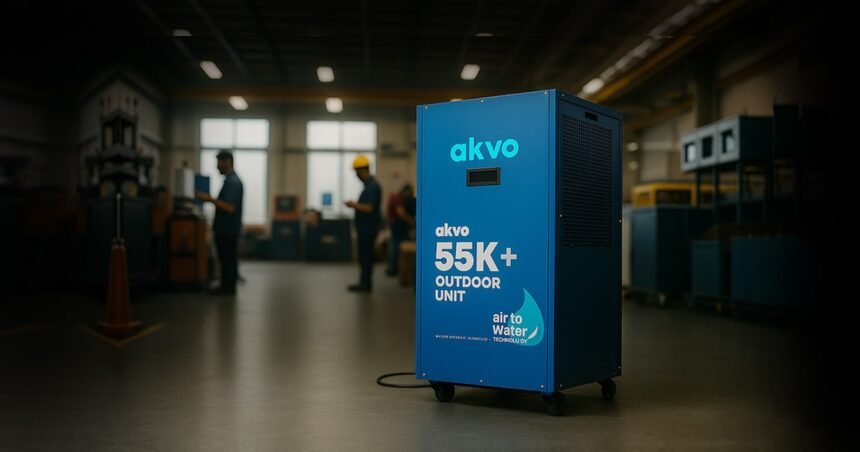
Every summer in Kolkata, the same queue forms: tankers inching down the lanes, buckets lined up at dawn, families waiting for water that may or may not arrive. Navkaran Singh Bagga grew up watching those queues. In 2017, he decided the answer was not another pipe, another borewell or another tanker — it was the sky itself. His company, Akvo Atmospheric Water Systems, builds machines that pull drinking water straight out of thin air — and today more than 2,000 of them are running in 15 countries, having generated over 100 million litres without drawing a single drop from the ground.
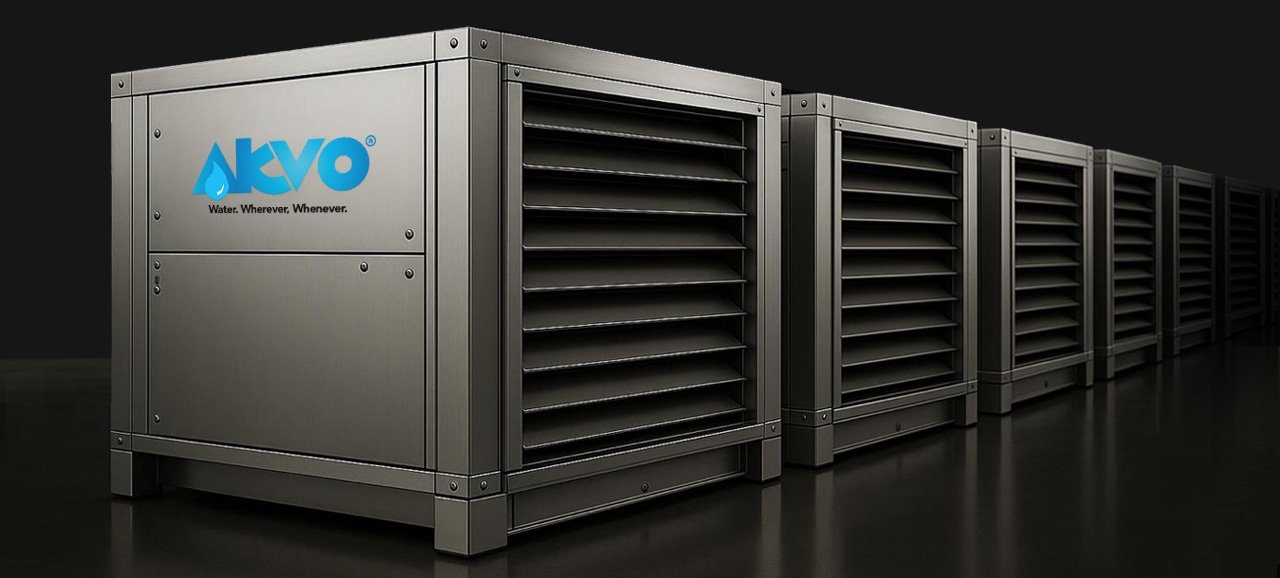
Akvo’s modular Water Block units. (Image: Akvo Atmospheric Water Systems)
The machine that drinks the sky
An atmospheric water generator works on the same principle as condensation on a cold glass. Warm air holds moisture; cool it to its dew point and the vapour turns to liquid water. Akvo’s machines filter the incoming air, chill it to trigger condensation, then pass the collected water through multi-stage filtration and UV treatment, finishing with mineral balancing so it tastes like drinking water should. The whole thing is plug-and-play: power it up, and it makes water continuously, even in low-humidity conditions, the company says.
Efficiency is where the engineering lives. The company says its Water Block systems use around 0.29–0.35 kWh for every litre of water produced, and the water itself costs about ₹1.75–2 a litre to generate — a fraction of what bottled water costs, with no plastic and no tanker in sight. Akvo says it is the first player in India to manufacture atmospheric water generators indigenously, and its manufacturing and assembly keep moving deeper into India’s supply chain, with its main production facility in Chennai run in-house rather than outsourced.
2,000 machines, 15 countries
Since the first deployment in 2018, Akvo has installed more than 2,000 systems across India, the Middle East, Southeast Asia, East Africa and parts of South America — an installed base the company says generates roughly 300,000 litres of water a day. Its clients are the places where water cannot be allowed to fail: manufacturing plants, renewable-energy sites and hospitals. At Acciona’s Tuppadahalli Wind Farm in Karnataka, water is now generated on site, so clean power and clean water arrive together. Units also run at NTPC’s Netra campus in Noida, at Vimhans Niyati Hospital in New Delhi, and for the Airports Authority of India in Lakshadweep.
More Read

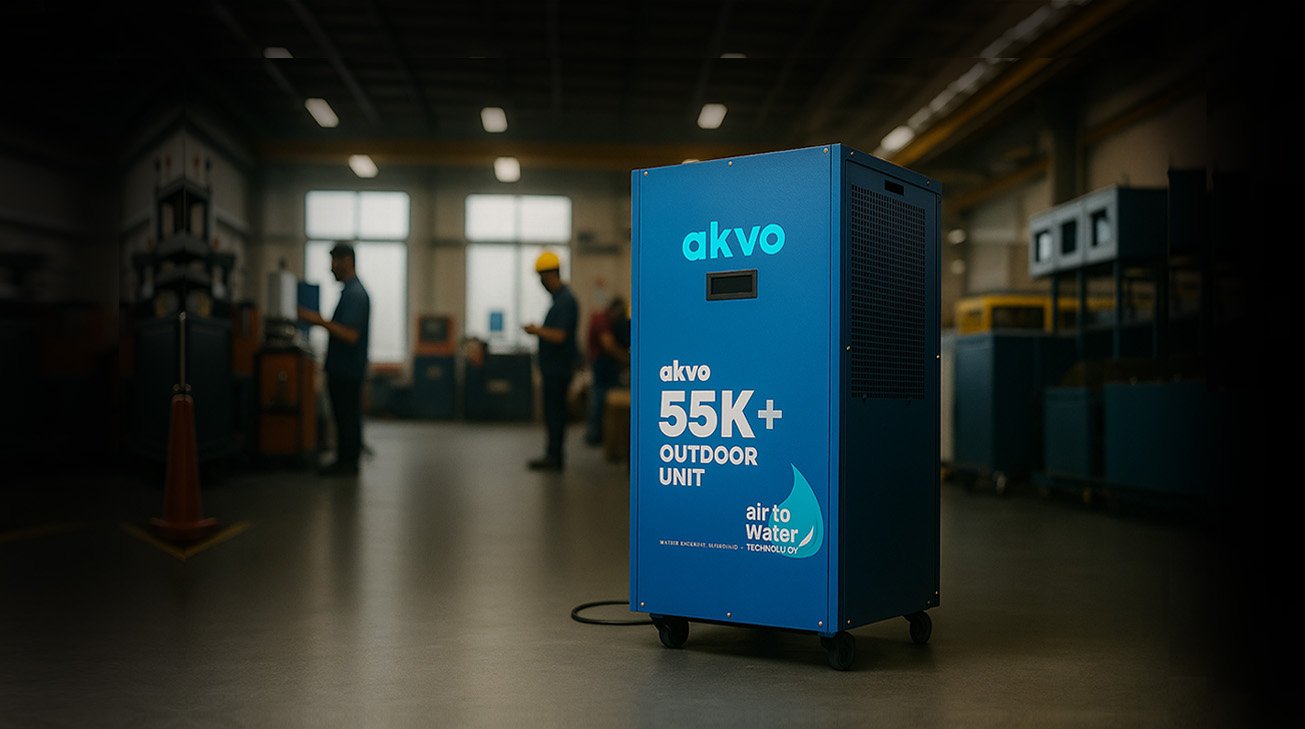
Akvo’s 55K+ outdoor unit at a factory installation. (Image: Akvo Atmospheric Water Systems)
Water as a service
Akvo’s newest idea is not a machine at all — it is a way of buying water. Under its Water-on-Want model, the company installs, owns and operates the generators at a customer’s site, and the customer simply pays for the water consumed. No capital purchase, no tanker contracts, no plastic bottles. The model is already deployed across water-stressed regions in Tamil Nadu, Karnataka, Maharashtra and Gujarat, and the company says it has tripled in size over the past three years.
Every machine is watched by Nimbus OS, Akvo’s IoT platform, which reports run hours, litres produced, energy consumed, ambient temperature and humidity, and filter health in real time across the whole fleet. And for sites that want to cut the grid out of the picture entirely, the company has built Akvo Helios, a solar-thermal system that pairs atmospheric water generation with rooftop solar and rainwater harvesting.
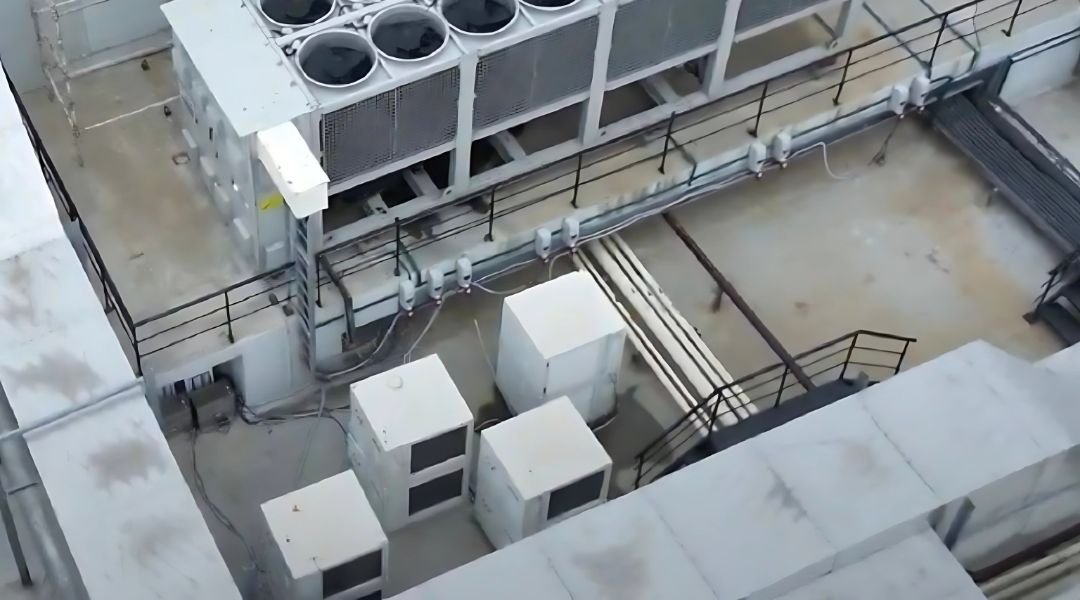
Akvo units installed on a corporate rooftop in Chennai. (Image: Akvo Atmospheric Water Systems)
A Kolkata idea, built for the world
Bagga studied finance, not engineering, and came to water through a second-generation entrepreneur’s eye for a problem hiding in plain sight. The atmosphere above India holds an estimated 13,000 cubic kilometres of water vapour at any given time — far more than all of the country’s rivers combined, the company notes. The global market for atmospheric water generators is projected to grow from about $4.36 billion in 2025 to $7.92 billion by 2030, and a Kolkata company that started with a single idea about tanker queues is now selling into 15 countries on the strength of machines built in Chennai.
For the factory, the hospital, the wind farm and the community that cannot wait for a pipeline, water from air is already here — made in India, running around the world, and poured from the sky.
Keep reading: Ten Minutes, 65 Tests: Inside Clinics On Cloud, the Pune Startup Putting a Health ATM in Every Village · No Surgery, No Implants: Inside xStep, the Bengaluru Device Helping Paralysed Patients Move Again · More Chemicals, Materials & Life Sciences stories
Like stories like this? Add Exceptional Technology as a preferred source on Google to see more of our reporting in your search results and Discover feed.







