


On 1 November 2026, Railway Minister Ashwini Vaishnaw walked the floor of BEML’s Aditya manufacturing complex in Bengaluru and watched a defining test for India’s first homegrown bullet train. The carbody of the B28 — the Bharat-made high-speed trainset taking shape there — was put through its squeeze test, the brutal structural check every bullet train must pass before it can ever carry passengers at speed.
The B28 is being designed and built in India by BEML Limited together with Chennai’s Integral Coach Factory (ICF), for the Mumbai–Ahmedabad High-Speed Rail corridor. The company says the eight-coach trainset is designed for a test speed of 280 kmph and will run at 249 kmph in service — a machine built to international standards, on Indian shop floors, for Indian conditions.
The squeeze test: why a bullet train must survive a vacuum
At very high speeds, the air rushing past a train creates a layer of vacuum around it, and the full weight of atmospheric pressure presses in on the coach body. That is why the squeeze test matters so much: the finished carbody is subjected to controlled compressive and tensile forces to prove its structural strength, rigidity and dimensional stability before a single seat goes in.
The minister’s visit confirmed the design itself is complete and the squeeze test done. As he put it during the inspection, the whole structure has been designed to international standards, and the squeeze test — which he called the most rigorous of its kind — is what proves the coach can bear the strain of high-speed travel. With the structure proven, the train now moves to propulsion integration and climate testing, where it will face temperatures from scorching heat to sub-zero cold, along with rain and dusty conditions.
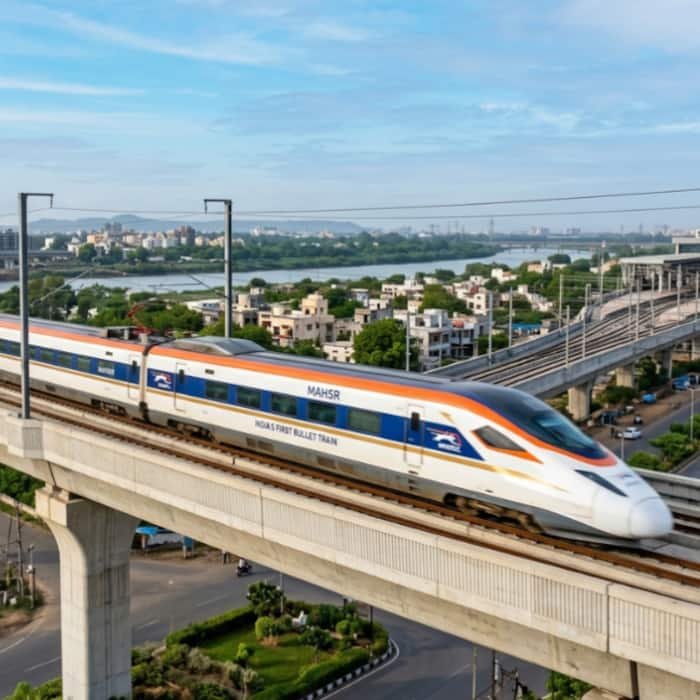
Eight cars, 557 seats, built for Indian passengers
The B28 is around 202 metres long, made up of four motor cars and four trailer cars, with a driver’s cab at each end fitted with an intelligent on-board control system. The company says it will carry around 557 passengers: seven standard-class coaches with 3×2 seating and one executive-class coach with 2×2 seating, with dedicated space for two Divyangjan passengers. Two eight-coach trainsets can even be coupled into a 16-coach formation as demand grows.
Inside, the train is a showcase of passenger-first engineering. The Railways says the coaches will offer reclining and rotatable seats, wide windows at every row, LED lighting, power outlets and overhead racks, plus bio-digester toilets and a sealed, single-piece gangway between cars. A passenger information system will display updates in English, Hindi and regional languages, with automatic announcements, emergency talk-back units and a Wi-Fi-based infotainment platform. Accessibility runs through the design: level boarding with floors aligned to platform height, retractable footsteps to close the gap, wheelchair-friendly doors and toilets, and Braille signage.
More Read

Under the floor, the engineering is just as considered. The train will run on a 25 kV, 50 Hz single-phase AC traction system with regenerative braking that recovers energy as it slows. Its nose and carbody profile have been shaped with computational fluid dynamics simulations to cut air resistance, soften tunnel pressure waves and keep the ride quiet — helped by sound insulation, noise-damping coatings and specially designed skirts, bogie covers and fairings. Two air-conditioning units in every coach will hold temperature and humidity steady through India’s harshest summers.
From Bengaluru’s shop floor to Surat’s test track
The journey to this point began in October 2024, when ICF awarded BEML a ₹866.87 crore contract to design, manufacture and commission two eight-coach high-speed trainsets, at ₹27.86 crore per car. At the Aditya complex, precision-engineered jigs and fixtures shape the carbodies through underframe, sidewall and roof assembly, final car assembly, surface preparation and treatment — processes the Railways says are critical to meeting the stringent quality and safety standards of high-speed operation.
The road ahead is now clearly mapped. The company says the first train is likely to be ready in the first quarter of 2027, with track trials around April–May 2027. Testing starts on a dedicated track created inside BEML’s Bengaluru facility, then moves to the Surat depot, where longer tracks await, before the train is cleared for commercial service. The Railways is targeting August 2027 for the first service on the 97-kilometre Surat–Vapi stretch of the Mumbai–Ahmedabad corridor — India’s first bullet train section.
A bigger order book behind the first two trains
The B28 programme has already grown far beyond its first two prototypes. In September 2026, BEML disclosed a ₹5,400 crore order from the National High-Speed Rail Corporation Limited (NHSRCL) to supply and maintain 16 more high-speed trainsets for the corridor, to be delivered over the next seven to eight years — the largest single order in the company’s history, taking its overall order book beyond ₹21,000 crore. And the ambition does not stop at the B28: the Railways has said a faster B35 trainset, designed for 350 kmph, is the next stage of India’s indigenous high-speed programme.
From a Bengaluru workshop to a 280 kmph design speed, the B28 is India’s high-speed rail story turning from blueprint into steel — and the squeeze test it has just passed is the moment that story started to feel real.
Keep reading: Seven Minutes to a Full Charge: Inside Energy In Motion, the Pune Company Electrifying India’s Heaviest Trucks · The Watcher in the Cab: Inside Novus Hi-Tech, the Gurugram Company Teaching India’s Trucks to Watch the Road · More Automotive & Mobility stories
Like stories like this? Add Exceptional Technology as a preferred source on Google to see more of our reporting in your search results and Discover feed.







