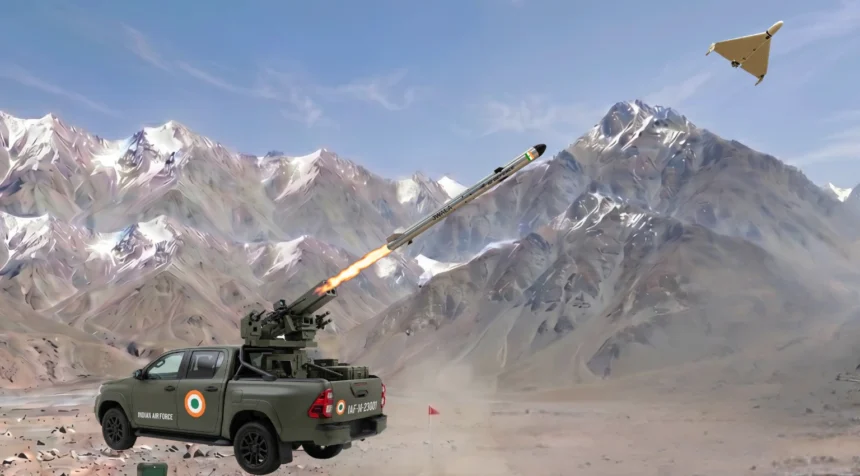
IG Defence, the startup that began in 2018 as IG Drones mapping mines and pipelines in Odisha, has test-fired two solid rocket motors for JWALA, the micro-missile it is developing to kill hostile drones. According to Business Standard, the firings — conducted in the early hours of 3 October 2026 — are a key step toward what the company describes as India’s first indigenously developed private-sector micro-missile programme for a scalable hard-kill counter-drone capability.
The economics of drone warfare, answered with a missile
Drones have inverted the cost equation of air defence: a hostile quadcopter can cost a fraction of the interceptor sent to destroy it. Soft-kill systems — jammers and electronic warfare — are cheaper, but drones hardened against jamming or flying pre-programmed routes can shrug them off. JWALA is IG Defence’s answer to the gap between guns, jammers and full-size surface-to-air missiles: a compact interceptor designed to be built in volume and fired in numbers.
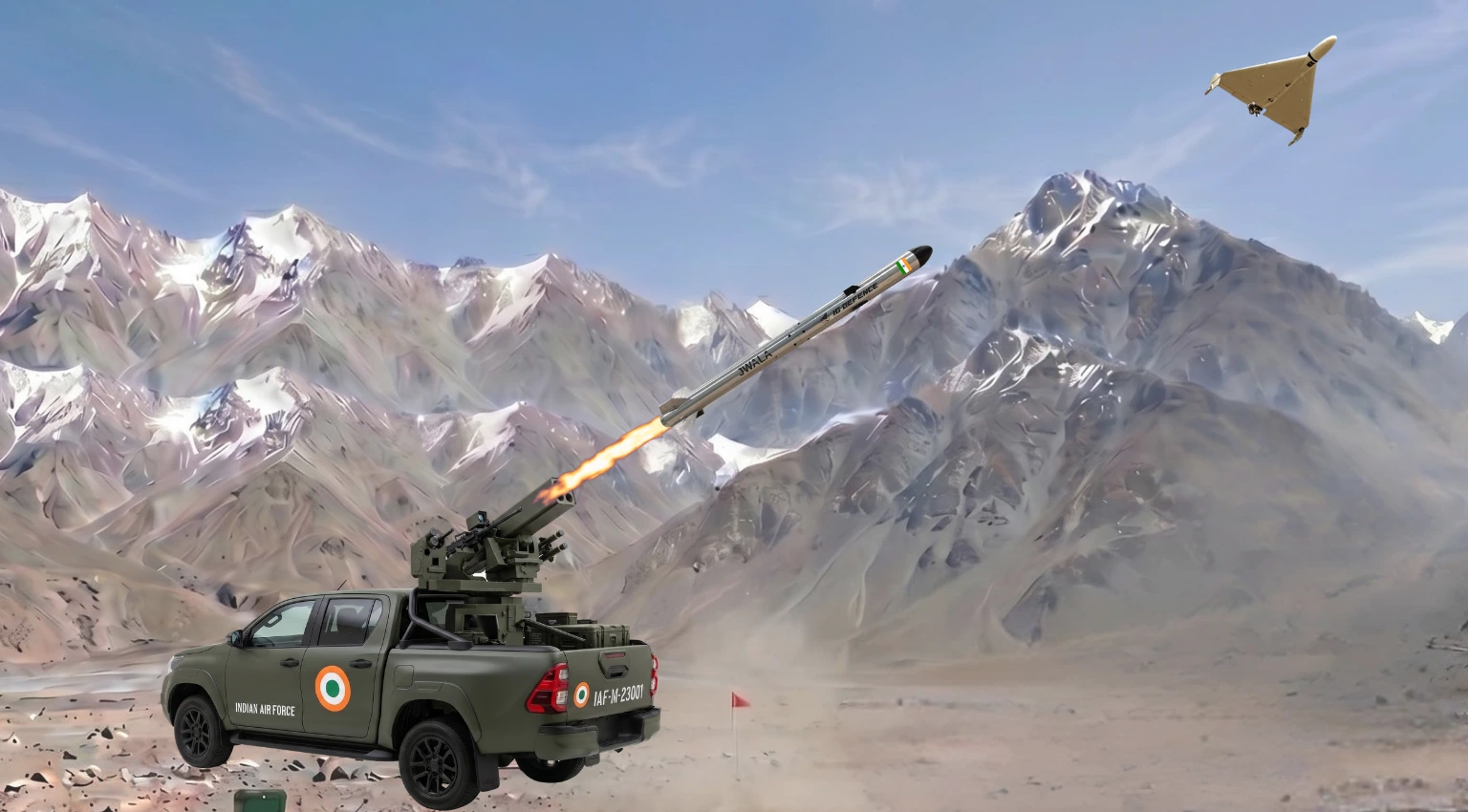
The company’s specifications for JWALA MK1, listed on its official product page, put it in the short-range air-defence class: an engagement range of 2–5 km and an altitude envelope of 50 metres to 5,000 metres, with air defence against UAVs as the mission role. Per the company, via Business Standard: propulsion comes from a dual-pulse solid rocket motor with fin control, the warhead is a 0.5–1.5 kg pre-fragmented high-explosive with a proximity fuze, the claimed circular error probability is under two metres at maximum range, and the system targets a reaction time of less than seven seconds from detection to launch. The launcher is configured as a truck-mounted multi-canister unit, giving the system mobility and magazine depth for sustained counter-UAS operations.
A brain and a muscle: JWALA inside GRID
IG Defence is not pitching JWALA as a standalone weapon. The missile is being developed as the hard-kill effector inside GRID Defend, the company’s AI-enabled battle-management architecture designed to fuse inputs from multiple sensors, build a common operational picture, assess threats and coordinate authorised responses. “JWALA becomes the hard-kill effect, while GRID provides the brain that coordinates the mission,” founder and CEO Bodhisattwa Sanghapriya told Business Standard. The same architecture already runs the company’s soft-kill layer: T-SHUL BEAM, an electronic-warfare counter-drone system, was demonstrated at the Indian Air Force’s Dronathon 2026 exercise in Pokhran.
From mapping drones to Operation Sindoor
The rocket-motor milestone caps a fast evolution. Founded by VSSUT alumni Bodhisattwa Sanghapriya and Om Prakash, the company spent its early years as IG Drones serving industrial customers in mining, energy and infrastructure — building, along the way, what it says were industry firsts including India’s first 5G-enabled drone and its first indigenous defence drone simulator. The company came into national view during Operation Sindoor, when it supplied FPV striker drones to the government, and has since been scaling its defence work: it raised around $5 million in a pre-Series A round led by India Accelerator and Finvolve, and bagged a significant Indian Army order for VTOL and FPV drones.
What remains
The company is careful to frame the motor firings as a propulsion milestone, not a finished weapon. JWALA still faces system integration, its first experimental flight trial in the coming months, and the long road of reliability, manufacturability and scalability testing. But if the programme matures, it would give India a domestically built hard-kill layer for counter-drone warfare — interceptors designed to be produced in meaningful numbers, in India, without depending on imported components in a crisis. That is the magazine depth India’s air-defence planners are increasingly asking for.