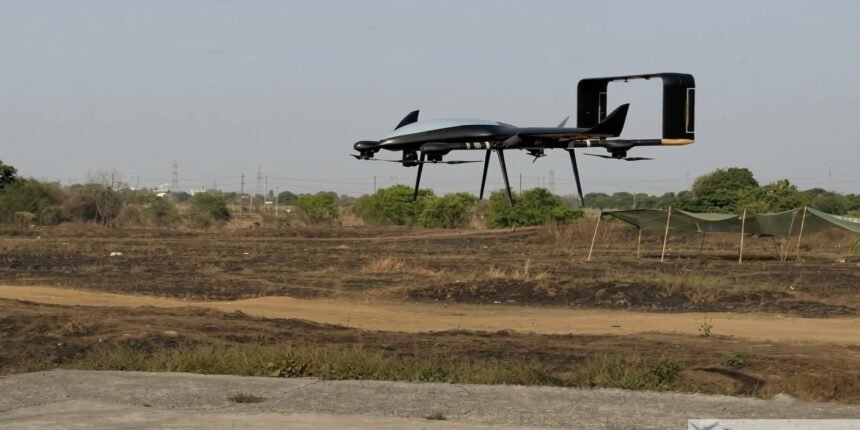
On modern battlefields, the first thing an adversary attacks is not the soldier — it is the signal. Jamming a drone’s GPS and radio link turns a sophisticated aircraft into scrap metal. Mumbai-based ideaForge Technology has spent nearly two decades building drones that refuse to die that way, and its ZOLT tactical UAV is the sharpest expression of that philosophy yet: a platform designed from the start to fly, navigate and deliver payloads when the enemy is actively trying to blind it.
In November 2025, the Indian Army put its money where the philosophy is. Following what the company described as extensive field trials in electronic-warfare environments and stringent country-of-origin checks, the Army awarded ideaForge a Capital Emergency Procurement order of around ₹75 crore for ZOLT — PTI-reported, not a company whisper — with deliveries to be completed within twelve months.
Why the Army trusted a drone in a jammed sky
The emergency-procurement route is the defence ministry’s fast lane for kit it needs quickly, and it does not hand out cheques lightly. The ZOLT order — alongside a ~₹30 crore order for ideaForge’s battle-tested SWITCH V2, taking the day’s total to roughly ₹100 crore — followed a competitive evaluation that put the aircraft through electronic-warfare scenarios. That is the hard part of the story: proving a drone can complete an ISR mission when GPS is denied and the data link is being jammed, the conditions in which A-THON’s ASHVA ATV proved its own ground-level resilience in Ladakh. Defence drones that cannot survive the spectrum war are expensive paperweights.
ZOLT’s answer is a three-pillar indigenous stack the company calls out explicitly: anti-jam communications, GNSS-denied navigation, and onboard intelligence that does the deciding at the edge instead of depending on a continuous data link. Put together, the aircraft can navigate and keep working when signals are degraded, disrupted or denied outright — the capabilities that turned the EW trials into a contract.
A platform that sees and strikes
Unveiled at Aero India 2025 in Bengaluru, ZOLT was positioned as a next-generation tactical platform bridging the gap between small quadcopters and large MALE-class aircraft. Reported figures from the unveiling put it at roughly 6 hours of endurance, a 10-kg payload capacity and an operational range past 50 km, with modular mission loads spanning electro-optical and infrared sensors through precision-strike armament. The weaponised end came through a partnership with Zeus Numerix, integrating smart guided munitions — an early signal that India wanted its own indigenous loitering-strike ecosystem rather than importing it.
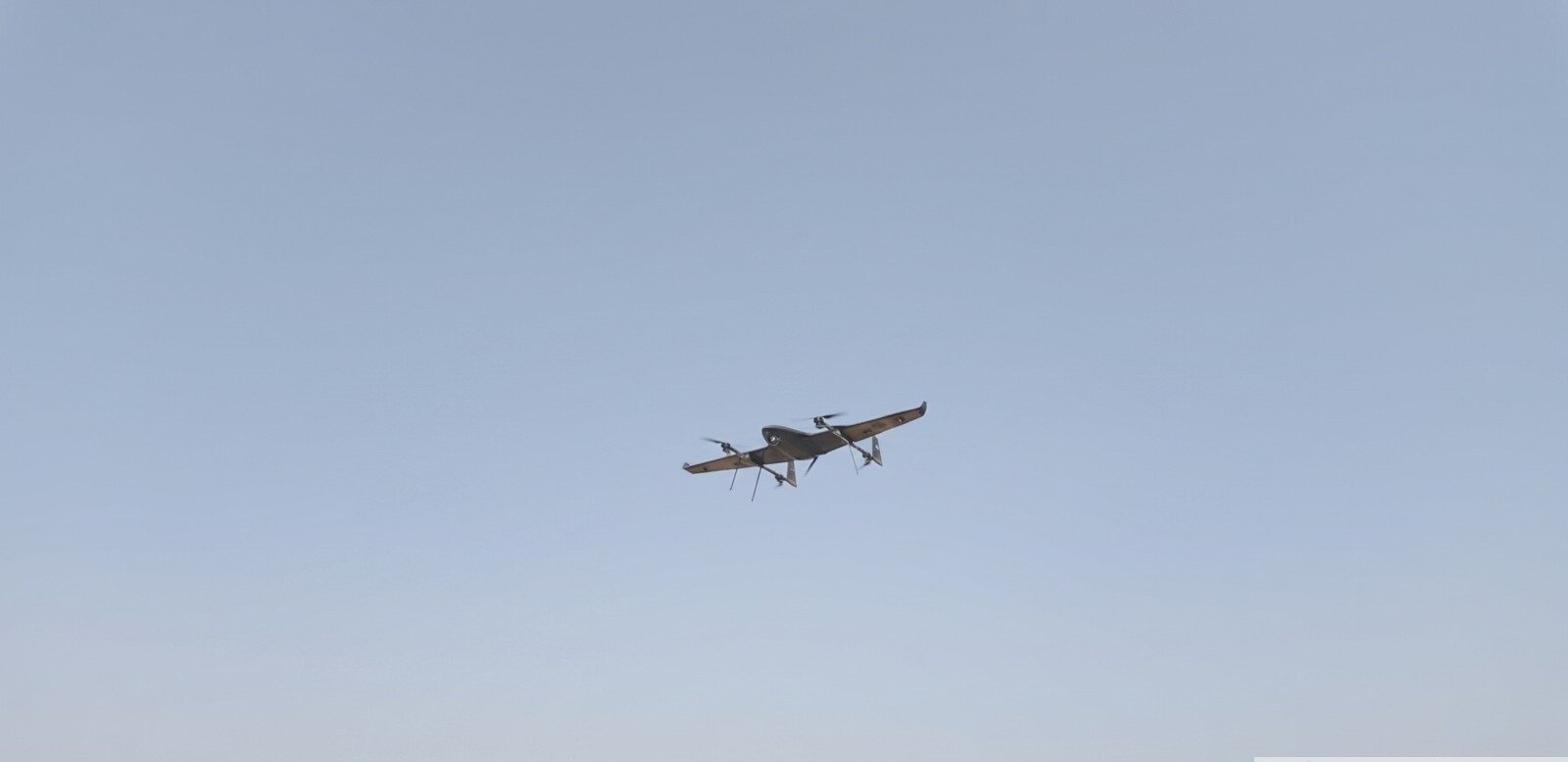
That matters because ZOLT arrived at the same moment India’s defence establishment was learning a blunt lesson: in contested airspace, the drone that survives is the drone that can think without phoning home. Onboard intelligence for tracking, threat detection and obstacle avoidance, combined with AI-enabled autonomy for GPS-denied flight, pushes the platform toward missions — counter-insurgency, border surveillance, tactical strike support — where loitering munitions would once have been the only answer.
More Read
October 2026: ZOLT grows into a family
On 6 October 2026, ideaForge announced that ZOLT had become a platform family rather than a single aircraft. The two new variants mark its entry into segments the company had never competed in before: long-range ISR and unmanned combat aerial vehicles.
ZOLT Hybrid pairs an internal-combustion engine with battery power for persistent overwatch — the company lists more than 6 hours of endurance, up to 100 km of line-of-sight data transmission, and launch capability from altitudes up to 2,000 m above mean sea level. A high-altitude variant, launchable up to 4,000 m AMSL for contested terrain, is to follow. ZOLT UCAV is the battery-powered striker built for tactical missions and “precision effects”: 2–3 hours of endurance, 30–50 km line-of-sight transmission, and launch altitudes up to 4,500 m AMSL — high enough for much of the terrain along India’s northern borders. Both sit on the same anti-jam, GNSS-denied stack, and both can carry ideaForge’s NAKSH family of ISR payloads — EO, infrared, MWIR observation, laser ranging and tracking.
Key takeaway
Key takeaway: ZOLT is not interesting because it is a new drone — it is interesting because the Army validated it in the specific conditions where most drones fail. The ₹75-crore order is the engineering verdict; the UCAV and Hybrid variants are the commercial one.
“The tactical long range UAV field is evolving from platforms that primarily see the battlefield to systems that can contribute more directly to the mission,” said Sachin Pukale, AGM of Product Management at ideaForge, at the October launch — a statement borne out by the company’s experiments under its ideaForge Labs programme, where ZOLT has been demonstrated carrying and deploying an air-launched autonomous effector mid-flight. The company is careful to call those demos experiments under active development in controlled conditions, not finished products. The discipline is refreshing; the direction is unmistakable.
The bigger picture is what makes this an exceptional-technology story rather than a procurement story. ideaForge — founded in 2007 by IIT Bombay engineers, now a listed company — has become India’s pre-eminent drone maker not by chasing the cheapest quadcopter but by stacking hard problems: EW resilience, indigenous content, air-launched effects. With ZOLT, it is building what the armed forces asked for in their own acquisition language — survivability in a jammed, GPS-denied sky — and the rest of the portfolio, from the logistics YETI heavy-lift programme to the NATO training deal, suggests the ambition travels beyond India’s borders too.
What is the ZOLT UAV?
ZOLT is ideaForge Technology’s multi-role tactical unmanned aerial vehicle, unveiled at Aero India 2025. It combines VTOL launch with fixed-wing endurance and is built for long-range ISR and precision payload delivery in high-threat, signal-contested environments.
What does “GNSS-denied navigation” mean?
It means ZOLT can navigate and complete missions without relying on satellite positioning (GPS/GNSS) — using onboard sensors and intelligence instead — so it keeps working when the enemy jams or denies those signals.
How big is the Indian Army’s ZOLT order?
Around ₹75 crore under the Capital Emergency Procurement route, announced in November 2025, with deliveries due within 12 months. A separate ~₹30 crore order for ideaForge’s SWITCH V2 took the day’s total defence orders to roughly ₹100 crore.
What are the ZOLT Hybrid and ZOLT UCAV variants?
Launched 6 October 2026. The Hybrid (IC engine + battery) offers 6+ hours endurance and up to 100 km line-of-sight transmission for persistent overwatch; the UCAV (battery-powered) offers 2–3 hours and 30–50 km transmission for tactical precision-effects missions, launching from up to 4,500 m AMSL.
Sources & further reading
- Business Standard / PTI: ideaForge’s ~₹100 cr Army order (Nov 2025) — The ₹75-crore ZOLT Capital Emergency Procurement order, EW-environment trials and country-of-origin checks
- Aviation & Defence Universe: ZOLT Hybrid and ZOLT UCAV launch (6 Oct 2026) — Full press release with variant specifications, NAKSH payloads and company quotes
- ideaForge Labs: Tactical Deployment with ZOLT, Phase 2 (official video) — The air-launched effector experiment, described by the company as under active development in controlled conditions
- Indian Defence News: ZOLT unveil with smart munition capability — The Aero India 2025 unveiling and Zeus Numerix smart-munition partnership