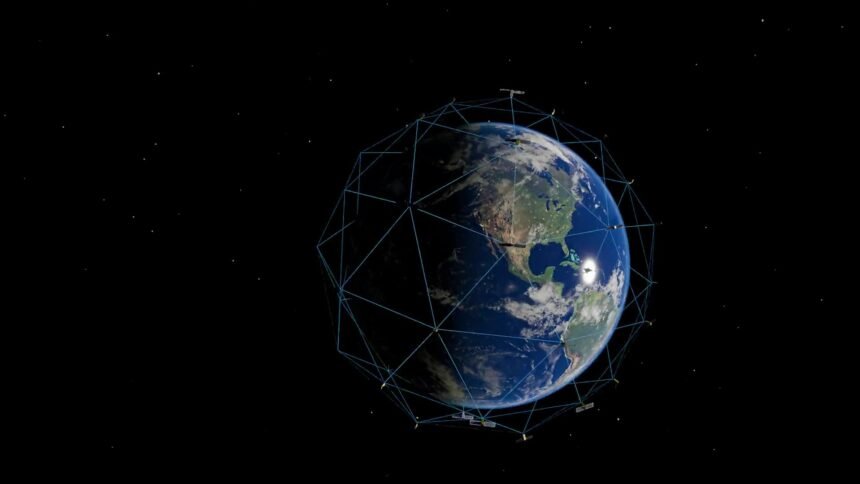
A modern Earth-observation satellite can image vast swathes of the planet in a single pass, capture terabytes of data a day, and then throw most of it away. Legacy radio links, capped at 1–2 gigabits per second, can offload only a fraction during the brief windows a satellite spends over a ground station. As QOSMIC’s co-founder and CEO Shreyaans Jain tells it, roughly two-thirds of the imagery a satellite collects is overwritten before it is ever downlinked. The bottleneck, in other words, isn’t in space — it’s on the ground.
A Bengaluru deep-tech startup is trying to replace that ground layer entirely. QOSMIC builds laser-based optical ground stations designed to catch satellite data at 10 gigabits per second, on a stack the company says is designed to scale to 100 Gbps — about a hundred times faster than the radio systems they replace — at a claimed cost of $1 per gigabyte, with no spectrum licence required.
ARGUS: many telescopes, one aperture
For decades, optical ground stations have been built around one assumption: if you want to collect more light from a satellite, you need a bigger telescope. QOSMIC says that logic breaks down past a point — large telescopes are expensive, slow to build, and a single failure can take the whole station offline.
ARGUS, the company’s optical ground station, takes the opposite route: an array of smaller phased telescopes that work together as one aperture. The modular design can be scaled by adding more telescopes rather than replacing the entire system, and there is no single point of failure — if one telescope goes down, the rest of the array keeps working. The architecture behind ARGUS was granted a US patent in under a year from filing, which the company frames as significant because the technology was conceived, engineered and validated in India.
QOSMIC’s published specs for ARGUS: an effective aperture of 0.5–1.0 metres, 1550 nm C-band, data rates of 1–100 Gbps, sub-arcsecond beam tracking with atmospheric turbulence compensation, deployment in under six months, and standards interoperability with CCSDS 142.0-B, ESTOL v2.2 and SDA 4.0.
ZAPHOD: the space end of the link
Ground stations are only half the stack. The other half is ZAPHOD, QOSMIC’s satellite optical terminal — a sub-3 kg laser communications payload for LEO, rated at 1–10 Gbps for CubeSat to SmallSat form factors. ZAPHOD is being co-developed with TakeMe2Space, the Hyderabad company building orbital data-centre infrastructure, for its MOI satellite constellation.
More Read
The two companies are going further: a joint programme to develop optical inter-satellite link (OISL) systems, with QOSMIC building the optical terminals and TakeMe2Space contributing high-precision gimbals, satellite bus interconnects and attitude-control hardware and firmware. The first optical communications terminal is scheduled for launch in the second quarter of 2027 — a step toward what the companies describe as India’s first sovereign laser-based satellite data relay network, routing data between satellites instead of waiting for ground-station visibility.
Proven over 10 km of open air
The hard part of optical communications is pointing, acquisition and tracking: locking a pencil-thin laser beam from a satellite hundreds of kilometres up onto a ground receiver, and holding it there while both ends move. In under a year since founding, the company says it field-validated its complete optical chain — pointing, acquisition, tracking and high-speed data transfer — over a 10-kilometre terrestrial link outside laboratory conditions, reaching Technology Readiness Level 6. An in-orbit demonstration is the next milestone.
QOSMIC’s longer plan is network-level: more than 50 stations operated as one unified network, with weather-adaptive scheduling that routes each downlink to the clearest sky, automated handoffs and a claimed 99.9% network uptime.
The bet behind it
QOSMIC was founded in 2025 by Shreyaans Jain, who built his foundation working on satellites at the Indian Institute of Science — including private missions and projects linked to the Gaganyaan programme under the mentorship of co-founder Prof. Aloke Kumar — alongside Dr. Rohit Ramakrishnan as co-founder and CTO. The company is incubated at IISc’s ARTPARK, and in July 2026 raised a $3.33 million seed round co-led by Accel and Prosus, with South Park Commons, ARTPARK and angel investor Manish Jain participating.
A few caveats belong alongside the claims. Optical links are blocked by cloud cover — the weather dependence is real, which is precisely why the 50-station network is part of the design. And not everyone is sold: as The HinduBusinessLine noted, GalaxEye CEO Suyash Singh has argued that the energy cost of precision pointing is better spent taking more images, and that he is content with radio for now. The 100x throughput and $1/GB figures are the company’s own; independent operators have yet to verify them at scale.
Why it matters
QOSMIC’s argument is that the centre of gravity in space is shifting from sensing to computing — orbital data centres and AI processing in orbit will generate traffic at scales radio physically cannot carry. Radio spectrum is crowded, expensive to license, and easy to intercept; an optical beam from low Earth orbit lands in a footprint about the size of a tennis court, making it inherently difficult to eavesdrop. On that view, optical infrastructure isn’t a ten-times improvement over radio — for the traffic that’s coming, it’s the only way to land the data at all. If the company is right, the ground segment is the missing layer of the orbital economy — and this one would be built, patented and validated in India.