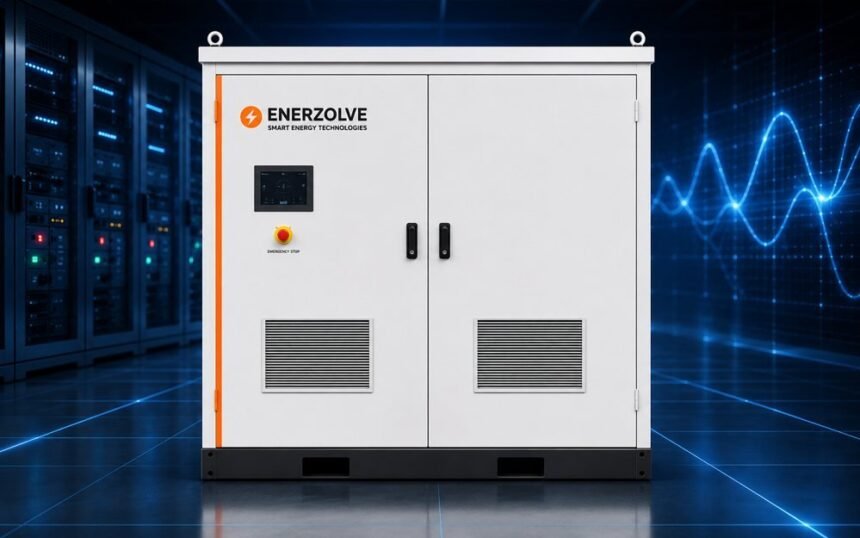
Image credit: Enerzolve Smart Technologies
Solar panels get the ribbon-cuttings and batteries get the headlines. But between a solar farm’s direct-current output and the alternating current your home actually uses sits a box that decides whether the whole energy transition works: the power conversion system. For years, India has mostly bought that box from abroad. A Bengaluru startup founded in November 2024 is betting the box should be designed and built at home.
The company is Enerzolve Smart Technologies, and its lead product is a bidirectional power conversion system (PCS) — a two-way inverter that ties battery energy storage to the grid, pulling AC from the network to charge and pushing it back as AC on discharge. The systems span 30 kW to 2.5 MW, and the engineering argument is simple: switch at high frequency with silicon-carbide (SiC) devices, and the magnetics — the coils and cores that handle power inside the unit — shrink dramatically. The company says its 2.5 MW unit is designed to weigh around two tonnes, a fraction of what conventional hardware of the same rating demands.
According to the company, the system is ready and is undergoing testing and certification. The timing is deliberate: India’s grid is being rebuilt around renewables and utility-scale storage, and the converters that connect batteries to the network are becoming the load-bearing wall of the whole structure. Enerzolve has raised $5.1 million (about Rs 45 crore) in seed funding co-led by Jungle Ventures and Kae Capital, with angel participation from founders of Zetwerk, Livspace and Unacademy, and was named to YourStory’s Tech30 2026 cohort of India’s most promising deep-tech startups.
The PCS: high frequency, small magnetics
A power conversion system is the control point of a storage installation. On charge, it rectifies grid AC into DC for the battery; on discharge, it inverts stored DC back into grid-quality AC, and in Enerzolve’s architecture it can also interface solar PV directly, enabling PV-to-battery, PV-to-grid and battery-to-grid power flows. The company’s platform is built on a multilevel neutral-point-clamped (NPC) topology with SiC switching, which it rates at over 98% peak efficiency across the full load range.
The quiet technical story is modularity. Every converter the company builds is assembled from the same validated power block on a common TMS320 DSP control platform with CAN and Modbus interfaces — add modules and you add power, from kilowatts to megawatt class, without redesigning the system. Modules are N+1 redundant and hot-swappable, so one can be serviced while the system keeps running. The inverters support both grid-following and grid-forming control with black-start capability, aimed at the IEEE 1547, CEA and IEGC grid codes, and the hardware is engineered to IEC 62477 and IEC 61000 standards. The target applications are utility-scale solar-plus-storage, grid-tied battery systems, microgrids, renewable integration and EV fast-charging hubs.
More Read
The specifications above are the company’s stated design targets — what is independently verified is the hardware effort: the startup says it has filed patents in India and the United States for some of its products, and its converters are moving through the testing and certification gauntlet that Indian utilities demand before any hardware gets near a substation.
A transformer with no iron
Enerzolve’s second act is the more radical one. A conventional transformer is a 19th-century machine — an iron core, copper windings, oil cooling — and it does one passive job: step voltage up or down. Enerzolve’s planned solid-state transformer (SST) does the same job with power electronics and software instead of an iron core: smaller, regulated, and able to hand a DC bus straight to storage and EV charging.
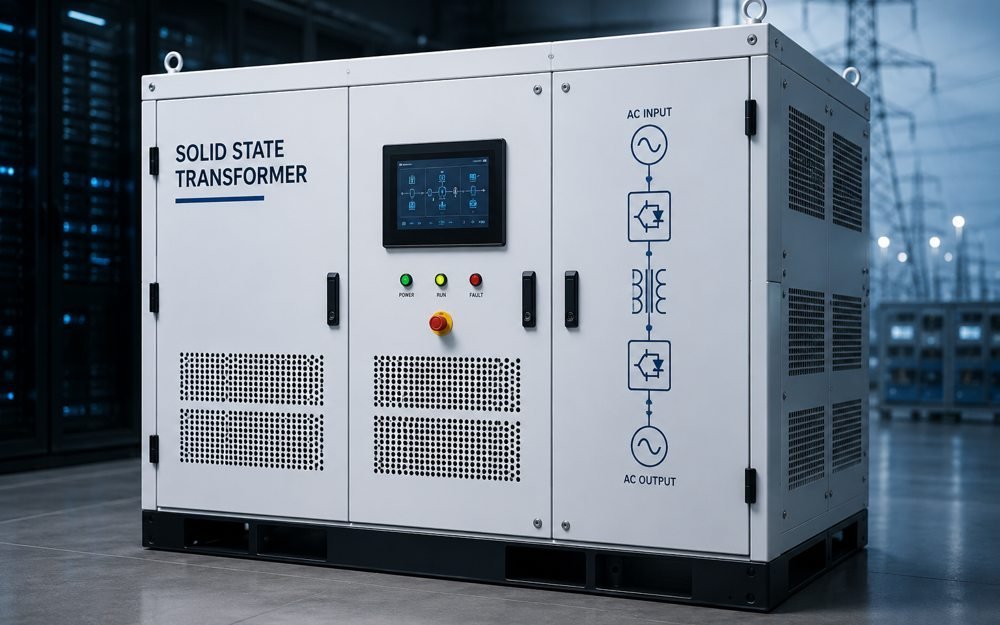
The design steps medium-voltage AC (11–33 kV) down to low-voltage AC (up to 1,000 V) through high-frequency isolation, in two configurations: MV AC to LV AC, and MV AC straight to a regulated, fully isolated low-voltage DC bus — the latter removing the need for a separate rectifier stage to feed DC loads and storage. The company lists industrial and commercial distribution, renewable collection substations, traction and rail auxiliary supply, smart-grid interconnection, EV fast-charging hubs, BESS DC-coupling, data-centre DC power, DC microgrids and electrolyser supplies as the intended applications.
That product is still under development, so it belongs in the roadmap column rather than the shipping column. But the direction is clear: Enerzolve wants to replace the bulkiest, most passive component on the grid with a software-driven power electronics device.
Meters, magnetics, and manufacturing in Yelahanka
Power conversion is one of three verticals. The company also builds instrumentation — smart energy meters and ultrasonic smart water meters — and energy storage systems, from batteries and battery management systems to energy management software. Its metering products are manufactured and certified in India, with BIS, ISI and CPRI certifications, plus MID and ISO 4064 compliance for the water meters — the paperwork that lets hardware qualify for India’s smart-metering programmes and utility tenders.
The manufacturing base matters to the story. Enerzolve is headquartered in HSR Layout, Bengaluru, with a manufacturing facility at the Hitech Defence and Aerospace Park in Yelahanka and offices in Kolkata and Noida. The company’s own description is that it designs and builds its systems in India for both Indian and global markets — aimed at utilities, engineering firms, OEMs and infrastructure developers across energy, automotive, railways and industrials.
The people and the playbook
Enerzolve was founded by Abhay Adya, who serves as CEO, and Anupam Kumar Bhatt as co-founder. Adya has spent more than 15 years across the energy transition and large infrastructure, with leadership roles at Zetwerk, Sterlite Power, Adani Energy Solutions and Larsen & Toubro; Bhatt managed operations under Adya at Zetwerk before a stint at Rivexa. Between them, they bring around three decades in power, infrastructure and manufacturing — which is the experience their investors have said they were backing.
That background shapes the playbook: both founders spent years on the buying and building side of grid infrastructure, which is where they encountered the gap the company now addresses. And Adya is disarmingly honest about how far indigenisation goes. Power semiconductors — the IGBTs and SiC devices that handle heavy currents — are imported, because India has no semiconductor manufacturing capability. But as he told YourStory: “the firmware, the magnetics, the design, the PCBs, everything is built in India.” The strategy is to localise the parts of the stack where Indian engineering can actually compete, rather than pretend the whole stack is indigenous.
Between a certified meter portfolio already in production, a megawatt-class converter moving through testing, and a solid-state transformer on the drawing board, Enerzolve is doing the unglamorous work the energy transition actually runs on: making the hardware that connects the sun and the battery to the grid — and making it in India. The inverter between the battery and the substation may never get a ribbon-cutting, but nothing on the new grid works without it.
Sources: Enerzolve Smart Technologies (enerzolve.com), YourStory, The Economic Times, Inc42. Performance and specification figures are the company’s stated claims; funding and certification facts are independently reported.