Image credit: Okulo Aerospace
A drone that never needs to land to refuel is not a new dream. Solar wings have been sketched on whiteboards for decades, but making one fly — reliably, legally, and in the thin, freezing air over the Himalayas — is where the dream usually ends. A Bengaluru startup has now done the harder thing: it got India’s aviation regulator to sign off.
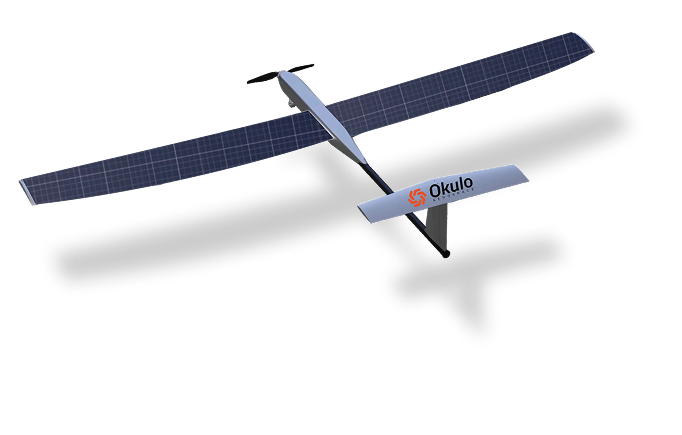
The company is Okulo Aerospace, and its small fixed-wing aircraft SUVI V1 became, early in 2026, India’s first DGCA type-certified solar-electric UAV in the sub-10-kilogram class. The certificate matters because type certification is the regulator’s stamp of airworthiness — it moves a machine from experimental curiosity to something defence and commercial operators can actually buy and deploy. In a drone industry crowded with battery-swapping endurance tricks, Okulo’s bet is simpler and harder: harvest the sun, fly longer, and build the whole aircraft in-house so nobody else’s supply chain can ground it.
That bet is now pointing higher. At the India Mobile Congress 2026 in October, the company stood on stage as one of six winners of the Ericsson Innovation Challenge — picked from more than 800 applicants nationwide — with a pitch that scales the SUVI philosophy to the edge of space: a solar-powered High Altitude Pseudo Satellite (HAPS) cruising at 20 kilometres, acting as a cell tower in the sky for the half-billion Indians who are still offline.
The sun as fuel: SUVI V1
SUVI is a hand-launched, solar-electric fixed-wing UAV. According to the company, it can stay airborne for up to seven hours with a range beyond 50 kilometres, drawing from solar cells laminated across its long wings and a proprietary onboard energy system. It needs no runway — a launch crew can throw it into the sky from a patch of open ground — and it carries interchangeable payloads, so operators can swap cameras and sensors in the field to match the mission.
The company says the platform is designed for hostile conditions: freezing temperatures, high winds, and the harsh Himalayan envelope that punishes conventional UAVs. Encrypted communication links with anti-jamming features are built in, aimed at contested electromagnetic environments. Whether the full endurance figures hold in every operating condition is the company’s claim — but the regulatory milestone is not: the DGCA type certificate is a public fact, and independent press coverage of the certification corroborates it.
More Read
In September 2026, Okulo demonstrated SUVI to the Southern Coast Guard and Coastal Police for maritime surveillance — persistent aerial watch over coastline that is expensive to patrol by ship and aircraft. The use cases the company lists are familiar — border surveillance, mapping, environmental monitoring, infrastructure inspection, disaster response — but the economics of a sun-powered airframe change the pitch: surveillance that keeps going after the fuel budget would normally say stop.
HINET: the mountain machine
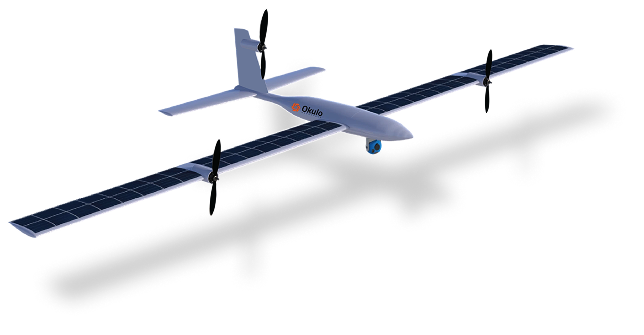
While SUVI handles the low-altitude, long-endurance role, Okulo’s second platform aims at a different physics problem. HINET is a solar-powered medium-altitude, long-endurance (MALE) UAV with vertical take-off and landing capability, built for the Defence Ministry’s iDEX challenge. The company describes it as India’s first solar-powered MALE-class VTOL, engineered to operate at altitudes approaching seven kilometres — the kind of height where mountain borders live and ordinary drones falter.
The VTOL architecture removes runways from the equation entirely, which is the point: forward posts, improvised clearings, and mountain ridgelines are exactly where persistent surveillance is most valuable and least available. Harvesting solar energy during flight stretches endurance profiles that battery-only VTOL designs cannot touch.
Twenty kilometres up: the HAPS gamble
The most ambitious layer of Okulo’s roadmap leaves the tactical drone business behind. The company’s planned HAPS platform is designed to operate in the stratosphere, above 60,000 feet — above conventional air traffic and weather — delivering telecommunications, earth observation, and remote sensing from a perch that blends the reach of a satellite with the repositionability of an aircraft.
The economics case at the Ericsson stage was connectivity. The company’s pitch: a single solar HAPS aircraft flying at 20 kilometres could deliver direct-to-phone 5G coverage over roughly 3,800 square kilometres with latency under 10 milliseconds — ground-tower-quality signal over terrain where towers do not reach and satellite links are too slow or too expensive. With over 500 million Indians still offline, and disaster-hit regions where telecom recovery can lag for days, the company argues a stratospheric tower that can be flown to where it is needed beats a mast that cannot move.
That is the company’s framing, and it deserves the usual caution: HAPS is one of aerospace’s most unforgiving engineering challenges — stratospheric winds, thermal extremes, and energy budgets that must balance for months. What Okulo brings to the argument is flight-proven hardware beneath the ambition: the certified SUVI and the iDEX-built HINET are not renders, they are machines the company has built and flown. The startup says it is now looking for telecom operators and public-sector partners to run a 5G-enabled HAPS pilot in an underserved rural corridor.
The people and the playbook
Okulo was founded in 2019 by Parithi Govindaraju and Abiseka Akash Ganesan. Govindaraju holds a PhD in aerospace engineering from Purdue University and spent years as a senior research scientist at United Technologies Corporation, with research work alongside NASA, the US Air Force and the FAA; Ganesan studied sustainable energy technology at TU Delft in the Netherlands. The pair’s pedigree shows in the company’s playbook: everything designed in-house, down to motors and structures, with a team of under 30 people and backing that includes Ideaspring Capital’s defence portfolio.
That vertical integration is the quiet technical story here. Solar-endurance UAVs live or die on the grams: airframe weight, motor efficiency, solar-cell integration, and energy management software all compound into whether the aircraft can survive the night on stored power. Okulo told YourStory in late 2025 that its long-term goal is drones that stay aloft for days or even months, harvesting energy by day and storing it for night flight. SUVI’s seven-hour figure is the first rung of that ladder, not the last.
Between a certified aircraft already flying, a Himalayan VTOL built under iDEX, and a stratospheric 5G tower on the drawing board, Okulo Aerospace is doing what the country’s deep-tech ecosystem is supposed to do: turn a hard physics problem — staying airborne on sunlight — into an industrial capability India did not have before. The regulator’s certificate on SUVI suggests the physics is already paying off. The next question is whether the sky at twenty kilometres will pay too.
Sources: Okulo Aerospace (okuloaerospace.com), Ericsson IMC 2026 press release, YourStory, Indian Masterminds, IDRW. Performance and coverage figures are the company’s stated claims; certification and challenge-winner facts are independently reported.