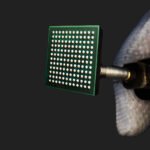
India makes solar panels at scale — the country has some 144 gigawatts of module capacity — but the foundation they stand on is imported in its entirety: polysilicon, the ultra-pure feedstock every solar cell and semiconductor starts from, comes almost exclusively from China. A Chennai startup wants to break that dependency at the atomic level. Evoxia has developed a proprietary hydrogen-plasma process that converts silica directly into high-purity elemental silicon, bypassing the toxic chemistry and enormous energy bill of the conventional Siemens process. The company says its route delivers six-nines (6N) purity polysilicon with up to 95% fewer emissions.
A different chemistry for making silicon
The legacy Siemens process dominates global polysilicon production, but it is brutally energy-hungry — 100 to 110 kilowatt-hours per kilogram of silicon — and runs on a hazardous silicon-tetrachloride loop. Evoxia’s answer is a plasma-based reduction reactor the team designed entirely in-house, right down to the chamber geometry and nozzle configuration. Hydrogen plasma breaks silica into elemental silicon in a closed loop that, the company says, eliminates silicon tetrachloride completely: the only effluent is carbon monoxide, which it claims to valorise into secondary bioproducts.
The technical milestone Evoxia points to is validation, not just concept. Its process is TRL 4 validated, with ICP-MS data confirming purity of 99.9999% — 6N, meeting the SEMI standards required for Czochralski ingot pulling, the method used to grow the monocrystalline silicon ingots that become solar wafers. On intellectual property, the startup says it has filed two patents — one published and under examination — with four more on the way.
The claims, with the caveats attached
Evoxia’s headline numbers are aggressive, and all come from the company itself: roughly 80% less energy than the Siemens route (a 20x energy advantage in its framing), 95% fewer emissions, and a lab-scale throughput of 10 kilograms per hour — about 70 metric tonnes a year. It estimates gross margins around 70%, based on projected energy-efficiency gains, an estimate YourStory noted is yet to be validated at commercial scale. That honesty matters: every one of these figures still needs proving on an industrial line, which is precisely the step the startup is preparing for next.
The road to wafers
Evoxia’s immediate focus is solar, where it is in discussions with prospective customers for paid pilots that would require several tonnes of material, and is awaiting letters of intent from three partners. The longer arc is more ambitious: push purity to nine-nines for solar and eleven-nines for semiconductor-grade silicon, and eventually become a wafer manufacturer in India — moving further downstream once its silicon meets spec. A one-tonne-per-annum pilot plant is in preparation as the bridge to commercialisation.
The company behind the plasma
Evoxia Labs India Private Limited was founded in 2024 by mother-son duo Nirmala and Harsh Chordia, with Harsh as CEO. It is a DPIIT-recognised startup incubated at IIT Kanpur and PIEDS BITS Pilani, supported by EDII Tamil Nadu through the IVP voucher programme, and has taken about Rs 1.3 crore in grants and accelerator funding. It was featured in Forbes India’s Top 100 Startups to Watch in 2025 and named to YourStory’s Tech30 2026 cohort; it is now preparing to raise roughly $1.5 million in pre-seed funding.
More Read

India’s solar story so far is a story of assembly — modules put together from imported cells, cells from imported wafers, wafers from imported polysilicon. If Evoxia’s plasma route survives contact with industrial scale, the country’s clean-energy supply chain could start one link further back: at the silica itself. The pilots will be the test. Watch whether the LOIs convert and whether the six-nines holds at tonnes, not kilograms.