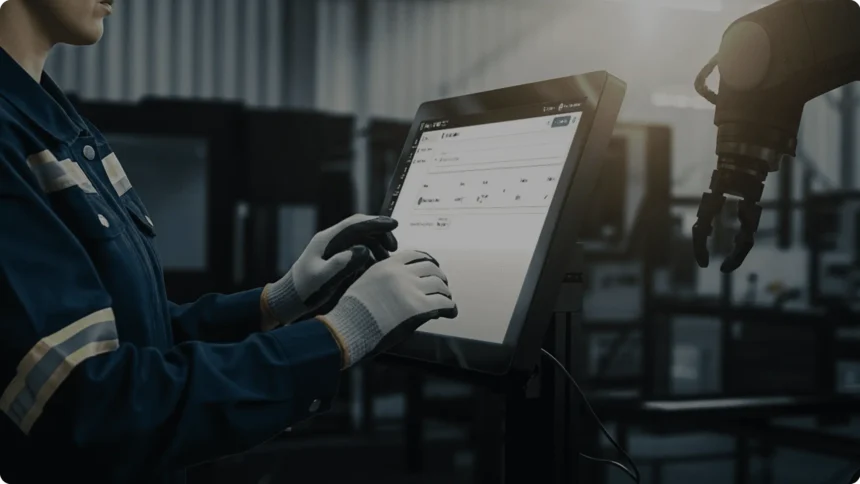
Ask a question on a factory floor and wait for the factory to answer. That is now an everyday reality inside an electronics plant in Tirupati, Andhra Pradesh, where an operator can type a plain-language question — which work orders are stalled, where defects are clustering, which supplier documents are pending — and an AI assistant answers it from live production data. Then, when authorised, it acts: rescheduling, rerouting, and keeping a record of every action for review. The software listening is Fynd Forge — and the company that built it is better known for selling India’s retail than for running its factories.
Fynd is a Mumbai retail-technology company founded in September 2012 by Farooq Adam, Harsh Shah and Sreeraman Mohan Girija. The company — Shopsense Retail Technologies — began with interactive in-store screens and grew into the commerce engine behind thousands of brands; in August 2019 Reliance Retail Ventures took an 86.69% stake for ₹295.25 crore, and today the company says its platform serves more than 2,300 brands. Forge marks a bold new chapter: the company calls it an “AI-native manufacturing OS” that unifies planning, procurement, hardware integration, assembly, quality and shipping into one agentic platform.
The system was launched in 2025, and it is now in live production — not a demo, not a pilot — at the Tirupati electronics facility of NeoLync, where it runs end-to-end shop-floor operations. Across more than 100 stations and nearly 90 process stages, around 160 operators use Forge concurrently during each shift. It carries each unit from component receipt and assembly through testing, packing and dispatch, validating components, enforcing quality checks and blocking any product with an unresolved quality issue from being shipped.
The engineering depth shows in the details. Forge plans with capacity-aware schedules for SMT, testing and packing, auto-replanning instantly if a reflow oven or SPI machine goes down, and locks the manufacturing bill of materials by product variant. It connects directly to shop-floor hardware — SPI, AOI and X-ray inspection, reflow ovens and PLCs — capturing machine and test data in real time, auto-detecting process deviations and triggering instant interlocks and corrective steps. Mandatory step-by-step assembly scans bind component barcodes to individual PCBs, while failed checks are automatically routed to rework stations. Quality data is bound to serial numbers and IMEIs, building an audit-ready electronic device history with complete traceability from component lot to PCB to finished device to carton to shipment — the kind of genealogy regulators and brand owners demand. Packing is barcode-driven with region-specific labelling compliance, and ASNs and e-invoices generate automatically from packing scans.
Then comes the AI layer. Forge’s built-in assistant lets factory teams query live production and quality data in natural language — finding stalled work orders, investigating defect patterns, processing supplier documents and building workflows — and carry out authorised tasks with every action recorded for review. Forecasting capabilities support production planning, while daily AI briefs, SPC dashboards and proactive bottleneck alerts give supervisors what Fynd calls “lead with clarity”: a full view of factory health without digging through spreadsheets.
For NeoLync, that clarity matters at scale. The company — founded in 2019 by Ruvi Shaibel, backed by Israel’s Neolync Holdings and with a ₹20 crore investment from Reliance Strategic Business Ventures — is one of the electronics manufacturers approved under MeitY’s large-scale electronics PLI scheme, building mobile phones, telecom products and computing devices at its Andhra Pradesh facilities. Running multiple manufacturing programmes with different assembly processes, testing requirements and quality controls on the same floor is precisely the chaos Forge was built to tame. “Running different manufacturing programmes on the same floor means managing distinct processes, tests and customer requirements,” said Harish Kumar, Head of Business Operations at NeoLync. “Forge brings these into one system while retaining the controls each programme needs. Our teams can track a unit’s production history, understand its quality status and know whether it is ready for the next stage.”
More Read
For Fynd, the deployment at NeoLync is the proof that its engineering travels beyond retail. “Manufacturing is a new business segment for Fynd and a significant step in our growth beyond retail,” said Farooq Adam, Founder of Fynd. “With Forge, we are extending our technology from how products are sold to how they are made. Our partnership with NeoLync has grounded this expansion in the realities of a working factory, where every component, production step, and quality decision matters. We are entering this sector with a system already running live manufacturing programmes, giving us a strong foundation to serve more manufacturers and build this business further.”
There is a pleasing symmetry to the story. A company that spent fourteen years making India’s retail smarter — from touchscreen catalogues to omnichannel commerce — is now making India’s factories smarter, with an AI-native OS built for the shop floor. If Forge proves itself at NeoLync’s scale, the factory that talks back may soon be a very Indian export.
Forge on the shop floor: an operator works with the Forge interface on a factory touchscreen. Image: Fynd
Keep reading: The End of Air Cooling: Inside Refroid Technologies, the Hyderabad Startup Plunging India’s AI Data Centres Into Liquid · Forty Percent of the Calls: Inside Arrowhead AI, the Bengaluru Startup Teaching Voice Bots to Speak India’s Languages · More Industrial Automation & Technology stories
Like stories like this? Add Exceptional Technology as a preferred source on Google to see more of our reporting in your search results and Discover feed.