Some jobs need a human’s judgment but no human should stand anywhere near them. In one of its trials, a robot built in Bengaluru picked up a measuring cylinder full of chemicals and poured it into a laboratory beaker — while its operator stood safely out of the room, wearing a VR headset and haptic gloves. The arm simply copied the operator’s hand movements, at a distance.
The company behind the demo is Integra Robotics, the deep-tech robotics brand of Social Hardware International Pvt. Ltd. Founded in 2017 by Abhit Kumar (co-founder and CEO) and Cameron Norris, the startup builds robotic hardware and software for factories, defence and subsea work — and its central bet is that all three can run on one modular platform.
Built like Lego, not like appliances
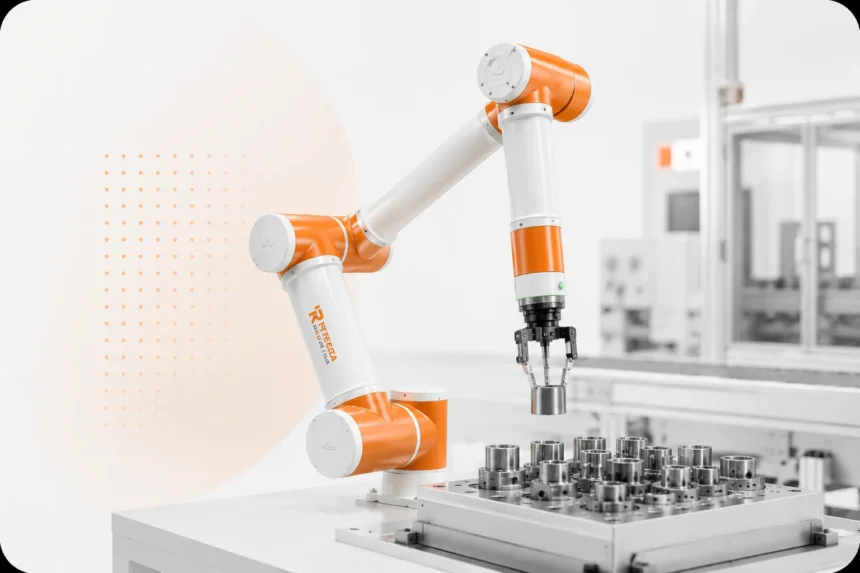
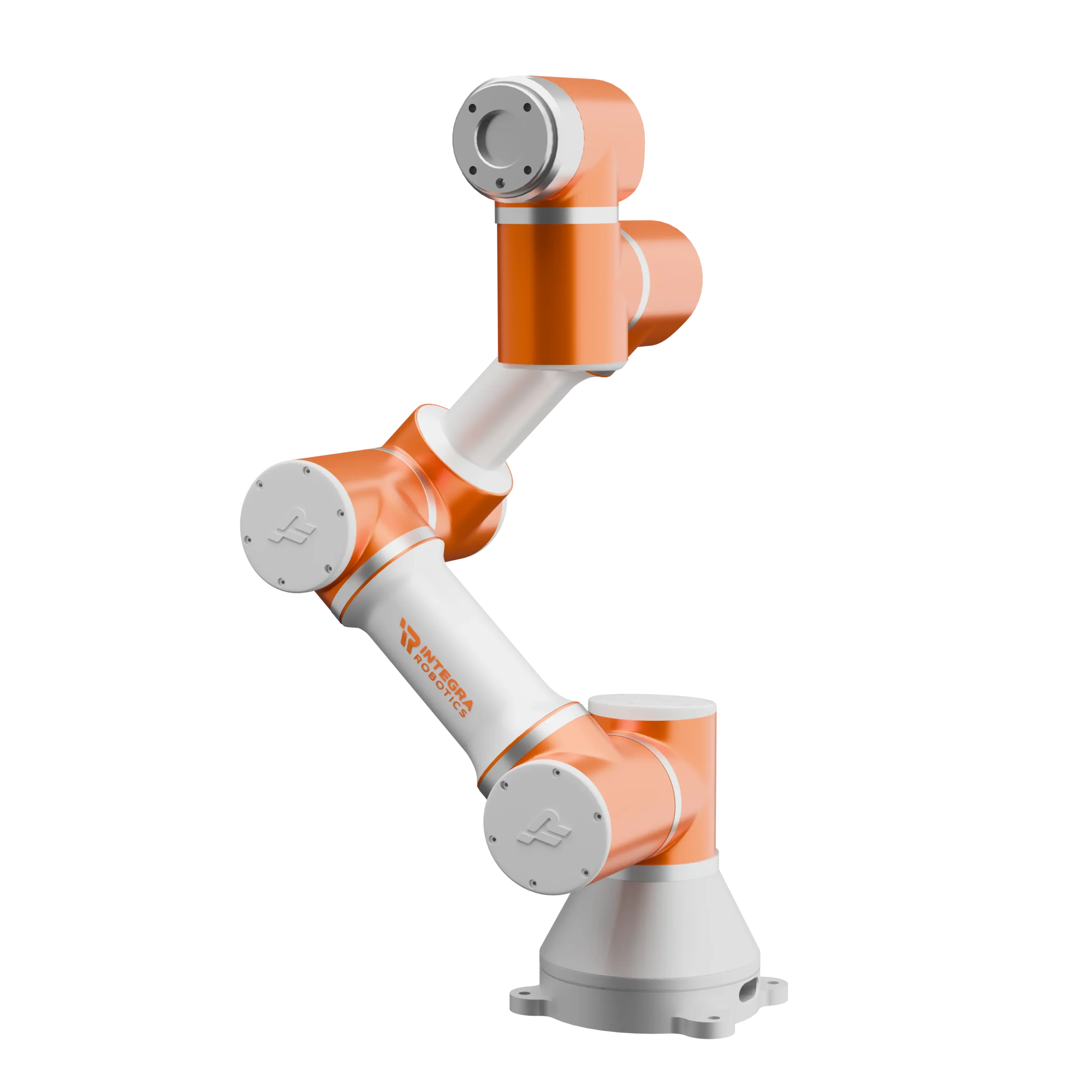
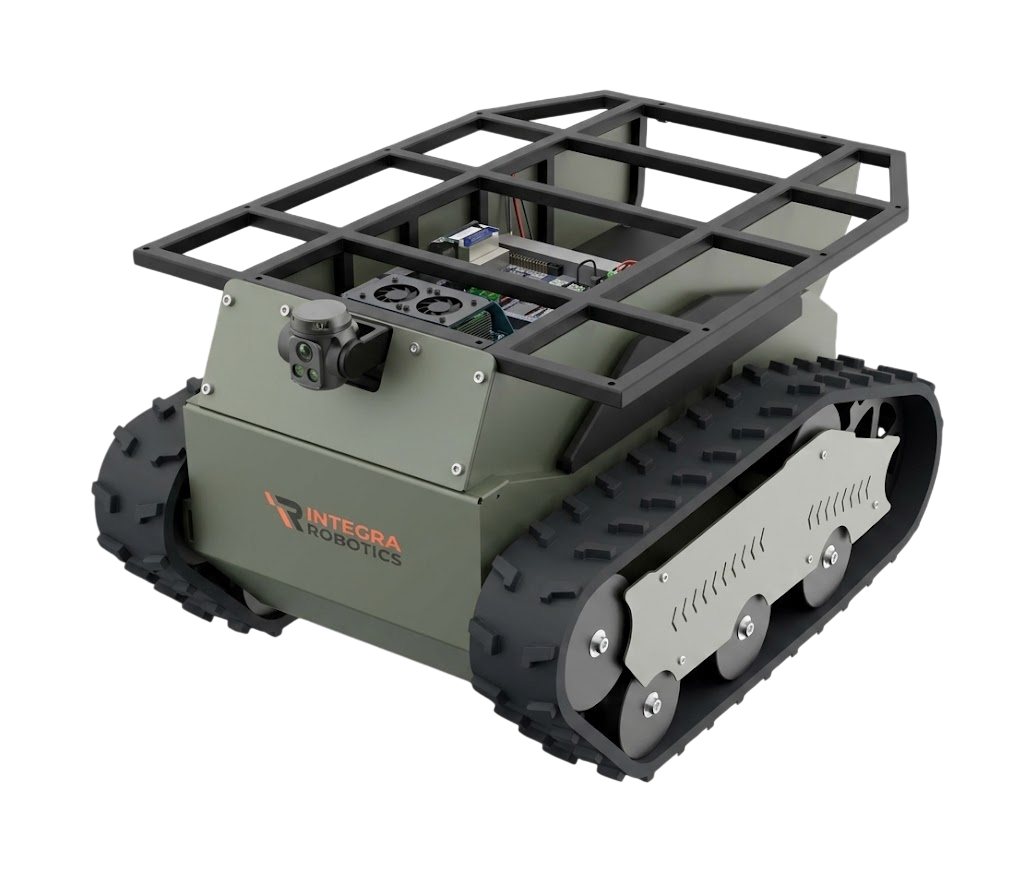
Most robots are built like appliances: one machine, one job. Kumar describes Integra’s hardware platform instead as Lego — reconfigurable modules the company can arrange for different tasks without redesigning the product each time. The industrial line is a family of four six-axis collaborative robot arms — the P3-R600, P5-R900, P10-R1300 and P20-R2000 — spanning 3 to 20 kg of payload and up to 2,000 mm of reach. Beyond arms, the range includes a heavy-duty tracked UGV rated for 500 kg and the R-ATV, a tracked remote-intervention platform carrying a six-axis manipulator arm plus 150 kg of cargo, rated IP67, and operable remotely from up to 10 km away — pitched at disaster relief, mining, infrastructure inspection, IED/EOD response and military surveillance. The company lists 14 robotics SKUs and says 95% of the design is done in-house.
Modularity runs through the supply chain too. The company says it has standardised roughly 50–60% of its bill of materials across defence and commercial products, and it pre-builds its systems, settling the final configuration only once a customer places an order. The robots are manufactured in Bengaluru, where Integra 3D-prints carbon-fibre components in-house. About 65% of components are sourced locally, Kumar says; the rest come mainly from the Western Hemisphere, with some sourced from China with approval from the defence ecosystem.
Teleoperate today, automate tomorrow
The software stack operates in three modes: teleoperation, where the robot mirrors a human operator; supervised autonomy; and fully autonomous operation. The company says all three layers have been developed, and it has been granted Indian patent IN597459 B1 for a teleoperation system that lets a person drive a humanoid-like robot remotely through a VR headset, body-motion tracking and haptic gloves. It also sells a tele-operation SDK with 200+ Hz synchronisation for capturing physical-AI training data.
Every deployment feeds the next one. Depth cameras record the arm’s movements and surroundings in timestamped episodes, along with force and joint feedback, and the company uses reinforcement learning and machine learning to turn that data into simulations before loading refined models back onto the hardware. It is, in effect, a human-in-the-loop data flywheel: people handle the hard edge cases now, and the machines learn from them. Over the next year the startup wants to gather roughly 20,000 hours of operational, manipulation and environmental data to keep feeding that layer.
More Read
Where the robots already work
Integra currently has six paying customers, most of them private companies and system integrators. Its deployments so far include underwater robotic arms supplied to EyeROV — the Kochi marine-robotics company whose TROUT vehicles have been ordered by the Indian Navy — and robots for ordnance handling and explosive disposal supplied to Anuvyom Alliance. For government buyers it works through companies that already supply government agencies, with those suppliers keeping Integra’s products in inventory.
The startup has raised about Rs 12 crore: a seed round led by Inflexion Point Ventures in 2024, followed by a pre-Series A round in May 2026 led by Finvolve and India Accelerator with GrowthCap Ventures participating. It plans to deploy nearly 50 robotic arms for industrial automation over the next year, continue its underwater robotics work, and deliver ordnance-handling systems under existing contracts.
Caveats, honestly stated
Six paying customers is genuinely early, and the company has not named the private industrial customers in its order book — so the real breadth of factory demand is still to be proven. Full autonomy is also still a work in progress: Kumar says the company continues to develop the autonomous manipulation models that would let robots operate without human intervention in hazardous environments. The claim that a robot deployed in one industry could later be redeployed in another “without training” is a roadmap statement, not a demonstrated result.
And while the Made-in-India story is real — Bengaluru manufacturing, in-house carbon-fibre printing, 65% local sourcing — the sourcing note that some components come from China (even with defence-ecosystem approval) shows how far even determined builders remain from full supply-chain indigenisation. Rs 12 crore is modest capital for a hardware company with this breadth of ambition, so the next raise will determine how far the platform idea travels.
Still, a Bengaluru startup building one reconfigurable robotics stack that spans factory floors, bomb disposal and the deep sea — with paying customers in all three directions — is exactly the kind of unglamorous, hard-engineering bet worth watching.