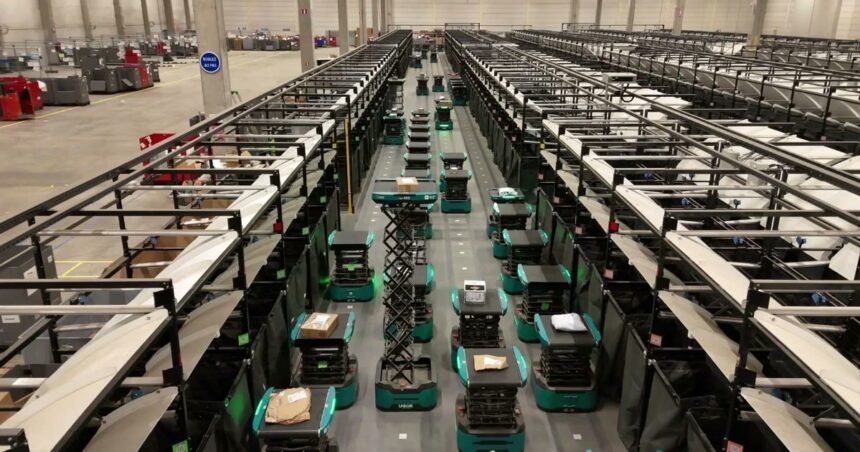
In a warehouse outside a major Indian metro, the floor has run out. Parcels keep arriving faster than people can sort them, and renting a bigger building means renting more air — most of it empty space above the racks. In Pune, a robotics company decided the answer was not more floor, but more sky. Unbox Robotics has built UnboxSort, a fleet of swarm-intelligence robots that sorts parcels vertically — climbing racks, dodging each other and dropping packages into the right chutes at speeds the company puts at up to 20,000 parcels an hour.
Image: Unbox Robotics (official company image) — the UnboxSort swarm sorting parcels in a live warehouse.
Up, not out: the vertical warehouse
The idea is simple and radical at once. Traditional sorters are long, hungry machines — kilometres of conveyor belts and cross-belt loops that eat floor space and lock a warehouse into one layout. UnboxSort works the other way: a swarm of autonomous mobile robots operates in 3D space, lifting parcels up vertical racks and sorting them into destinations — orders, routes, stores, carriers — without a single metre of fixed conveyor.
Because the robots use the vertical space warehouses already have, the company says UnboxSort cuts the sorting footprint by roughly 50 to 70 percent, doubling space density. The whole system is modular: operators add or remove robots as volumes change, and the company says a deployment goes live in under two weeks — weeks, where conventional sorters take months of construction and commissioning. It is, the company says, the world’s first patented vertical robotic sortation system of its kind.
Swarm intelligence, 99.9 per cent accuracy
The engineering underneath is where it gets interesting. The robots coordinate like a swarm — the company’s swarm-intelligence software assigns robots to chutes dynamically and reroutes them in real time, so there is no single point of failure and throughput holds through peak-season surges. Machine-learning algorithms tune the flow as parcel mixes change through the day.
More Read
The company says the system sustains 99.9 per cent sorting efficiency, handles anywhere from 2,000 to 20,000 parcels an hour depending on fleet size, and triples personnel productivity. When every mis-sorted parcel is a failed delivery promise, that kind of accuracy is the whole business case.
From Pune to the world
UnboxSort is now running in fulfilment centres, sort hubs, delivery hubs and returns facilities across India, Europe and the United States — with hundreds of the modular robots deployed and global e-commerce and retail names including Myntra, DTDC, the Miroglio Group and Inditex trusting it with their operations. The company says Western markets already account for the overwhelming majority of its revenue, and its systems have been built for international reliability from the start.
That global traction has drawn serious capital. In January 2026 Unbox Robotics closed a $28 million Series B round co-led by ICICI Venture and Redstart Labs (Info Edge), with F-Prime, 3one4 Capital, Navam Capital and Force Ventures participating — on the back of what the company describes as more than five-fold year-on-year growth and profitability.
A Pune origin story
Unbox Robotics was founded in 2019 by Pramod Ghadge and Shahid Memon, who met through the Entrepreneur First programme. Ghadge is an alumnus of BITS Pilani and the National University of Singapore who had previously worked at Flipkart — where he was involved in implementing the company’s first robotic sorting systems — while Memon brought a robotics background and a master’s from the University of York. Their answer to the e-commerce sorting bottleneck is designed and manufactured in India, with proprietary hardware and software.
In September 2026 the company’s robots were showcased at the Bharat Innovates Exposition in New Delhi, where they were presented to the Prime Minister and BRICS leaders touring India’s deep-tech showcase — a fitting stage for a system that took a warehouse problem every country faces and solved it from a Pune engineering floor.