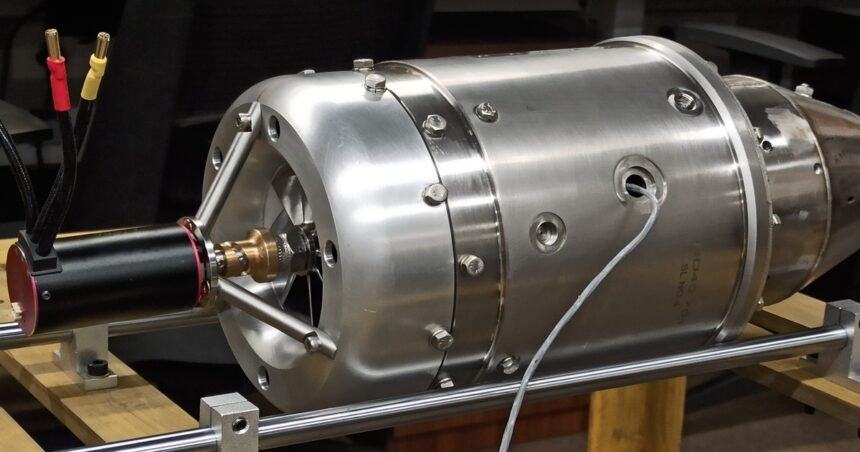
India designs drones, light aircraft and cruise missiles — and for the engines that power them, it has long had to look abroad. Gas turbines are among the hardest machines in engineering to build well: they run hot, spin at nearly 100,000 revolutions a minute, and have to hold their tolerances for thousands of hours without failing. In January 2026, a Bengaluru startup showed how quickly that gap can close. Nabhdrishti Aerospace ran its first micro gas turbine, the ND400, just nine months after starting from a clean sheet of paper — a 400-newton turbojet that weighs less than four kilograms.
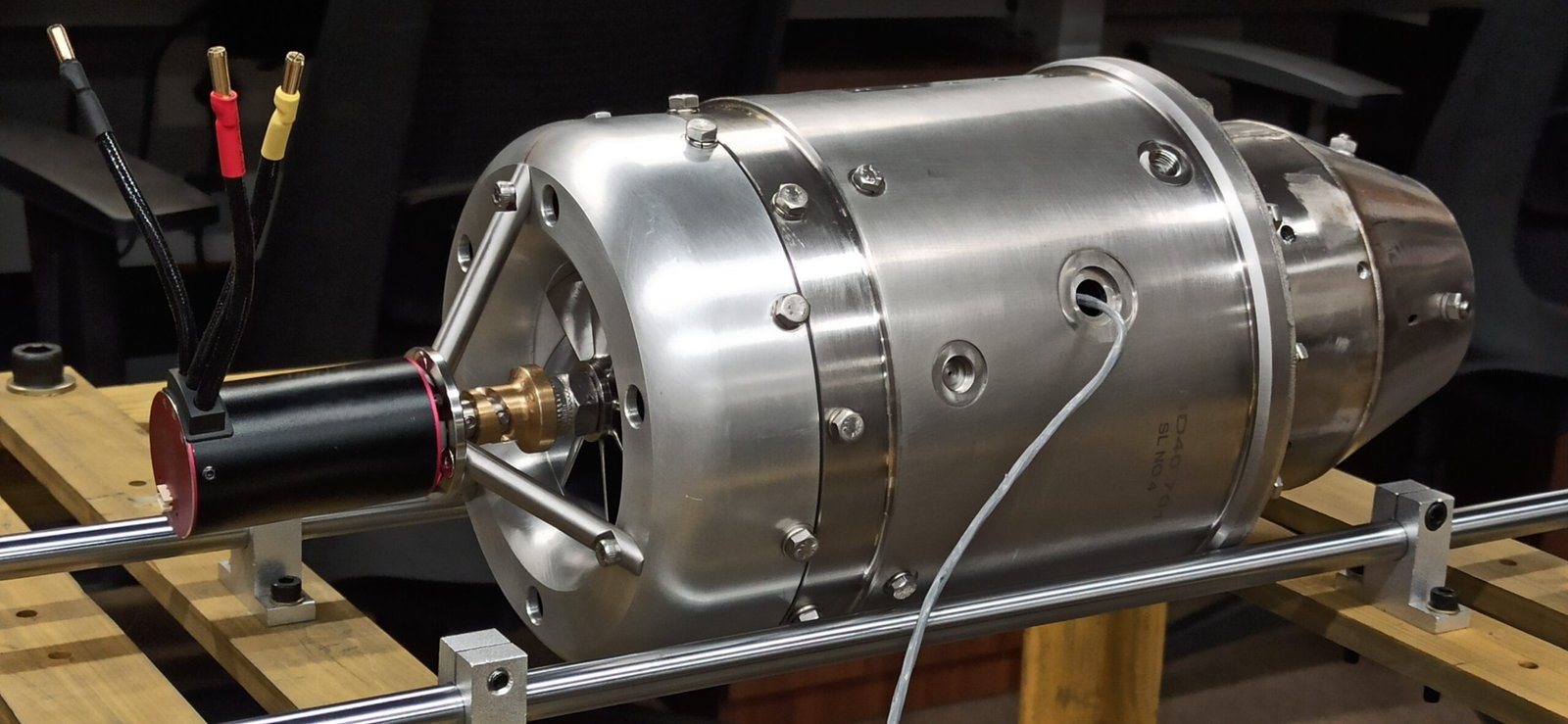
The ND400 is built for unmanned aircraft and small aircraft, and the company publishes its numbers itself: 400 newtons of maximum thrust, a top speed of 95,000 revolutions per minute, an engine just 145 millimetres across and 395 millimetres long, and a whole propulsion system — engine, starter and all — of 5.2 kilograms. The company says it can fly to 10,000 metres and up to Mach 0.85, which puts it squarely in the class of engines that power surveillance drones, target drones and small one-way aerial platforms.
One core, two machines
The clever part is not a single engine but the plan behind it. Nabhdrishti builds one micro gas turbine core and derives two kinds of machine from it. The ND400 is the propulsion version, a turbojet for aircraft. The same core also becomes a power generator: the ND350, a 275-kilowatt turbogenerator that doubles as a 350-shaft-horsepower turboprop, and the ND2000, aimed at industrial and defence users at up to two megawatts. One development programme, spread across aviation and power, instead of two.
The other design choice is fuel flexibility. The engines are built around a fuel-flexible combustor that the company says can burn LNG, natural gas, hydrogen, flare gas, biofuels and conventional fuels like diesel and jet fuel, with nitrogen oxide and carbon dioxide emissions down by more than 80% against conventional engines. The company uses 3D printing across the design to keep the hardware elegant and the cost down — a practical answer to the oldest problem in turbine building, which is that developing one is expensive and slow.
From GTRE to the test stand
Nabhadrishti was founded in Bengaluru in 2023 by Rohit Chouhan, Arjun Srivatsa and Antanu Sadhu, who between them have worked at General Electric, Rolls-Royce and the Gas Turbine Research Establishment, the DRDO laboratory that develops engines. The company raised Rs 3 crore in a pre-seed round led by IIMA Ventures in April 2024, then Rs 25.64 crore — about $3 million — in a seed round led by Accel in March 2025, with IIMA Ventures taking part again. The company said the money would go towards testing three engine prototypes, flight trials with customer UAVs, early revenue and hiring.
The January 2026 first run was the payoff. The company described the campaign as taking the engine from a clean-sheet design to a successful first run in nine months, and published video of the test. Ground testing is now nearing completion, with flight trials next, and the company says it aims to be India’s leading propulsion provider by 2032. The wider ecosystem is noticing: in November 2026, GTRE director Dr S. V. Ramana Murty named Nabhdrishti among the Indian startups building small gas turbines in his map of the country’s growing fighter-engine supply chain.
More Read

The ND400 is small — it fits in a backpack and weighs less than a bowling ball — but the point is bigger than one engine. Every drone, light aircraft and generator that flies on an Indian-built turbine is one less import, one more capability designed, manufactured and tested at home. Nine months from a blank page to a roaring test stand is a start the whole sector can build on.
Keep reading: Fire Without Getting Out: Inside Kalyani Strategic Systems’ RAMS, the 120mm Mortar on Wheels · A Cleaner Push to Orbit: Inside Dream Aerospace, the Chennai Startup Building Green Thrusters for India’s Satellites · More Aerospace & Defense stories
Like stories like this? Add Exceptional Technology as a preferred source on Google to see more of our reporting in your search results and Discover feed.