


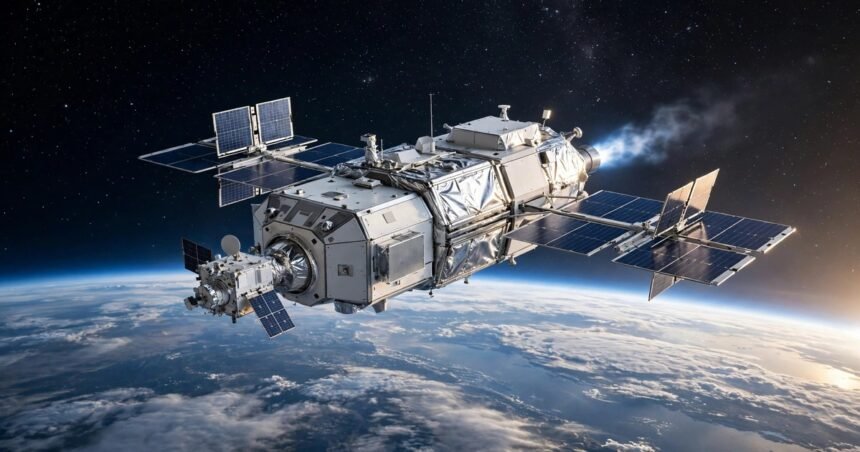
Every rocket that leaves Earth drops its satellites off somewhere near their destination — and then leaves them to fend for themselves. The launch vehicle can put a satellite into the general neighbourhood of its orbit, but the last stretch, the precise climb to the exact slot where it will spend its working life, is a journey the satellite usually has to make alone, burning its own limited fuel. A Hyderabad startup decided that last mile deserved a vehicle of its own: a space taxi that picks satellites up, ferries them to the right address, and then goes back for the next passenger.
That taxi is called Lucas, and it is being built by Stardour Aerospace. Founded in 2020 by Sankarsh Chanda and led by former ISRO scientist B. Rama Rao, the company has spent its first years working quietly on the hardest part of the problem first — the engine. In July 2025, Stardour test-fired India’s first privately developed hydrogen–oxygen propulsion engine at the Indian Institute of Science in Bengaluru, a milestone the company says puts it among a very small group of organisations worldwide working with green cryogenic propulsion.
The engine that breathes out water
Most orbital transfer stages today run on hypergolic propellants — toxic, corrosive chemicals that ignite on contact. Stardour’s thruster runs on liquid oxygen and liquid hydrogen instead, the same pairing that powered the Space Shuttle’s main engines and some of the most efficient rockets ever flown. The exhaust is, quite literally, water vapour.
The test at IISc validated a 1 kN-class thruster built entirely in-house, with the company reporting combustion efficiency above 95% and stable operation across its throttle range. For a small startup working with cryogenic fuels — hydrogen must be kept at around minus 253 degrees Celsius — getting a clean, stable firing on the first major campaign is the kind of result that turns a concept into a programme. IISc supplied vacuum-rated feed systems, high-speed diagnostics and safety oversight for the test, while Stardour supplied the design, the hardware and the instrumentation.
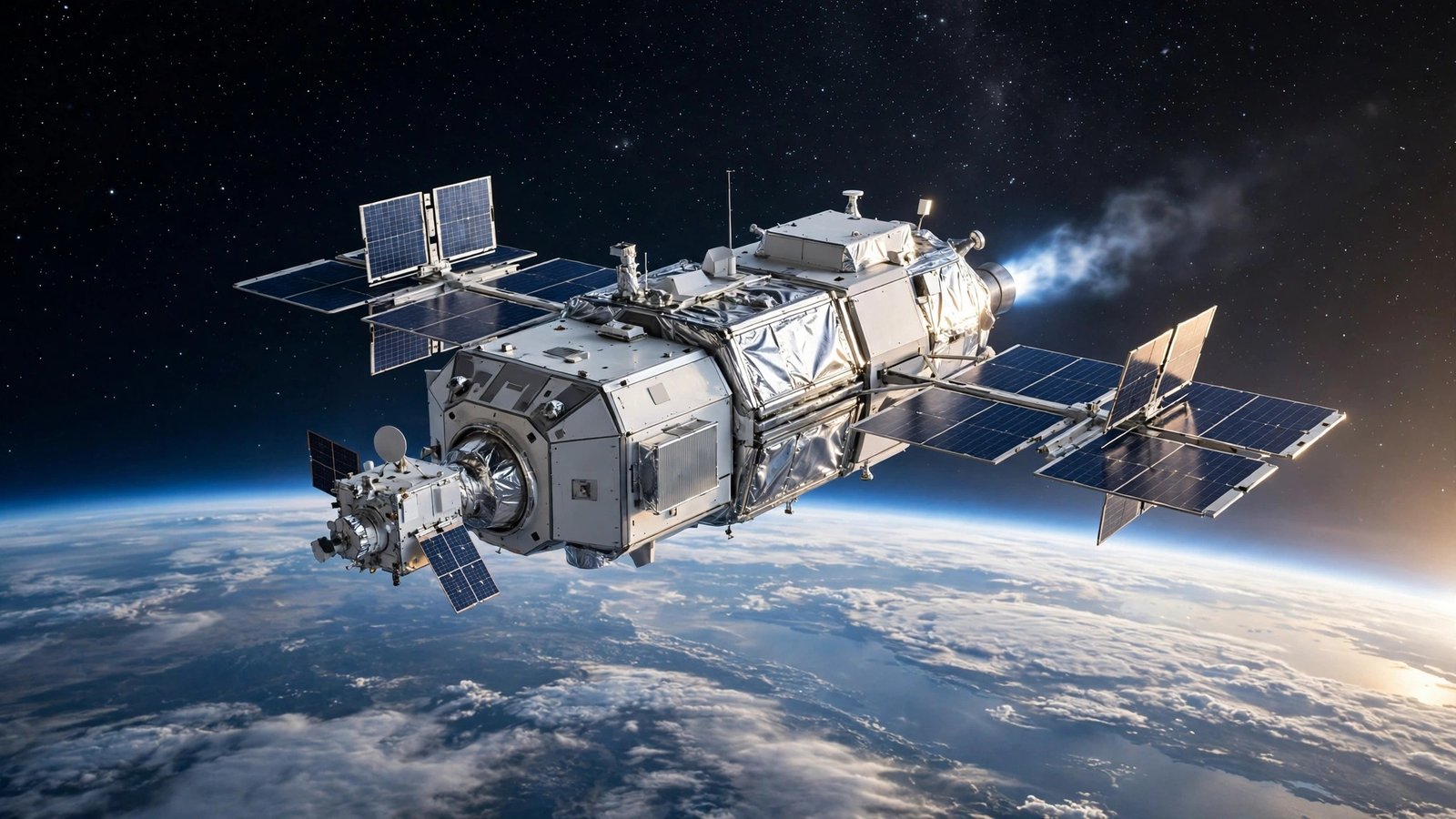 Illustration: Lucas, Stardour Aerospace’s orbital transfer vehicle, firing its hydrogen–oxygen engine above Earth.
Lucas, the space taxi
Lucas is the reason the engine exists. The modular orbital transfer vehicle is designed to meet satellites where their launch vehicle leaves them and haul them to their operational orbits — in low Earth orbit, geostationary transfer orbit and even cis-lunar trajectories. The company says early mission studies give Lucas a delta-V budget above 2 km per second with payload capacities of several hundred kilograms, figures made possible by the high specific impulse of the hydrogen–oxygen cycle.
More Read

The same vehicle is designed to do far more than deliveries. Lucas is being built for life-extension missions that keep ageing satellites working, for in-orbit refuelling, for clearing debris and de-orbiting satellites at the end of their lives, and for carrying telescopes, cameras and research payloads. Future concepts include a robotic arm for maintenance and proximity operations. The company is targeting the third quarter of 2027 for Lucas’s maiden flight, with missions spanning geospatial surveillance, agriculture, asset management and telecom.
A small team with a large orbit
Stardour remains a compact, largely bootstrapped team of around 40 engineers and scientists — about half of them focused on propulsion, the rest spread across structures, avionics, guidance and navigation, thermal systems and mission design. Alongside Chanda and Rama Rao, the leadership includes Vandana Anumagala, Head of Propulsion, and Vivek Satheesh, Mission Design Lead. The company is now raising around Rs 15–20 crore to expand the team, build an in-house test facility and complete subsystem development and integration.
Why it matters
India’s private space sector has learned to build rockets and satellites at remarkable speed since the industry opened up in 2020. Stardour is betting that the next frontier is what happens after the launch — the quiet, precise work of moving things around once they are already in space. A reusable, clean-fuelled tug that can deliver, service and retire satellites changes the economics of every mission it touches: satellites last longer, rideshare launches become more flexible, and orbits stay cleaner. If Lucas flies as planned in 2027, the company says it will be among the first privately developed liquid oxygen–liquid hydrogen systems to fly anywhere in the world — a Hyderabad engine, breathing out water, hauling India’s satellites to their front doors.
Keep reading: Thinking in Orbit: Inside SkyServe, the Bengaluru Startup Teaching Satellites to See for Themselves · Reading India From Orbit: Inside SatSure, the Bengaluru Startup Building the Country’s Own Earth-Observation Brain · More Aerospace & Defense stories
Like stories like this? Add Exceptional Technology as a preferred source on Google to see more of our reporting in your search results and Discover feed.







