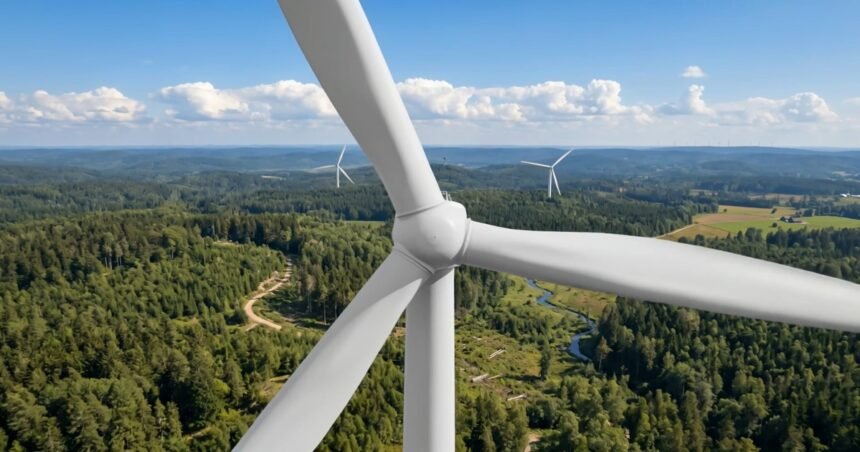
Image credit: Suzlon official photograph of its wind turbines.
Wind turbines spend their working lives making clean power. Now, three of India’s biggest names in energy and materials want the turbines themselves to be clean at the end of the story too. On 4 November 2026, at the Bharat Renewable Energy Summit & Expo 2026, Pune-based Suzlon Energy, Grasim Industries’ Advanced Materials Division and Aditya Birla Renewables signed an agreement to develop, commercialise and scale what the companies describe as India’s first wind turbines with recyclable blades.
The blade problem nobody sees
A wind turbine blade is a marvel of materials engineering: long, light, enormously strong, and built to flex through storms for decades. The companies say today’s blades are predominantly made from thermoset composite materials, and that toughness comes with a catch at the end of a blade’s service life — the material is difficult to recycle, so retired blades are often sent to landfill or incinerated.
As India’s wind fleet keeps growing, that end-of-life question grows with it. A truly clean energy system, the partners argue, should not leave its biggest parts behind. That is the problem this partnership sets out to solve, with chemistry rather than with a landfill.
Recyclamine: a blade designed to come back
The heart of the programme is Grasim’s Recyclamine epoxy technology. Blades manufactured using Recyclamine epoxy can be chemically recycled at the end of their life, the companies say, allowing valuable composite constituents to be recovered and reused in new applications. Instead of a blade that can only be discarded, the material itself becomes feedstock for what comes next.
Grasim’s Advanced Materials Division will supply the Recyclamine technology, and Suzlon, as the turbine maker, will integrate it into the manufacturing of recyclable blades. Rajesh Balakrishnan, chief executive officer of Advanced Materials at Grasim, said the collaboration marks an important step toward building a truly circular wind energy ecosystem, combining Recyclamine technology with Suzlon’s manufacturing expertise and Aditya Birla Renewables’ renewable energy capabilities.
More Read

Three companies, three jobs — and a turbine in the field
The partnership divides the work cleanly. Grasim supplies the recyclable epoxy. Suzlon builds it into blades. Aditya Birla Renewables will deploy a turbine fitted with the recyclable blades at one of its selected project sites, demonstrating the technology under real operating conditions rather than only in a laboratory.
The collaboration begins on a pilot basis, and the companies say they will explore wider adoption across India and other mutually agreed markets. Amit Jain, chief executive officer of Aditya Birla Renewables, said the partnership would help address the end-of-life challenges associated with wind turbine blades and advance circularity in the renewable energy sector.
From one pilot to every future turbine
Suzlon brings serious scale to the idea. The company says it has more than 22 GW of wind capacity installed across 17 countries, and its flagship S144 platform is, in the words of co-founder Girish Tanti, among the wind turbines with the lowest carbon footprints in the world. Tanti said Suzlon is working towards making all of its future turbines recyclable within the next three to four years, with the potential for significant carbon savings as material circularity takes hold.
Grasim, the flagship company of the Aditya Birla Group, has been building the surrounding ecosystem too: its Advanced Materials business recently signed an agreement with Organic Recycling Systems to set up a commercial recycling chain for composite waste. The blade, the chemistry and the recycling chain are all being built by Indian companies, for turbines that will spin in India and beyond.
Wind power already gives India clean electricity. With recyclable blades, the turbine itself joins the circle — a machine built to harvest the wind, engineered so that when its working life ends, its materials begin another one.
Keep reading: From Tirupati to Telangana’s Giga Corridor: Inside Amara Raja’s ₹2,320 Crore LFP Battery Bet · From Kakinada to the World: Inside AM Green’s 1.5 MTPA Green Ammonia Project · More Energy & Power stories
Like stories like this? Add Exceptional Technology as a preferred source on Google to see more of our reporting in your search results and Discover feed.