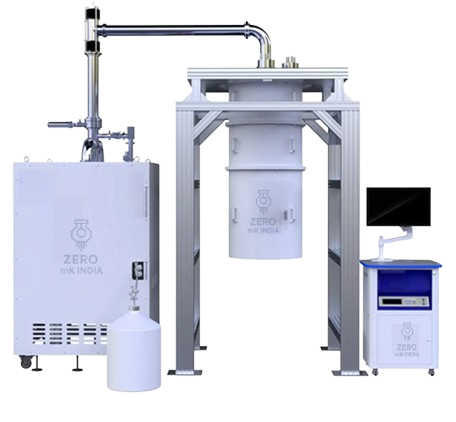
Image credit: Zero mK India — official company visual.
Twenty millikelvin. That is 0.02 degrees above absolute zero — roughly 135 times colder than the background temperature of deep space. It is also the temperature at which the quantum computers India wants to build this decade have to live. The catch: the machines that can make that kind of cold are not made in India. On 24 September 2026, the Defence Research and Development Organisation decided to change that.
DRDO signed its first high-value deep-tech project agreement under the Technology Development Fund (TDF) scheme — the first project from a Rs 500 crore deep-tech corpus approved by Defence Minister Rajnath Singh in November 2025 — with Zero mK India Private Limited, a startup from Alwar, Rajasthan. The contract: develop an indigenous 20 mK dilution refrigerator for quantum applications.
The machine: colder than the coldest thing in nature
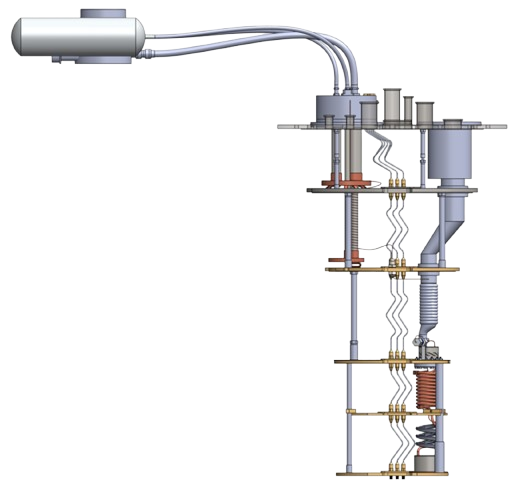
A dilution refrigerator is the cold room of the quantum world. It circulates a mixture of helium-3 and helium-4 through nested cooling stages to reach temperatures a fraction of a degree above absolute zero. Heat is the enemy of quantum hardware — thermal noise scrambles the fragile quantum states that superconducting processors, quantum sensors and secure-communication hardware depend on. Without a dilution refrigerator, you cannot operate or even properly test these devices.
Zero mK India is developing its system, called Shunya 0X, with a target base temperature of 20 mK or lower, a planned cooling power of 300 µW at 100 mK, a vector and single-axis superconducting magnet configuration, a large-diameter experimental flange and configurable RF, DC and twisted-pair wiring — all built around helium-3/helium-4 dilution refrigeration. The company says the project is in detailed design and development, with a first prototype expected in Q4 2027, and its longer-term ambition is a ~10 mK system at what it calls global standards.
More Read
The company: cryogenics from missile ground stations to quantum labs
Zero mK India is a DPIIT-recognised deep-tech startup founded by Kapil Bansal. It does not start from scratch, analysts note: the company draws on the engineering legacy of its group company SAR Indus Kikai, a member of the Society of Indian Defence Manufacturers, with experience in cryogenics, helium handling, vacuum engineering and high-pressure gas systems — including a Gas Purity Tester built around a Joule–Thomson cryogenic micro-cooler for cooling the IR seeker of the Spyder missile system, a joint patent with the Indian Air Force on missile ground station equipment, and projects executed for the IAF, Blue Star, Daikin, NTPC and GAIL.
The DRDO agreement was signed in New Delhi between the Director of TDF and the company. The project will be monitored, mentored and technically supported by DRDO’s Solid State Physics Laboratory (SSPL), which works on advanced materials and low-temperature physics. Defence Secretary and DRDO Chairman Rajesh Kumar Singh attended the signing; Rajnath Singh publicly complimented the teams, saying the partnership would set an important precedent for future DRDO–industry collaborations in emerging technology domains.
Why it matters: the import nobody talks about
Until now, the defence ministry says, much of this cryogenic infrastructure has been imported. The dilution refrigerator is one of the least discussed chokepoints in any national quantum programme — every superconducting processor a country builds must sit inside one of these machines, and the handful of companies that make them are all abroad. The project aligns with the National Quantum Mission’s push for a self-reliant quantum ecosystem, and its stated goal is to give Indian researchers and companies cheaper, better-serviced access to this hardware.
India has faced a cryogenic denial before. In 1993, under American pressure citing the Missile Technology Control Regime, Russia withdrew from transferring cryogenic rocket-engine technology to ISRO — and India spent the next two decades building its own, flying the GSLV with an indigenous cryogenic upper stage in January 2014. The same logic now applies at twenty millikelvin.
The honest caveats: the project is at the design stage, the prototype is a 2027 target, the contract value has not been disclosed, and an indigenous refrigerator does not by itself fix the upstream dependencies — helium-3 supply and export licensing remain outside any single company’s control. But for the first time, India has a funded, DRDO-backed attempt to build the coldest machine in its quantum supply chain on its own soil.
Sources: Ministry of Defence statement via PTI (24 Sep 2026); Financial Express; company website zeromkindia.com. Company claims attributed as such.