
The most dangerous thing about a reconnaissance vehicle is being noticed. Engine roar carries for kilometres; exhaust heat glows on thermal cameras; a diesel’s rumble announces itself long before the vehicle arrives. Pravaig Dynamics, a Bengaluru EV startup, built its answer around silence: VEER, an all-terrain electric tactical vehicle designed for forward patrolling and reconnaissance, with minimal acoustic, thermal and visual signature. The Indian Army has completed trials. An iDEX award followed. What hasn’t happened — and must not be claimed — is induction.
From stealth startup to stealth vehicle
Pravaig Dynamics Private Limited is a Bengaluru company founded by Siddhartha Bagri (CEO) and Dhawal Khullar (CTO), consistently cited across coverage as the founding team. Work began as early as 2011; the company stayed in stealth until around 2020, then surfaced with consumer EV concepts — the Extinction MK1 and MKII sedan and the Defy SUV. The consumer pivot didn’t hold, and Pravaig turned where the money and mission converged: defence. VEER — formally the Electric Tactical All-Terrain Vehicle, or E-TATV — is the result.
The concept is straightforward and hard to execute: an electric 4×4 built for the last tactical mile, where silence is survivability. Electric drive means near-zero acoustic signature at low speed and a fraction of the thermal signature of a diesel. The company describes it as built for forward patrolling, reconnaissance and ISR (intelligence, surveillance, reconnaissance) missions.
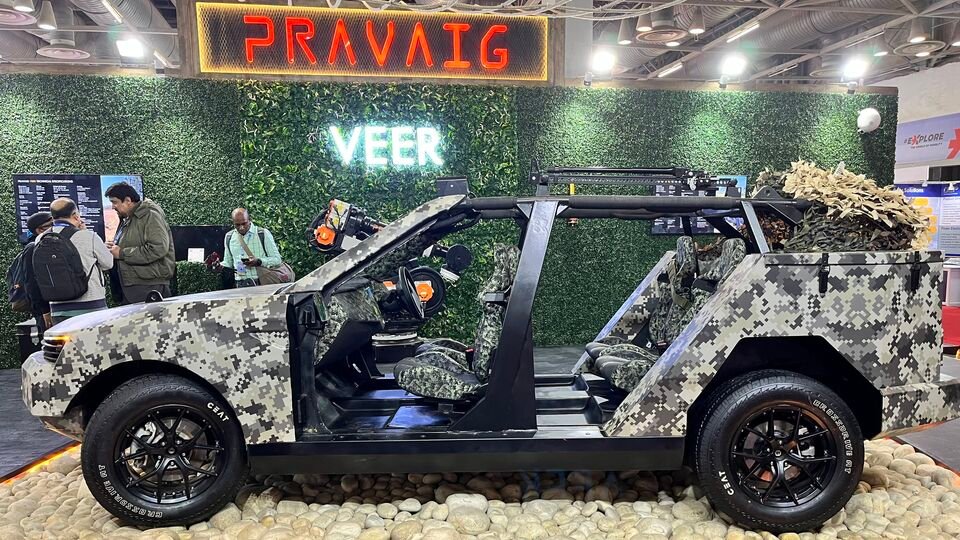
The 2026 machine, specified
VEER’s specifications have evolved across generations, and mixing figures from different years produces fiction — so here is one consistent set, from the 2026 generation as shown in the company’s 2026 factory footage: a 108 kWh battery pack weighing roughly 550 kg with about 5,500 cells, dual motors producing around 400 hp, 0–100 km/h in 5.6 seconds, roughly 1,000 kg of payload, and over 400 km of real-world range — stretching to 520–550 km in Ladakh conditions, where thin air and steady speeds favour EVs. Fully loaded weight is about 3 tonnes, with 250 mm of suspension travel for broken terrain.
Two details deserve emphasis. First, the body: factory footage shows body panels laser-cut and formed on a 9-axis CNC bending machine, over a tubular space frame rather than a conventional ladder frame — unusual, labour-intensive construction for a military vehicle. Second, the range extender: VEER is primarily electric but carries a flex-fuel generator running on petrol or ethanol for use after battery depletion, a pragmatic hedge for operations far from charging.
A 3-tonne war machine that runs silent — VEER trades the diesel’s roar for a 108 kWh battery, betting that stealth is worth more than range in the reconnaissance role.
iDEX, trials — and the line not to cross
In March 2025, the project won formal recognition: Atima Corporation, a wholly-owned Pravaig subsidiary, won the 9th iDEX Open Challenge for the E-TATV concept, via the Defence Innovation Organisation under the Ministry of Defence’s Department of Defence Production. The award is widely seen as the first step toward eventual induction. Separately, the vehicle completed trials with the Indian Army across terrains, from the Himalayas to Rajasthan, according to test coverage.
Here is the line: iDEX recognition plus completed trials does not equal induction. Some defence blogs have reported weaponised variants — a Kornet-EM anti-tank fit, an LMG variant — and even suggested supply, but those claims are single-source and unverified. PTI’s reporting confirms the trials and the iDEX award, not induction. Until the Army or the Ministry announces a contract, VEER is a trialled, recognised prototype — promising, but pre-order. Defence-tech startups earning institutional trust is a pattern — Sagar Defence’s Navy trials follow the same playbook.
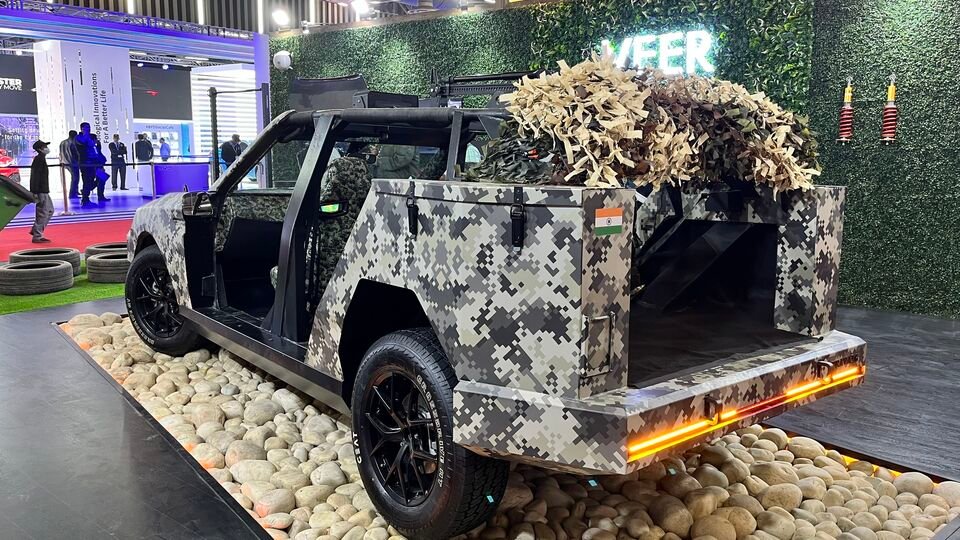
Key takeaway
The takeaway: VEER is real, trialled, and iDEX-recognised — but it is not inducted. The honest story is a startup that earned its way into Army trials; the induction chapter hasn’t been written. On the civilian side, Propel’s electric dumpers show what electrification looks like at 90 tonnes.
The business behind the machine
Pravaig’s manufacturing claims are modest and specific: a low-volume, high-mix pilot line rated at roughly 100 vehicles a month — about 1,200 a year — with a larger plant being set up, per company statements in the 2026 factory video. That scale fits the defence prototype phase, not mass production. The company’s earlier consumer specs (90.9 kWh, 690 kg payload, from 2023–2025 coverage) belong to earlier generations and should not be mixed with the 2026 figures above. For investors, the bet is binary in the way defence startups are: iDEX recognition opens the door, but revenue waits on procurement decisions the company doesn’t control.
What is Pravaig’s VEER?
VEER (Electric Tactical All-Terrain Vehicle, or E-TATV) is an all-terrain stealth electric vehicle built by Bengaluru’s Pravaig Dynamics for forward patrolling, reconnaissance and ISR missions. It is designed for low acoustic, thermal and visual signature.
What are VEER’s specifications?
The 2026 generation, documented in a factory visit that year: 108 kWh battery (~550 kg, ~5,500 cells), dual motors (~400 hp), 0–100 km/h in 5.6 seconds, ~1,000 kg payload, 400+ km real-world range (520–550 km in Ladakh), ~3 tonnes fully loaded. Earlier generations had different figures (e.g. 90.9 kWh) — the platform evolved.
Has the Indian Army inducted VEER?
No. The vehicle completed Army trials across varied terrain and won the 9th iDEX Open Challenge in March 2025 (via subsidiary Atima Corporation), which is seen as a first step toward induction. Reports of weaponised variants or supply are single-source and unverified; no induction has been confirmed.
Who founded Pravaig Dynamics?
Siddhartha Bagri (CEO) and Dhawal Khullar (CTO) are consistently cited as the founders. The company began work around 2011, stayed in stealth until ~2020, and pivoted from consumer EVs (Extinction, Defy) to defence.
What is the iDEX award?
The Innovations for Defence Excellence (iDEX) programme, run by the Defence Innovation Organisation under the Ministry of Defence, funds and challenges startups to solve military problems. Pravaig’s subsidiary Atima Corporation won the 9th Open Challenge for the E-TATV concept in March 2025.
More Read

Sources & further reading
- PTI via Times Now: Pravaig’s stealth EV undergoes military trials — Trials coverage and the “world’s first” company claim
- ET Auto: Pravaig’s all-terrain stealth vehicle gets iDEX recognition — iDEX award via Atima Corporation, 9th Open Challenge
- Pravaig Dynamics: VEER walkaround (official) — VEER walkaround, battery-pack deep-dive, 9-axis CNC body work — source of 2026 specifications